COEX1ST · The Fog · Working paper and edited evidence portfolio
4D Solar-System Inquiry
A shared reality, approached from within
The question is what perspective could give people with different beliefs, including no religious belief, usable common ground. The proposition developed here begins with shared participation: we inhabit a world that precedes our account of it, encounter it through limited channels, transform what reaches us, and leave consequences that other participants inherit. A person can examine those relationships without first accepting the Sun as conscious, a creator, survival after death, or one religion’s account of ultimate reality. The stronger ontological possibilities remain questions within the inquiry rather than admission requirements.
What the 4D lens contributes
The solar-system lens asks what changes when a system is described through its history and continuing relationships, rather than through an isolated present appearance. The recorded correction matters: three spatial coordinates plus time form a spacetime description; a larger or generative system does not acquire another mathematical dimension merely by being larger. A human biography can be represented as a temporally extended history. That does not establish an observer who sees every event at once, a route back to a past event, or continued first-person consciousness. The working use of the lens is to examine partial access, inherited conditions, and relationships across scales.
The practical starting point
The preserved August 20 chronology begins with pyramids, solar orientation, and heat protection. An HVAC intuition was refined into a possible combination of solar rejection, thermal buffering, and air stratification. The question then widened into what funerary systems preserve and what restoration their participants expected. The Sun hypothesis entered that conversation before the comparison with Re’s disappearance and return, sleep, and continuity. This chronology matters because the final framework was not supplied as a template and then decorated with supporting stories. The trail contains changing questions, corrections, and later integrations.
The physical floor
The detailed physical records examine radiation, heat, particles, gravity, rotation, orbital relationships, tides, material exchange, and state-dependent response. The moons dossier is particularly concrete: Io, Enceladus, resonances, rings, plasma, ocean worlds, and the very uneven depth of observation across planetary systems challenge a picture of unrelated objects. Its extension distinguishes energy magnitude from biological information, and established tidal or ecological mechanisms from weak generalized claims about human lunar effects. These relationships support a systems description. They do not establish one integrating mind.
Communication and the disputed step
The communication record proposes a broad definition: one state causing a structured change in another through an established relationship. Light as state, heat as urgency, or geoneutrinos as an integrity signature are interpretations layered onto physical processes. The distinction is consequential. If communication means only causal interaction, conventional science already describes much of it. If it means intention, understanding, awareness, or a unified subject, additional criteria and evidence are needed. The Reflected-Light Principle adds the idea that mediation can be the scale-compatible way an embedded participant gains access, rather than merely a defect in access.
History and religion as particular accounts
The comparative research does not need every tradition to repeat one hidden message. Egyptian restoration, Gilgamesh’s failed bodily immortality, Enkidu’s changed belonging, Eden, Baldr’s blocked recovery, and Jörmungandr’s boundary function pose related but different questions. Solar traditions also have regional histories and counterexamples; there was no single worldwide end to Sun worship. A structural resemblance, a direct textual relationship, historical borrowing, and independent convergence are different claims. Contradictions are part of the evidence. They can narrow a proposed common pattern rather than being treated as inconvenient noise.
Embodiment, perspective, and local freedom
The August 28 work asks what embodied life contributes: sensation, feeling, memory, valuation, choice, and changed conditions. The resulting loop connects environmental contact to experience and action, then back to an altered environment. The cell/body comparison keeps local participation consequential without assuming that the whole micromanages each component. A bounded participant has conditions it did not choose, yet constraint alone does not settle determination. The parallax and memory proposal asks what multiple limited views and successive generations can reveal. It does not prove an external memory repository or that a cosmic subject receives those views.
Calibration, responsibility, and what remains after a choice
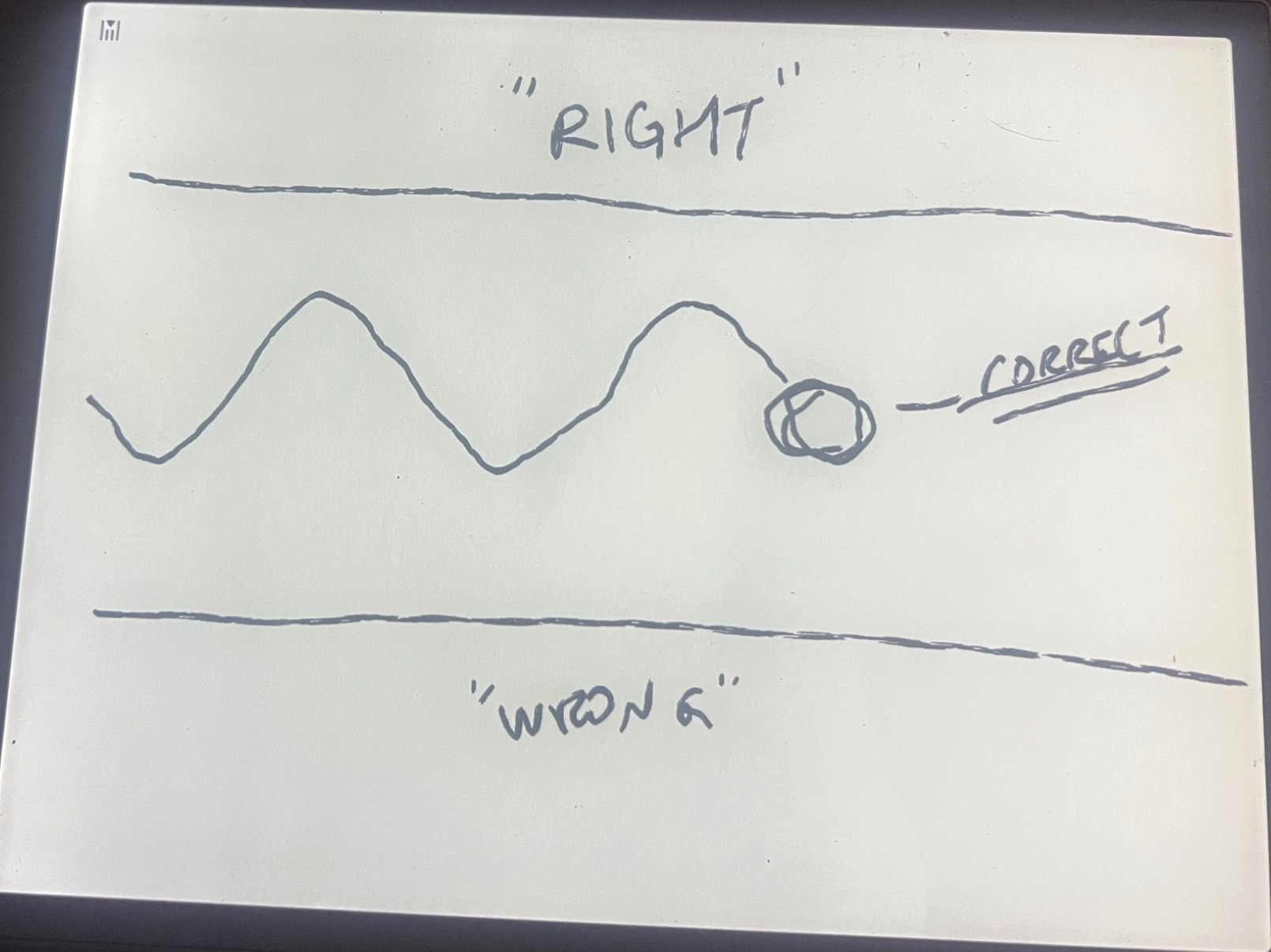
The ethical work distinguishes local correctness from a wider assessment of relationship, consequence, purpose, and recoverability. The original corridor sketch is included because it records the reasoning: a lived trajectory moves between conditions rather than arriving at permanent purity; a local point can be correct without becoming the whole standard. Challenge within recoverable limits became a governing philosophical principle. It is not a measured universal optimum, permission to impose hardship, or a claim that suffering is deserved. Moral remainder keeps attention on a displaced obligation or remaining harm even when a choice has a defensible reason. Private case material is excluded from this reading.
Sleep and the creator question
The later sleep discussion returns to agency, self-assessment, learning, failure, success, and revision. Workload and internal reorganization are different problems. A later state can inherit changes without retaining an accessible narrative of the intervening experience. Under an omniscient-creator premise, the question also changes: beings who undergo discovery need not be imagined merely as collecting information their creator lacks. Whether first-person becoming has value within that premise is a philosophical inquiry. Only excerpts of the October conversation have been recovered; the fuller August records remain distinguishable from those excerpts.
What would make the framework useful or wrong
The modest common-ground proposition can be judged by whether it represents different positions fairly, clarifies actual disagreements, and helps participants reason about shared consequences. The stronger solar-system integration proposal needs more: a definition that separates it from ordinary coupling and predictions that distinguish it from established explanations. Elegance, scale, ancient resemblance, and the limits of human perception do not supply that evidence. A thermal reconstruction, a historical source comparison, a numerical estimate, and an interpretive diagram each answer different questions. This working paper keeps those roles visible.
The evidence portfolio
The complete edited source readings follow. They retain the detailed arguments, tables, numerical context, corrections, and bibliographic anchors recovered from the archive. Repeated source passages appear once in this combined portfolio. The separate trail readers select the relevant passages so each line of inquiry can be explored on its own. This is a working synthesis and evidence edition, not a claim that every underlying chat or original diagram has been recovered.
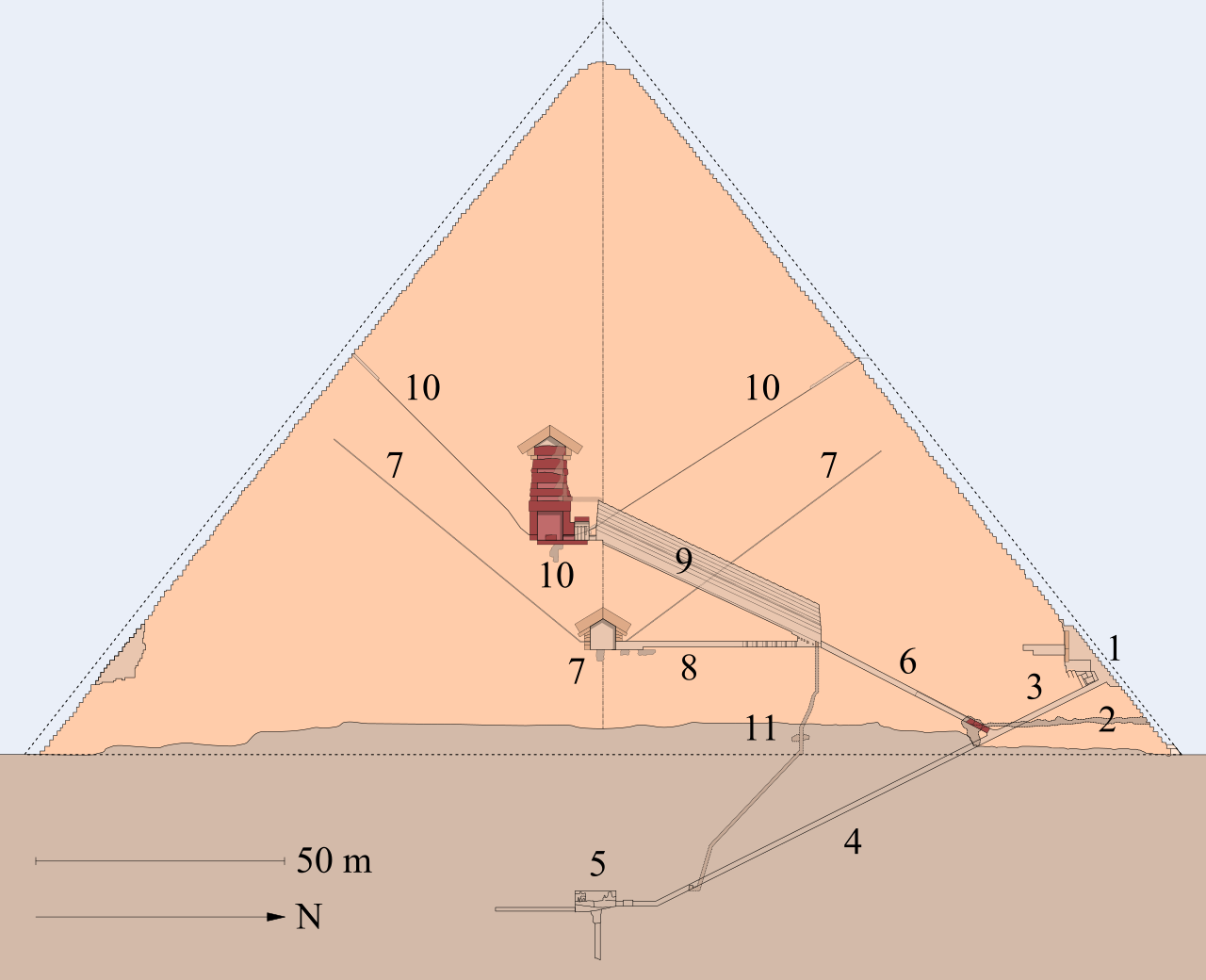
Communication beyond human perception
24 August 2026
1. Where the thought began: soil, life, and energy
The discussion began with a simple question: where did soil come from? Soil is mineral material broken down by weather and time, then transformed through water, air, roots, fungi, microorganisms, decomposition, and living activity. Sand is mainly a particle size. Soil is a functioning relationship between mineral structure and life.
That led to a second question: if soil contains life, does it contain energy? Yes. Plants collect solar energy, roots distribute chemical energy, and microorganisms, fungi, insects, and decaying matter move that energy through an underground ecosystem. The energy is real, but it is diffuse and already performing biological work, so ordinary soil is not a practical electrical battery.
The useful correction was that conductivity is not the same as stored power. A copper wire can carry electricity without producing it. Soil, water, air, plants, and living bodies can conduct or move charge, but that does not by itself tell us where a usable voltage difference comes from.
Instead of ending the question there, the discussion widened. If soil carries energy, plants function electrochemically, the atmosphere can move charge, and Earth contains currents and thermal motion, perhaps Earth should not be viewed as a passive rock with life scattered across its surface. Perhaps Earth is an integrated field of exchanges.
The question changed from “Where is the usable electricity?” to “What is all this movement doing within the larger system?”
2. Earth as a subsystem inside a larger 4D whole
An earlier version of the idea treated Earth itself as the possible larger being. The theory became stronger when Earth was placed inside a wider structure: the solar system as one four-dimensional, being-like process, with Earth functioning as a major subsystem rather than the final whole.
Here, 4D does not mean a magical creature looking down from another spatial direction. It means treating the solar system as extended through time rather than frozen in one three-dimensional snapshot.
In a snapshot, Earth is a sphere next to other spheres. In a four-dimensional view, Earth includes its entire history of rotation, orbit, seasons, geological change, atmospheric change, biological development, radiation exchange, solar-wind contact, impacts, and every continuous relationship connecting one moment to the next.
Every rotation is part of Earth’s extended form.
Every orbit is a recurring path through the solar field.
Every season is a change in the geometry of contact.
Every geological and biological transition becomes part of the object’s shape through time.
The solar system is therefore not merely a collection of separate objects photographed at one instant. It can be imagined as one enormous unfolding structure made from continuous relationships.
Across time, a planet’s orbit is not merely something the planet does. The orbit is part of the planet’s shape.
3. Light as contact, information, and immediate state
Sunlight reaches Earth, but Earth does not return an untouched copy. It absorbs some wavelengths, reflects some, scatters some, stores some, redistributes energy through land, oceans, atmosphere, weather, and life, then releases energy in altered forms.
Clouds, ice, water, vegetation, dust, gases, temperature, and surface materials all change the outgoing signal. This means that light leaving Earth carries information about the state of the Earth that encountered it.
Within the theory, sunlight is not merely illumination. It is contact. Earth’s response depends upon what Earth currently is.
Reflection is a response.
Refraction is a response.
Scattering is a response.
Absorption is a response.
Almost no reflection is still information, because it reveals that the incoming radiation was absorbed, transmitted, or transformed rather than returned.
The absence of a mirror-like answer is not silence. It is a different physical answer. Earth’s surface can therefore be viewed as a communication membrane, the boundary where exterior solar input encounters the current condition of the planetary system.
Earth does not merely receive light. Earth answers light according to what Earth is.
4. Heat as urgency, intensity, need, or consequence
The decisive theoretical step was to ask whether heat might represent the urgency, intensity, need, or quality of a message.
This does not mean that every temperature has a hidden English translation. It means that the intensity of an energetic condition may be inseparable from what that condition causes the surrounding system to do.
Heat compels change. Temperature differences drive energy transfer. Materials expand. Fluids circulate. Chemistry accelerates or slows. Phase changes occur. Organisms respond. Atmospheres move. Radiation output changes. In a physical system, the state and the pressure for response may be the same event.
The heat does not describe the fire. The heat is part of the fire’s declaration.
In human language, content and urgency can be separated. The sentence “the building is on fire” can be printed calmly on a page. In a physical system, the condition and its urgency may arrive together. Greater intensity produces greater consequence and a stronger demand for redistribution.
The word need becomes especially useful here. A temperature gradient is an imbalance. The cooler region does not consciously want heat, but the combined system behaves according to a built-in pressure to redistribute energy. The imbalance itself contains the instruction, even though no part translates that instruction into words.
A possible physical grammar
| Physical behavior | Possible system-level meaning |
|---|---|
| Light | State, reach, contact, inquiry, or immediate exterior information |
| Heat | Intensity, urgency, consequence, need, or demand for response |
| Temperature difference | Imbalance and pressure for redistribution |
| Spectrum and wavelength | Character, source, or quality of the condition |
| Absorption | Incorporation and transformation by the receiver |
| Reflection | Immediate boundary response |
| Refraction or scattering | Redirection through local structure |
| Re-emission | A processed response after the receiver has changed |
| Thermal inertia | Memory of earlier contact stored in matter |
| Equilibrium | Temporary resolution of pressure or need |
| Geoneutrino output | Deep continuity or internal-integrity signature |
| Solar wind and magnetism | Touch, stress, circulation, and active coupling |
| Gravity and orbit | Enduring relationship, position, rhythm, and structural continuity |
This grammar is theoretical, not established scientific terminology. Its purpose is to show that the metaphor is not detached from physics. Each proposed meaning is anchored to a real physical relationship in which one state carries information, changes another state, or records prior contact.
5. Geoneutrinos as an internal steadiness report
Radioactive decay inside Earth produces heat and also releases electron antineutrinos. When those antineutrinos originate inside Earth, they are called geoneutrinos. They interact so weakly with matter that nearly all of them pass through the planet and continue outward.
A necessary correction strengthens the theory: geoneutrinos are not literally heat. They are particles released by some of the same radioactive processes that generate heat. Most of the locally deposited decay energy becomes heat in surrounding material. The geoneutrinos carry away a smaller, unusually clean signature of the event.
That gives Earth at least two related forms of internal expression:
Geothermal heat, which moves slowly through matter and is repeatedly transformed on its way outward.
Geoneutrinos, which escape with comparatively little alteration and maintain a cleaner relationship to their point of origin.
The theory does not require geoneutrinos to deliver a detailed tectonic message or to warn of each earthquake. Their value may be almost the opposite. Their extraordinary steadiness could represent the continued integrity of deep planetary machinery.
Geoneutrinos may function as a planetary integrity checksum: a slow, clean report that the deep radioactive inventory and long-term thermal machinery remain present and coherent.
The kidney analogy clarified this point. Healthy kidneys do not need to move dramatically or announce themselves every hour. Their comparative stability is part of the body’s wellbeing. A meaningful deviation matters precisely because the ordinary condition is steady.
Inside a system whose lifetime is measured in billions of years, a change taking hundreds of thousands or millions of years may not be unbearably slow. It may be a pulse. What seems static to a human may be active communication at planetary scale.
6. The surface as the meeting boundary of interior and exterior
The theory initially became too narrow when the question was framed as whether an individual geoneutrino must strike sunlight at Earth’s surface and pass information directly into a photon. Known physics gives no reason to expect meaningful communication through that specific collision.
The wider theory does not require it.
The solar field contacts the whole Earth system. The sunlight arriving at the surface encounters a planet whose current boundary has already been shaped by internal heat, geology, atmosphere, oceans, life, magnetic conditions, stored energy, and previous solar exposure. At the same time, deep heat and deep-origin particles are moving outward.
The surface is therefore not merely where sunlight stops. It is the meeting boundary where exterior solar input and interior planetary condition become jointly expressed. The outgoing light and heat are Earth’s integrated response, even when no single particle touches every other channel.
The crucial unit is not one photon meeting one geoneutrino. It is the Sun’s field encountering Earth, with Earth’s entire current state determining the response.
The larger system does not need to combine its channels the way a human computer merges data files. Their coexistence, mutual influence, and physical consequences may already be the integration.
7. Rotation and orbit as whole-body presentation
The next question deliberately applied a human image: if something were keeping an eye on an entire sphere, would it not benefit from having that sphere rotate, bringing every region through the field of contact?
The theory does not claim that the Sun intentionally designed planetary rotation as surveillance. The functional fit is still striking.
Rotation repeatedly presents different regions to direct solar contact.
Orbit repeats the encounter through changing position and context.
Axial tilt changes the angle and duration of exposure.
Rotation speed becomes a refresh rhythm.
Day becomes active exposure and immediate processing.
Night becomes continued processing, cooling, and release rather than absence from the system.
Seasons become long-form changes in the geometry of communication.
The Sun also rotates. It emits changing radiation, plasma, particles, and magnetic structures outward. The solar wind fills the heliosphere and physically interacts with planetary atmospheres and magnetospheres. The system is therefore not a stationary Sun watching passive planets.
A rotating central source sends changing fields through rotating and orbiting bodies, which absorb, transform, resist, reflect, heat, cool, and return altered conditions.
Everything is turning through everything else. The planets continually present themselves to the solar field, while the Sun continually presents itself through its changing output. The exchange is reciprocal even though the participants are radically unequal in scale and power.
8. Communication without a conscious decoder
The model became much broader once it stopped requiring the Sun to consciously read a planetary message. A human-style decoder is not necessary for a structured exchange to carry meaning within a system.
Cells do not consciously decode hormones. Neurons do not understand thoughts. Kidneys do not comprehend blood chemistry. Yet a physical condition arrives, the receiving structure changes, and that change affects what happens next.
A working definition: communication is one state causing a structured change in another state through an established relationship.
Under that definition, interpretation does not require language, imagination, or self-awareness. The response is the interpretation.
Absorbed sunlight warms matter. A warmed ocean changes circulation. Circulation changes clouds. Clouds alter reflection and absorption. The changed radiation field alters later conditions. The system has not exchanged symbols about those events. The events themselves are the exchange.
The system does not necessarily communicate descriptions of itself. Its state changes are the communication.
This also changes how awareness might be imagined. A larger system would not need a central control room that collects every measurement. The complete web of contact, alteration, resistance, storage, and return could be the system’s form of knowing itself.
9. The duality of human consciousness
The theory then returned to human experience. A person can know intellectually that existence is not all about them, yet every person remains the unavoidable center of their own experienced reality.
Light reaches my eyes. Sound reaches my ears. Events enter my awareness. Memories exist within my mind. Even when I devote myself to family, religion, work, community, or humanity, I experience that devotion from the local center of my own consciousness.
I am not the center of existence, but I am necessarily the center of my experience of existence.
That is not automatically ego. It is the geometry of perception. Human maturity does not require escaping that center, which is impossible. It requires understanding that other centers are equally real and are not merely scenery inside one’s own field.
This produced one of the theory’s clearest statements:
Every consciousness is the center of a field, but no consciousness is the center of the whole.
The same structure may repeat across scales. A cell is centered on its membrane and internal regulation. An organ is a functional center within a body. An organism experiences the world around its senses and nervous system. Earth organizes its atmosphere, biosphere, Moon, and local gravitational environment. The Sun organizes the dominant field of the solar system. The solar system moves within the galaxy.
Every level can be both a whole and a component, a center of local relation and an object inside a larger field. Being central at one scale does not make something supreme at every scale.
We must live from the center while knowing we are not the center.
10. Nested centers rather than one final center
The model therefore does not need a pyramid with one king at the top. It can be imagined as nested centers of relation:
Cells within organs
Organs within organisms
Organisms within ecosystems
Life within Earth
Earth within the solar system
The solar system within the galaxy
Each level experiences or responds to reality through contact at its own boundary. Each level may be unable to perceive the complete form of the larger system it helps compose.
A cell does not understand the person. Its inability to understand the person does not mean the person is absent. By analogy, human inability to perceive system-level communication would not prove that no larger integration exists. It would only establish the limits of the human channel.
That does not grant permission to declare the theory true. It does create a disciplined reason not to assume that all meaningful communication must resemble the forms available to human senses and language.
Embodied life, agency, and moral calibration
28 August 2026
3.1 Initial question: what does human life provide?
The conversation opened by asking what human life might mean from the Sun's necessity if humans were given sensory and memory systems capable of mapping three-dimensional terrain through bounded perspectival images. The question treated human perception as a possible local translation layer inside a much larger time-extended system.
3.2 First answer: distributed parallax, compression, and memory
The initial synthesis proposed that many human viewpoints could produce depth through their differences. One observer produces a view; many observers produce parallax; generations produce temporal depth. Culture, language, records, and inheritance allow a map to exceed the life of any individual observer.
3.3 User correction: do not define life by what light cannot do
The user rejected an unnecessarily negative premise. The theory should not claim that light cannot capture feeling or perform some unknown function. Instead, it should ask what happens when solar contact is transformed by an embodied sensory being. This correction moved the argument from deficit language to positive function.
3.4 Embodied experience enters the loop
Human beings were then understood as processes that convert physical conditions into sensation, emotion, linear sequence, memory, valuation, and choice. The question became not whether the Sun lacks the terrain, but whether a local finite life produces a form of experience available only through limitation and embodiment.
3.5 Dimensional compression is reframed
The user proposed that a human 2D-like experience could stand two steps below a 4D being and therefore function as something like its 1D comparable. The response preserved the intuition but separated it from literal geometry. The strongest defensible version became a hierarchy of representation: whole, environment, perspective, biography.
4. Human life as embodied return
4.1 From physical contact to lived consequence
The strongest shift in the conversation was from asking what light fails to record to asking what a living organism does with illuminated conditions. Light already participates in rich physical exchange. It can reveal surfaces, motion, composition, heat, distance, and countless other relationships. The theory gains nothing by placing an arbitrary ceiling on light.
A nervous system, however, reorganizes those conditions into a local lived state. Heat becomes pain or comfort. Distance becomes safety or separation. A face becomes recognition, threat, desire, trust, or grief. An environment becomes navigable not only in space but in value. A living being does not merely contain data about an event. It becomes different because the event occurred.
PROTECTED WORKING FORMULATION
The larger system contains what happened. A living being produces what it was like to undergo what happened.
4.2 The embodied-return loop
The discussion developed the following causal loop:
WORKING CAUSAL CHAIN
Sun -> Earth -> life -> experience -> choice -> Earth -> Sun
Solar contact contributes to the conditions of Earth. Earth filters and transforms those conditions through atmosphere, water, terrain, chemistry, ecology, and history. Living organisms convert local conditions into bodily and behavioral responses. Conscious organisms additionally organize those responses into memory, interpretation, anticipation, and deliberate action. Their actions alter Earth, which changes what future organisms encounter and what the larger solar field receives in return.
This does not require the Sun to read a report, decode a symbol, or intend a message. In the broader 4D theory, the return can consist in the altered state itself. The system's next condition contains the consequences of what occurred within its components.
4.3 What feeling contributes
Feeling was treated neither as supernatural substance nor decorative emotion. It is a way living systems assign significance to conditions. Pain marks threat or damage. Pleasure can reinforce nourishment, attachment, play, or successful regulation. Fear prioritizes danger. Grief registers the disruption of attachment. Curiosity keeps the organism moving toward unresolved information. These are not infallible verdicts, but they change what the organism does next.
The difference between a map and a life is therefore not that one contains information and the other does not. The difference is that a life converts information into stakes. A map can record the cliff. A living being can fear falling, remember someone who fell, construct a barrier, warn a child, or decide the view is worth approaching.
4.4 Why autonomy matters to the creator hypothesis
The hypothetical creator-being branch introduced a precise possibility: a being that already contains or perceives the larger field may not obtain the same kind of local experience by controlling every detail of every participant. A completely puppeteered agent would not generate a genuinely local response to uncertainty, vulnerability, incomplete knowledge, and choice. The local view requires local limitation.
PROTECTED WORKING LINE
You cannot obtain the perspective of a limited being by refusing to let anything be limited.
This does not prove libertarian freedom or divine purpose. It identifies why autonomy would have functional value inside the thought experiment. The whole may possess the terrain, yet embodied life generates finite routes through it. Global possession and local experience may be related but non-identical modes of being.
4.5 Working principle
WORKING THEORY PRINCIPLE
THE EMBODIED-RETURN PRINCIPLE: Within the speculative 4D solar-system model, living consciousness may serve as a local transformation layer through which physical conditions become lived conditions. Embodied organisms compress environment into perspective, sensation, emotion, memory, valuation, choice, and consequence. Each life therefore returns not only a record of what occurred, but the effect of what occurred upon a finite participant within the system.
5. Dimensional compression and the finite trajectory
5.1 The original intuition
The user proposed that humans receive something like a two-dimensional experience of a three-dimensional Earth, and that relative to a 4D being this human experience might function as its one-dimensional comparable. The purpose was not to claim settled mathematics. It was to express a distance between modes of access: the larger being exists two representational steps beyond the form in which humans ordinarily experience the world.
5.2 The safer and stronger translation
The strongest version does not subtract dimensions as literal arithmetic. It describes nested compression:
The whole: a time-extended system containing many states and relationships.
The environment: the local three-dimensional world available to an embodied organism.
The perspective: the bounded field available from one body, angle, sensory range, and moment.
The biography: the sequence through which the organism links moments into one lived line.
WORKING COMPRESSION SEQUENCE
Whole -> environment -> perspective -> biography
This version preserves the user's intuition while avoiding false precision. A life is not literally one spatial dimension. It behaves like a line in the sense that consciousness advances through one sequence, cannot occupy every branch, and experiences a present coordinate rather than the whole path simultaneously.
5.3 Point and curve
From inside a life, consciousness occupies the point. It remembers fragments behind the point, imagines possibilities ahead, and chooses under uncertainty. From a hypothetical higher temporal perspective, the entire curve might be available as one structure. The central caution is that seeing the curve does not logically equal causing each bend.
PROTECTED WORKING LINE
Knowledge of the curve is not necessarily authorship of the curve.
This distinction became essential to the free-will branch. An observer outside our temporal mode could, in principle, know a complete history without coercing the local causes that compose it. Whether this is metaphysically possible remains open. The conversation preserved the distinction because ordinary language often collapses foreknowledge, containment, control, and authorship into one claim when they are conceptually separable.
5.4 Memory and selective access
The conversation also considered memory as a system that preserves more than the waking narrator can voluntarily retrieve. The safest claim is not that memory exists in another place. It is that storage, causal influence, and conscious availability are different functions. Forgotten experiences may continue shaping bodily response, fear, attachment, intuition, dreams, and behavior without being available as a clear story.
Within the speculative model, this provides a powerful analogy for calibrated access. The local self may require filtering in order to remain coherent, just as the eye requires limits in order to receive light without being overwhelmed. Forgetting can be failure, distortion, protection, or ordinary compression. The conversation did not choose one universal explanation.
6. The cell-human-solar parallel
6.1 Why the analogy keeps returning
The cell analogy mattered because it preserved the same structural relations without claiming identical mechanisms. A cell is a whole at one scale and a component at another. It is alive, bounded, responsive, dependent, locally consequential, and unable to represent the human organism in the terms available to human consciousness.
Likewise, the speculative model treats a human as a whole person and also as a component inside Earth and the solar system. Human inability to perceive the larger organization would not prove that no larger organization exists, just as a cell's inability to conceptualize a person does not make the person absent.
6.2 Nourishment without micromanagement
A person nourishes cells by maintaining system-wide conditions. Breathing provides oxygen. Eating provides materials. Circulation distributes resources. Sleep, temperature regulation, hormonal signaling, movement, and immune function alter the field in which cells operate. The person does not choose the private fate of each cell.
This became the most useful model for a powerful but non-controlling larger being. The containing level can establish, sustain, or dramatically alter conditions without individually scripting every lower-level event. Power to intervene is not evidence of constant intervention.
6.3 Local agency and upward consequence
A single cell can signal another. Altered cells can change tissue. Enough tissue-level dysfunction can compromise the organism. The analogy therefore demonstrates that local autonomy does not imply local insignificance. Components can be constrained by a whole while also helping determine the future condition of that whole.
The user explicitly noted that the point was not that humans exist to destroy the Sun or that cells plot against their organism. The structural observation is that a component can possess its own local trajectory and still produce consequences beyond its scale.
6.4 Meaning becomes condition
The richest inversion appeared when the conversation asked what a cell receives from a human-level event. The cell does not receive grief as grief, an argument as an argument, or love as love. It receives altered chemistry, pressure, nutrient distribution, electrical activity, immune signaling, and temperature. The higher-level meaning is causally real, but it arrives at the lower level as physical condition.
PROTECTED WORKING LINE
The cell never encounters the story, yet the story can change the cell's world.
This supports a disciplined upward question. Conditions that appear to humans as merely physical may, in principle, participate in an organizational description outside the human representational range. That possibility is not evidence that they do. It explains why successful lower-level mechanism does not automatically eliminate every higher-level description.
6.5 The anti-flattening rule
The analogy must never become "everything is everything." A cell is not a person. A person is not Earth. Earth is not the Sun. Distinct boundaries, mechanisms, and scales remain real. The recurring pattern is more precise: nature often builds wholes from centers that cannot perceive the whole they help compose.
PROTECTED WORKING LINE
Everything retains its boundary while participating in something larger than itself.
7. The microscope and the resolution principle
7.1 The visual insight
The user observed that humans see cells by directing and transforming light through a thin living structure that ordinarily appears opaque, flat, or undifferentiated. A microscope does not create the cell. It changes the relationship between the signal and the observer.
At ordinary resolution, tissue may appear as one continuous surface. Under appropriate preparation and magnification, it resolves into boundaries, organelles, movement, populations, and interactions. The underlying system did not become more organized. The observer gained a channel capable of detecting organization that was already present.
PROTECTED WORKING LINE
Resolution changed. Reality did not.
7.2 What the microscope legitimately teaches
The microscope is not evidence that the solar system is alive. It is evidence for a narrower epistemic lesson: failure to perceive organization can result from insufficient scale, mediation, contrast, or sensory range. A process may appear passive, uniform, mechanical, or opaque because the observer collapses its relevant distinctions.
The same lesson applies to phenomena humans later learned to detect through radio receivers, magnetic instruments, spectrometers, particle detectors, statistical models, and long-duration records. Human senses are not the measure of everything that exists. Instruments extend the boundary at which differences become legible.
7.3 Downward and upward mirror questions
Humanity has repeatedly looked downward through mediation and discovered autonomous living centers where unaided perception saw material. The 4D theory asks whether some future mediation could allow humanity to look outward or upward and resolve higher-order organization in relationships currently described only as separate physical processes.
These are not equivalent claims, and the second remains speculative. The mirror is useful because it converts dismissal into a researchable question: what scale, signal, integration, or prediction would distinguish a genuinely higher-order system from ordinary causal coexistence?
7.4 Working principle
WORKING THEORY PRINCIPLE
THE RESOLUTION PRINCIPLE: A system may appear passive, uniform, mechanical, or opaque when observed at the wrong scale or through an insufficient channel. Increased mediation can reveal previously unresolved boundaries, agents, interactions, and organization without changing the underlying system. Failure to perceive higher-order organization therefore cannot by itself establish its absence.
8. Free will inside an unseen architecture
8.1 The user's canonical thought experiment
The user proposed that if the 4D model were treated as canonical, human beings might possess genuine free will while remaining unaware of the dimensions in which their freedom is limited. The cell supplied the analogy. A cell possesses a meaningful range of response, yet its concept of possibility never includes everything available to a human organism.
The phrase "completely free will" was therefore best understood as complete local agency within the range actually available to the participant, not unlimited power to violate every boundary of existence. The human may choose among real alternatives while being unable to perceive possibilities that the containing structure does not make available.
8.2 Constraint is not determination
The central distinction became: constraint defines a possibility-space; determination specifies the only event that can occur within it. The existence of laws, bodies, histories, needs, and higher-order boundaries does not automatically settle whether every local choice is forced in the strongest sense.
PROTECTED WORKING LINE
The board limits what moves can be played. It does not necessarily play the move.
This is a third option between two absolutist formulations. "Everything is predetermined" converts all local agency into appearance. "Anything whatsoever is possible" removes the architecture required for a coherent world. The working model preserves real choice and real boundaries at the same time.
8.3 Why unseen limitation may not feel like captivity
A being develops its concept of freedom inside the conditions that make its life possible. A cell does not experience the inability to become a bird as a stolen option. A human does not experience the inability to reverse entropy by decision as a daily political oppression. Possibilities outside the organism's level may never appear as possibilities at all.
This leads to a precise possibility: humans may mistake bounded freedom for absent freedom because they imagine that freedom must mean access to every conceivable state. Local freedom may be the only kind of freedom any nested participant can possess.
PROTECTED WORKING LINE
Free will may be real precisely because it is local.
8.4 Seeing a worldline without causing it
The hypothetical 4D observer was imagined as possibly perceiving a completed human trajectory in a way the human point-consciousness cannot. The discussion separated four concepts that are often merged: knowledge, observation, containment, and control. Knowing an event is not conceptually identical to coercing it. Containing a process is not identical to micromanaging every event. Possessing power to intervene is not identical to exercising it continuously.
This distinction does not solve the philosophical problem of free will. It creates a coherent model in which a higher-order view and meaningful local agency are not automatically contradictory. The compatibility would need deeper work in physics, philosophy of time, causation, and information.
8.5 Why action matters
The moral and existential consequence was direct. If components help compose the future state of the whole, then local choices matter. One person changes another. Those changes propagate through families, institutions, ecosystems, technologies, and future generations. The 4D trajectory is not a backdrop placed behind action. It is made from the accumulated actions and responses of participants.
PROTECTED WORKING LINE
The larger future depends in part on what the local centers do.
9. The 99/1 rule and the difference between correct and right
9.1 The recurring 99/1 architecture
The user recognized that the free-will model closely resembled the principle that nothing is ever more than 99 percent true or less than 1 percent false. The principle is a refusal of absolute closure, not a claim that evidence cannot strongly favor one view.
At one level, the rule is epistemic: no local observer should assume that a successful description exhausts every scale of reality. At another level, it becomes ontological: freedom can be genuine without being infinite, and constraint can be genuine without being total. At a moral level, a person can act for defensible reasons without becoming perfectly pure, and can cause harm without becoming nothing but harmful.
WORKING FORMULATION
The missing 1 percent is not always error. It may be unresolved scale, unseen context, future evidence, or another valid level of description.
9.2 Correct
Correct concerns validity within a frame. It asks whether the evidence supports the conclusion, whether the procedure was followed, whether the mechanism worked, whether the inference follows, and whether the move was reasonable from the conditions visible at the time.
9.3 Right
Right concerns fit within the containing whole. It asks whether the action served the actual purpose, respected the relevant people and boundaries, preserved recoverability, created a viable future state, and remained aligned with the deeper reason the rule or mechanism existed.
9.4 Neither can replace the other
Something can be technically correct and systemically wrong. Code can run while the experience fails. A policy can be followed while the institution is harmed. A literal answer can satisfy the wording while betraying the mission. A scientific description can predict measurements while being mistaken for an exhaustive ontology.
Something can also be right in direction while still needing factual correction. A moral intuition may identify the relevant relationship before its explanation is complete. But rightness cannot grant immunity from evidence. Otherwise it becomes preference or certainty dressed as wisdom.
GOVERNING PRINCIPLE
Correct is necessary, but it is not sufficient. Right must recruit correctness, and correctness must remain answerable to purpose.
GOVERNING FORMULATION
Local correctness can produce global wrongness. Higher-order rightness cannot excuse local falsehood.
10. The visual corridor: right, wrong, correct, and the moving life
10.1 The image
The hand-drawn diagram showed two nearly parallel lines labeled right and wrong. Between them, a wavy path moved forward. One point on the path was circled and labeled correct. The drawing compressed the larger framework more effectively than a page of nomenclature.
Figure 1. Original corridor sketch: right and wrong as calibrating boundaries, a moving life trajectory, and correct as one local point.
10.2 Boundary conditions rather than destinations
The right and wrong lines were interpreted as boundary conditions that generate a field of calibration. They are not two equal moral substances and not two cosmic beings. Their difference creates the gradient through which a participant can sense deviation, receive feedback, and adjust.
Wrong can therefore function partly as an error boundary. This does not make wrongdoing good. It means the possibility and recognition of deviation are necessary for learning and correction. A system that cannot register error cannot adapt intelligently.
10.3 The wavy line
The waviness represents life. Living systems sense, move, overshoot, correct, fatigue, recover, and change their models. Perfectly straight performance is not the only image of health. A line that never responds to new conditions may represent rigidity or death rather than perfection.
WORKING FORMULATION
Oscillation is not automatically failure. It can be the visible form of calibration.
10.4 The circled point
The point marked correct represents the best local coordinate available to a finite being at one moment. It may be the valid technical move, the honest response, or the proportionate adjustment under current conditions. The point cannot contain the full future consequences of the curve.
GOVERNING VISUAL FORMULATION
Correct is a point on the path. Right is the relationship of the whole path to the system containing it.
10.5 Sun, Earth, and the experiential corridor
The discussion then placed the Sun-Earth relationship behind the image without equating one body with right and the other with wrong. The two entities create the relational conditions within which human life becomes possible: energy and matter, illumination and surface, input and transformation, exposure and filtering, periodicity and adaptation.
The Sun and Earth create the corridor. A life makes a path through it. Feeling gives the path significance. Choice gives the path shape. The completed path becomes part of the system's returned condition.
PROTECTED WORKING SYNTHESIS
The Sun and Earth create the corridor. Life creates a path through it. Feeling gives the path significance. Choice gives the path shape. The completed path becomes the returned signal.
11. Good, evil, shadow, and the human as fulcrum
11.1 Why permanent goodness is not a human state
The conversation rejected the idea that a healthy human being can or should inhabit a pure good pole at all times. Humans are incomplete, embodied, limited, reactive, and dependent. Even sincere good intent can produce harmful effects because no participant sees the entire system or future trajectory.
The danger of purity is not merely that the standard is unreachable. It can cause real capacities to be denied rather than governed. Denied anger can become passive punishment. Denied self-interest can become resentment. Denied aggression can become cowardice, covert hostility, or inability to defend the vulnerable. The rejected force does not necessarily disappear. It may lose conscious supervision.
PROTECTED WORKING LINE
The parts you refuse to govern begin governing you invisibly.
11.2 Feeding both sides
Feeding both sides does not mean equal moral endorsement of kindness and cruelty. It means acknowledging and developing every real human capacity so that it can perform legitimate work without becoming sovereign. The human is the fulcrum that regulates proportion and use.
Anger can identify a violated boundary.
Aggression can defend, compete, pursue, separate, or end what must end.
Self-interest can preserve the self upon which generosity depends.
Suspicion can become discernment.
Pride can protect dignity.
Desire can create movement, attachment, ambition, intimacy, and art.
Fear can prevent reckless exposure.
Destructive capacity can dismantle structures that have become harmful or dead.
PROTECTED WORKING LINE
The shadow needs employment, not a throne.
11.3 The pathology of good capacities
The capacities culturally labeled good can also become destructive when removed from proportion and context. Compassion without boundaries can become enabling. Forgiveness without accountability can become permission. Generosity without self-preservation becomes depletion. Patience without movement becomes avoidance. Loyalty without judgment becomes captivity. Honesty without care becomes cruelty with clean paperwork.
This does not erase moral difference. It relocates evaluation from the label attached to a capacity toward the form, proportion, purpose, power relationship, and future state produced by its use.
11.4 The mobile fulcrum
A fulcrum is not always located at the mathematical midpoint. It creates leverage and may have to move as conditions change. The amount of aggression appropriate during an attack differs from the amount appropriate during a disagreement. The amount of openness appropriate with a trustworthy person differs from the amount appropriate with someone demonstrating predatory behavior.
WORKING ETHICAL PRINCIPLE
Right proportion changes with the field.
The stable moral task is not to repeat one behavior in every circumstance. It is to regulate capacities in a way that preserves dignity, health, recoverability, and continued viable participation as far as the finite observer can honestly perceive them.
11.5 Intent, impact, repair, and character
Because humans cannot foresee every consequence, moral maturity cannot mean producing only good outcomes. Intent matters, but does not close the case. Impact matters, but does not reveal the full motive or history. Feedback exposes what the actor failed to see. Repair becomes the next moral act. Character appears as the pattern formed across time.
WORKING MORAL SEQUENCE
Intent is the direction you aimed. Impact is where the action landed. Feedback tells you what you failed to see. Repair is the next moral act. Character is the pattern formed across time.
11.6 Core formulation
PROTECTED WORKING LINE
Purity is not the human task. Stewardship is.
PROTECTED WORKING LINE
Feed both sides enough to keep them conscious. Let neither side become sovereign.
The human being is not asked to become the good side of the scale. The human being is asked to remain the conscious fulcrum through which competing forces are integrated, corrected, and made answerable to consequence.
13. Midgard and the defended middle
After establishing layered agency and moral calibration, the conversation turned toward older cultural lenses. Midgard became especially resonant because it depicts human life not as existence at one pure pole, but as life inside a maintained middle.
13.1 The defended middle
Midgard was interpreted as an inhabited enclosure whose possibility depends upon boundary. The wall does not exist for its own glory. It exists because vulnerable life, perception, relationship, memory, children, homes, and futures exist behind it. Strength receives its meaning from fragility.
PROTECTED WORKING LINE
Life exists inside a defended middle. Strength is justified by what it keeps alive.
13.2 Transformed danger
The mythic image discussed in the conversation does not make order from sterile material. The world and its protective architecture arise through the transformation of primordial force. This aligned with the shadow discussion. Dangerous capacities do not always need annihilation. They need form.
Anger becomes a boundary. Aggression becomes defense. Fear becomes caution. Destructive force becomes the ability to dismantle what is rotting or predatory. The inhabitable world is not made by pretending danger never existed. It is made by converting danger into structure that life can survive.
PROTECTED WORKING LINE
The wall is dangerous force converted into architecture.
13.3 Wall and gate
A completely open system is vulnerable to overload and dissolution. A completely closed system becomes isolated, stagnant, and brittle. Midgard therefore maps naturally onto calibrated permeability. The enclosure requires walls, but also gates, defenders, travelers, exchange, and the ability to distinguish knowledge-bearing contact from destructive invasion.
The outside is not reduced to pure evil, and the inside is not guaranteed to remain good. A wall can protect or imprison. A protector can become a threat. A stranger can carry danger or knowledge. The fulcrum must remain active.
13.4 Friction without suffering worship
The existence of the enclosure proves that raw exposure is not the good. Humans are not placed in unbounded force and instructed to become worthy through destruction. The valuable friction is pressure that can be survived, interpreted, integrated, and returned as strength or wisdom.
This is why the simple phrase "suffering creates strength" is inadequate. Suffering can also maim, fragment, narrow, or kill. Challenge develops capacity only when the system retains enough integrity, support, time, and resources to recover.
13.5 Mortality and inheritance
The Midgard discussion also fit the project's continuity themes. Strength does not abolish death or make the enclosure permanent. It holds the field together long enough for life, action, memory, and inheritance to occur. A finite participant cannot preserve everything, but can improve what the next participant receives.
13.6 Working principle
WORKING CULTURAL-PHILOSOPHICAL PRINCIPLE
THE MIDGARD PRINCIPLE: Life occupies a defended middle. Its boundaries must be strong enough to prevent dissolution, but permeable enough to permit challenge, knowledge, relationship, and growth. Human strength becomes right when it protects the fragile conditions in which feeling, choice, recovery, and inheritance remain possible.
PROTECTED WORKING LINE
Do not worship the wall. Do not surrender to the storm. Build a world in which something tender can become strong without ceasing to be tender.
14. The locked principle: challenge within recoverable limits
LOCKED EXACT WORDING
"The good is challenge within recoverable limits."
14.1 Why this is not a compromise sentence
The sentence does not split the difference between comfort and cruelty. It identifies the operating band in which living systems can change without losing the capacity to remain themselves. Challenge is required because a system that never receives demand has no reason to maintain unused capacity. Recoverable limits are required because pressure beyond the system's ability to repair ceases to be development and becomes damage.
14.2 Biological expression
Exercise applies recoverable demand to muscle, cardiovascular, skeletal, and metabolic systems. Learning applies recoverable demand to attention, memory, and model-building. Immune exposure trains response only when the organism survives and integrates the encounter. Sleep and repair allow the challenged state to become an inherited next state rather than an accumulating wound.
EXISTING PROTECTED PRINCIPLE
Life prolongs itself by repeatedly practicing recovery.
14.3 Psychological expression
A psyche without any frustration, uncertainty, responsibility, loss, or conflict becomes fragile and underdeveloped. A psyche subjected to relentless threat without safety, support, meaning, or rest may become injured rather than strengthened. Growth occurs where difficulty is real and recovery remains possible.
14.4 Moral expression
Moral development requires consequences, temptation, disagreement, error, feedback, remorse, repair, and repeated choice. A person who never encounters conflict cannot develop courage or judgment. A person pushed beyond recoverability may lose the very capacities moral systems claim to cultivate. Accountability is right when it preserves the possibility of truth, repair, and future participation wherever that remains safe and honest.
14.5 Social and institutional expression
A culture with no friction becomes complacent and brittle. A culture organized around humiliation, deprivation, or endless emergency consumes the people it claims to strengthen. Healthy institutions apply standards, distribute responsibility, permit disagreement, retain memory, and build mechanisms of correction before pressure becomes collapse.
14.6 Epistemic expression
A theory protected from criticism cannot grow. A theory attacked only to destroy its author cannot be productively tested. The good research environment places claims under enough pressure to expose weakness while preserving the thinker's ability to revise, learn, and continue. The 99/1 principle is itself a recoverability mechanism for belief.
14.7 4D expression
Within the speculative solar model, living systems could be understood as regions in which the larger field becomes locally challengeable and recoverable. Energy, environment, scarcity, relationship, risk, and time apply friction. Organisms sense, respond, repair, adapt, reproduce, teach, and alter the future field. The returned signal is not undisturbed existence. It is the history of how finite centers remained coherent through change.
14.8 The full process
WORKING CONTINUITY CHAIN
Challenge -> disruption -> response -> repair -> adaptation -> inheritance -> new state
Recovery is not a return to an untouched past. It is the process by which the system carries selected consequences forward without being destroyed by them. The recovered organism is not identical to the organism before challenge. It is continuous through transformation.
EXISTING PROTECTED PRINCIPLE
Not never disturbed. Not pushed beyond recoverability.
14.9 Fragility and strength
Fragility is often treated as the opposite of strength. This conversation produced a different relation. Fragility identifies what can be harmed and therefore what requires protection. Strength is valuable when it builds the conditions under which fragile life can survive challenge, recover, and become more capable without losing its tenderness or identity.
The wall is not the meaning of Midgard. The life behind the wall is. The challenge is not the meaning of growth. The recoverable transformation is.
Ancient Egyptian religion
20 August 2026
The core idea
Egyptians seem to have believed the universe had an underlying right order, called Ma’at: truth, balance, justice, cosmic stability, proper seasons, proper kingship, and proper behavior. Chaos was always waiting outside the walls.
Religion was, in large part, the maintenance crew for reality.
The gods, the pharaoh, priests, rituals, offerings, funerary practices, and ordinary human conduct all helped keep Ma’at functioning.
The gods were complicated
There was never one neat Egyptian pantheon with a universally agreed hierarchy. Different cities elevated different gods, gods merged together, changed functions, and accumulated identities.
Ra/Re: solar god, enormously important, especially in royal theology.
Amun: originally more regional, eventually one of Egypt’s supreme gods, often combined as Amun-Ra.
Osiris: death, resurrection, and kingship of the dead.
Isis: magic, motherhood, protection, healing, and royal legitimacy.
Horus: sky and kingship. The living pharaoh was strongly associated with Horus.
Set/Seth: desert, disorder, storms, and violence, but not originally simply “evil.” At times he was a protector.
Anubis: embalming, graves, and transition into death.
Thoth: writing, knowledge, calculation, and wisdom.
Hathor: fertility, love, music, motherhood, sky, sexuality, and the afterlife.
Ptah: creation, craftsmen, and Memphis.
Sekhmet: war, plague, destruction, and healing.
Nut, Geb, Shu, Tefnut: sky, earth, air, and moisture within older creation systems.
And that is only scratching the sandstone.
Egyptians could believe multiple creation stories simultaneously without necessarily seeing them as contradictions. One city might emphasize Ra emerging from the primordial waters, another Ptah creating through thought and speech, another a family of primordial gods.
Their theology tolerated overlapping explanations much better than later Western religious traditions often do.
The sun was extremely important
Solar religion was foundational.
The sun could be understood through different divine identities during different stages of its daily cycle. Khepri, associated with the scarab, represented the rising or becoming sun; Ra dominated the daytime solar tradition; Atum could be associated with the evening or completed sun.
The sun’s daily disappearance and return became part of a much larger pattern:
birth → life → death → passage through darkness → rebirth
That same cycle appears in Egyptian ideas about kingship, agriculture, the Nile, Osiris, and human death.
The sun was not merely a bright object they mistook for a person. Egyptian religious thought developed an elaborate metaphysical system around the observable fact that life, time, seasons, and ecological stability depend heavily upon recurring celestial cycles.
Pharaoh was part of the machinery
The pharaoh was not simply “a king who claimed to be God.” The concept was subtler.
The king occupied an intermediary position between humanity and the divine world. He was associated with Horus while alive and Osiris in death, and his job included preserving Ma’at.
Temple imagery constantly shows the king presenting offerings to gods because, symbolically, Egypt itself was feeding and maintaining the divine order through him. In reality, priests performed most of those rituals.
Political legitimacy and cosmic legitimacy were deeply intertwined.
Temples were not really churches
Ordinary Egyptians generally were not gathering inside temples every week for sermons.
Major temples were conceived almost as houses or physical residences of gods. A divine statue occupied the sanctuary. Priests would ritually awaken, wash, dress, perfume, and feed it through offerings.
The public usually remained outside the innermost areas. During festivals, however, divine images could be carried outside in processions, dramatically bringing the god into public space.
So Egyptian religion had both an elite temple system and a much more personal household religion involving charms, prayers, ancestors, fertility figures, protective gods, and local cults.
Death was enormous, but not because Egyptians were obsessed with dying
They were obsessed with continuing to exist.
Death was considered a dangerous transition rather than necessarily an endpoint.
A person was understood as possessing several interconnected aspects rather than a single Western-style “soul.” Important concepts include:
ka: something like vital essence or life-force.
ba: a mobile aspect of individual personality.
akh: a transformed, effective spirit.
ren: the name, whose continued existence mattered.
ib: the heart, containing important aspects of identity and moral character.
The body also mattered, helping explain mummification. Destroy the name, body, and memory completely, and continued existence became threatened.
That is one reason Egyptian tombs are filled with names, images, and representations of food, possessions, and people.
The famous judgment of the dead
By the later development of Egyptian funerary religion, the deceased could face judgment before Osiris.
The heart was weighed against the feather of Ma’at. A righteous heart passed. A failed heart could be consumed by Ammit, a composite monster traditionally represented with crocodilian, lion, and hippopotamus characteristics.
Importantly, this is not exactly the later Christian heaven-versus-hell framework. The Egyptian afterlife involved journeys, dangers, transformations, and ultimately continued existence in a restored ideal world.
Where the Book of the Dead fits
There was not one Egyptian holy book comparable to the Bible or Quran. Instead we have generations of religious and funerary texts.
| Text tradition | Broad period | What it was |
|---|---|---|
| Pyramid Texts | Old Kingdom | Originally inscribed in royal pyramids; among humanity’s oldest substantial religious writings. |
| Coffin Texts | Middle Kingdom | Related funerary knowledge became accessible to a wider elite population. |
| Book of the Dead | New Kingdom onward | Modern name for collections of spells intended to help the dead successfully navigate the afterlife. |
There were also works such as the Amduat, Book of Gates, and numerous hymns, ritual texts, wisdom writings, and temple inscriptions.
So Egyptian religion is reconstructed from an enormous jigsaw puzzle rather than one canonical scripture.
Akhenaten is the gigantic exception
Around the 14th century BCE, Pharaoh Akhenaten radically elevated the solar disk Aten, suppressing or diminishing other cults, especially Amun.
He moved the capital, changed religious imagery, and effectively reorganized the religious state around Aten and the royal family.
People sometimes call this the first monotheism. That is debatable. It may be better described as extreme monolatry or exclusive royal solar worship, because determining precisely what Akhenaten himself believed is difficult.
After his death, Egypt largely dismantled his revolution. His son famously began life as Tutankhaten and became Tutankhamun, signaling restoration of Amun.
The religion changed dramatically over time
| Era | Approximate dates | Religious significance |
|---|---|---|
| Early Dynastic Egypt | c. 3100-2686 BCE | Formation of the unified pharaonic state and early royal religious traditions. |
| Old Kingdom | c. 2686-2181 BCE | Pyramids and strong royal solar theology. |
| Middle Kingdom | c. 2055-1650 BCE | Afterlife traditions become more widely accessible. |
| New Kingdom | c. 1550-1070 BCE | Huge temple institutions, Amun-Ra, empire, Akhenaten, Tutankhamun, and Ramesses. |
| Late / Ptolemaic / Roman Egypt | 664 BCE onward | Increasing interaction with Persian, Greek, and Roman cultures while Egyptian cults remain active. |
Under Greek rule, Egyptian and Greek religion began blending in striking ways. Serapis, for instance, combines elements from several traditions. Isis worship eventually spread throughout the Mediterranean and Roman world.
Egyptian religion therefore did not suddenly disappear when Cleopatra died. Traditional temples and priesthoods continued for centuries under Roman rule.
Christianity gradually replaced the older religious institutions. By late antiquity, temple cults were heavily restricted and eventually disappeared. The Temple of Isis at Philae remained active remarkably late, into roughly the 6th century CE.
From the earliest dynasties to the last functioning temples, you are looking at something approaching 3,500 years of religious continuity and transformation. For perspective, Christianity itself has not existed that long yet.
What we genuinely know versus what we reconstruct
We know an unusual amount because Egypt left an archaeological mountain behind: temples, tombs, mummies, papyri, statues, inscriptions, hymns, legal documents, household objects, magical spells, letters, administrative records, and entire buried settlements.
But there is a major bias in the evidence. Most surviving material comes from royalty, temples, wealthy tombs, and elite scribes.
We know considerably less about exactly what an average farmer in 2200 BCE privately believed while looking at the moon from his doorway.
The beautifully organized Egyptian religion seen in textbooks is partly our reconstruction of thousands of fragmented local traditions accumulated over thousands of years.
Ark of the Covenant: historical research
20 August 2026
Framing note. There is no authenticated Ark of the Covenant in archaeology, and no scientific evidence for the supernatural effects described in religious texts. That does not mean every historical layer is automatically fictional. A portable sacred chest, shrine, divine throne-symbol, or war palladium is entirely plausible in the ritual world of the ancient Near East. This document keeps those lanes separate.
1. The Short Version
The Ark is described in the Hebrew Bible as a gold-covered wooden chest made at Sinai, carried by poles, associated with the covenant between Yahweh and Israel, and eventually installed in the Jerusalem Temple. In different biblical layers it functions as a container for sacred testimony, a mobile sanctuary, a divine throne or footstool, and a dangerous battle palladium.
The historical question is narrower: did ancient Israelites possess a particularly important portable cult object that later tradition remembered as the Ark? That is plausible. Archaeology cannot presently authenticate the biblical object itself, but portable sacred shrines and divine throne-symbols were common enough in the ancient Near East that the concept does not require a supernatural explanation.
The Ark disappears from the record before or around the Babylonian destruction of Jerusalem in 586 BCE. Later traditions place it beneath the Temple, on Mount Nebo, in Ethiopia, in Egypt, or eventually in the hands of medieval treasure-hunters. None has been physically verified.
2. What the Ark Was Supposed to Be
According to Exodus, the Ark was a chest of acacia wood overlaid with gold, fitted with carrying poles, and topped by a cover associated with two cherubim. The cherubim of ancient Near Eastern religion were not Renaissance baby-angels. They were formidable winged guardian or throne beings associated with sacred space and divine kingship.
The object combines several functions that later readers often collapse into one:
Covenant repository: in the biblical tradition, it contains the tablets of the covenant.
Mobile sanctuary: it travels with Israel and signifies divine presence.
Throne or footstool symbolism: Yahweh is described as enthroned above or between the cherubim.
Battle palladium: it is carried into military situations as a tangible sign that the deity accompanies the army.
Ancient Near Eastern cultures also used portable shrines, sacred chests, cultic standards, divine barques, and treaty deposits. Egyptian sacred barques carried by priests on poles are one frequently discussed visual parallel. Similarity does not prove direct borrowing, but it places the Ark within a recognizable ritual technology of the region rather than outside historical imagination.
3. The Biblical Biography
Sinai and the wilderness
Moses receives instructions for the Ark after the covenant at Sinai. The Ark travels with the Israelites and becomes an emblem of Yahweh moving with the community.
Jordan and Jericho
In the biblical conquest narrative, priests carrying the Ark enter the Jordan before the waters divide. At Jericho, the Ark is carried in the ritual procession that precedes the collapse of the city walls. These are theological narratives, not archaeologically demonstrated events, but they show the Ark functioning as the concentrated sign of divine presence.
The Philistine capture: the Ark as dangerous war relic
One of the most distinctive stories appears in 1 Samuel 4–6. Israel brings the Ark into battle against the Philistines, apparently expecting its presence to guarantee victory. Instead, Israel loses and the Ark is captured.
The Philistines place it in the temple of Dagon. Dagon’s image falls before it, communities associated with the Ark suffer a plague involving tumors or swellings, and the Philistines eventually return the object on a cart with offerings. Read historically rather than devotionally, this story has drawn attention because the Ark behaves like a powerful war palladium whose presence is dangerous even to the people who possess it.
Kiriath-Jearim
After its return, the Ark is said to reside at Kiriath-Jearim for an extended period. This location has become one of the most interesting intersections between Ark tradition and modern archaeology because the site identified with biblical Kiriath-Jearim, Deir el-‘Azar, has undergone systematic excavation.
David, Uzzah and Jerusalem
David later brings the Ark toward Jerusalem. During the transport, Uzzah touches it to steady it and dies. In the narrative, holiness is presented almost as a hazardous boundary condition: the object cannot be casually handled. David ultimately establishes the Ark in Jerusalem.
Solomon and the First Temple
The biblical account says Solomon installs the Ark in the innermost sanctuary of the First Temple, beneath monumental cherubim. 1 Kings 8:9 specifically says that at this point the Ark contained the two stone tablets. Later Jewish and Christian traditions also associate it with Aaron’s staff and a jar of manna.
4. What Archaeology and History Can Actually Say
There is no accepted archaeological discovery of the Ark itself. No surviving inscription identifies a specific chest as “the Ark of the Covenant,” and no securely provenienced artifact matches the biblical object in a way that can be authenticated.
The stronger historical case is contextual rather than direct. Portable cult objects, throne-symbols, guardian cherub imagery, priestly processions, temple treasuries, war palladia, and sacred treaty deposits all belong to the broader ancient Near Eastern world. An Israelite cult object with some combination of these functions is historically possible even if the later literary description has been expanded or theologized.
Kiriath-Jearim: the best modern archaeological rabbit hole
Excavations at Deir el-‘Azar/Kiriath-Jearim began in 2017 under a project associated with Israel Finkelstein, Thomas Römer and Christophe Nicolle. Archaeologists uncovered evidence that the site was an unusually important monumental center during the Iron Age. A major scholarly excavation volume appeared in 2025.
This does not mean archaeologists found the Ark. They did not. What makes the result interesting is more restrained: an allegedly obscure location that biblical tradition associates with the Ark was, in fact, a significant center. That gives scholars a real historical landscape in which to ask why an Ark tradition became attached to this site and whether the story preserves memories of political or cultic rivalry between Israel and Judah.
5. The Disappearance
The First Temple was destroyed by the Babylonians under Nebuchadnezzar II in 586 BCE, a historical event supported by both textual and archaeological evidence. Biblical accounts enumerate many Temple objects that were carried away or destroyed, but the Ark is not unambiguously listed among them.
When the Second Temple is later established, Jewish tradition remembers the Ark as absent. This silence is the seed from which almost every later Ark tradition grows.
The Ark becomes historically fascinating precisely where the source record becomes quiet: something once imagined as the center of the sanctuary simply stops appearing.— Research synthesis
Jeremiah’s strange clue
Jeremiah 3:16 imagines a future in which people will no longer talk about the Ark, remember it, miss it, or make another. Whatever one thinks about the prophecy, it suggests that the Ark’s disappearance or obsolescence became a theological problem that required explanation.
6. The Major “Where Did It Go?” Traditions
1. Destroyed or looted by Babylon
Historically plausible | Evidence rating: ★★★★☆
When Jerusalem was sacked, the Ark may simply have been destroyed, dismantled for precious metal, or taken to Babylon. A gold-covered wooden chest would be economically valuable and physically vulnerable. No surviving Babylonian record has been identified that names it, so the theory remains plausible rather than proven.
2. Hidden beneath the Temple
Ancient Jewish tradition | Evidence rating: ★★☆☆☆
Later rabbinic literature says King Josiah concealed the Ark before catastrophe reached Jerusalem. The Babylonian Talmud and Jerusalem Talmud preserve traditions in which the Ark and other sacred objects are hidden beneath the Temple complex. These texts are much later than Josiah, but the tradition itself is genuinely ancient and did not originate with modern conspiracy culture.
3. Jeremiah hid it on Mount Nebo
Ancient Jewish tradition | Evidence rating: ★★☆☆☆
2 Maccabees tells a story in which Jeremiah removes the Ark, the Tabernacle and the altar of incense and hides them in a cave on the mountain from which Moses viewed the Promised Land, usually identified with Mount Nebo in modern Jordan. The followers who try to mark the location later cannot find it. Archaeology at Mount Nebo has not produced an authenticated Ark.
4. Ethiopia and Aksum
Living religious tradition | Evidence rating: ★½☆☆☆
The Ethiopian Orthodox Tewahedo Church maintains that the Ark survives in Aksum. The medieval Kebra Nagast explains its arrival through Menelik I, the legendary son of Solomon and the Queen of Sheba. The object associated with the tradition is not available for scientific inspection, dating or material analysis. The religious tradition is unquestionably real; the historical identification is unverified.
5. Egypt to Ethiopia
Modern reconstruction built on real geography | Evidence rating: ★☆☆☆☆
Some modern writers propose that the Ark left Jerusalem for Egypt, became associated with an ancient Jewish community, and later moved south toward Ethiopia. The existence of the Jewish temple at Elephantine is historically real. The Ark’s presence there is not. This is a classic case of authentic dots connected by a speculative line.
6. Knights Templar
Medieval treasure legend | Evidence rating: ½☆☆☆☆
A popular modern theory holds that the Knights Templar excavated near the Temple Mount during the Crusades, discovered ancient Jewish treasures and carried the Ark to Europe. Depending on the version it then appears in France, England, Scotland or Rosslyn Chapel. No persuasive medieval document or archaeological discovery supports the claim.
7. Ancient technology or superweapon
Pseudoarchaeological speculation | Evidence rating: ☆☆☆☆☆
The Ark has been described in modern speculative literature as an electrical capacitor, radiation device, communications technology, meteorite container, manna machine or extraterrestrial artifact. The capacitor analogy usually points to gold-wood-gold construction and stories in which touching the Ark is dangerous. There is no archaeological evidence that it was electrically engineered, wired, charged or designed as a machine.
7. Evidence Matrix
| Tradition | Source type | What supports it | Rating |
|---|---|---|---|
| Babylon destroyed/looted it | Historical inference | Known destruction of Jerusalem and Temple; valuables were looted | High |
| Hidden beneath Temple | Rabbinic tradition | Ancient Jewish textual tradition of concealment | Low–medium |
| Mount Nebo | 2 Maccabees | Ancient literary tradition tied to a real location | Low |
| Aksum, Ethiopia | Ethiopian tradition | Continuous religious claim; medieval literary foundation | Low |
| Egypt → Ethiopia | Modern synthesis | Real Jewish communities in Egypt, but no Ark evidence | Very low |
| Knights Templar | Modern legend | Templar presence near Temple Mount | Very low |
| Electrical/advanced device | Pseudoarchaeology | Retrofitted reading of materials and danger stories | None |
8. The Historically Conservative Reconstruction
If every miracle and later treasure legend is temporarily stripped away, a reasonable working hypothesis looks something like this:
An early Israelite population may have possessed an unusually important portable cult object, probably a chest, shrine, throne-symbol or palladium, associated with Yahweh and perhaps carried in ritual and military contexts. The object or the tradition around it eventually became centralized in Jerusalem. At some point before or around the destruction of the First Temple, it disappeared from ordinary use. Later Jewish, Christian and Ethiopian communities developed competing explanations for its fate.— Conservative historical model
That hypothesis is not the same thing as proving the Ark described in Exodus existed exactly as written. It simply recognizes that the core concept belongs comfortably within the known religious world of the ancient Near East.
9. Why the Ark Generates So Many Myths
It is attached to foundational sacred history, but has no known ending.
Its disappearance coincides with a real historical catastrophe: the Babylonian destruction of Jerusalem.
Later Jewish texts explicitly preserve concealment traditions, so treasure-hunt speculation has ancient roots.
The Temple Mount is extraordinarily difficult to investigate archaeologically, leaving a permanent information vacuum.
Ethiopia maintains a living tradition claiming continued possession of the Ark, but the object is not available for scientific examination.
The biblical stories depict the Ark as dangerous, powerful and militarily consequential, which makes technological reinterpretation almost irresistible to modern speculative writers.
The result is a perfect myth-making engine: a possibly historical sacred object, a spectacular literary biography, a genuine ancient disaster, no confirmed final inventory, competing religious traditions, inaccessible locations, and just enough archaeology to keep the conversation alive without resolving it.
10. Research Sources & Further Reading
The following sources are useful starting points for distinguishing primary religious texts, modern archaeology and current scholarship. They do not all agree with one another, which is exactly why the Ark remains such an interesting research problem.
1 Kings 8:9: Biblical passage stating that the tablets were in the Ark when it was installed in the Temple. Open source
1 Samuel 4–6: Primary biblical narrative of the Philistine capture and return of the Ark. Open source
Jeremiah 3:16: Prophecy in which the Ark will no longer be remembered, missed, or remade. Open source
2 Maccabees 2: Ancient tradition that Jeremiah concealed the Ark and related sacred objects on the mountain associated with Moses. Open source
Babylonian Talmud, Yoma 52b: Rabbinic tradition connecting Josiah with the concealment of the Ark. Open source
Jerusalem Talmud, Shekalim 6: Additional rabbinic traditions concerning the Ark’s hidden location beneath the Temple precinct. Open source
Kiriath-Jearim Excavation Publication: Scholarly archaeology of the site traditionally associated with the Ark before its transfer to Jerusalem. Open source
Kevin McGeough, Readers of the Lost Ark (Oxford University Press, 2025): Modern scholarly treatment of the Ark, its archaeology, reception history, Ethiopia traditions and pseudoarchaeology. Open source
Oxford Reference: Ark of the Covenant: Academic reference overview of the Ark and scholarly interpretations of its function. Open source
Jewish Encyclopedia: Ark of the Covenant: Historical overview of biblical and later Jewish traditions. Open source
Bottom line: the supernatural Ark is a matter of faith and legend; the possibility of an underlying ancient Israelite cult object is a legitimate historical question. Its disappearance remains unresolved.
Permeability, equilibrium, and recoverability
27 August 2026
7.1 The central 4D premise used here
“4D” in this theory does not primarily mean a magical creature standing in an extra spatial direction. It treats a system as extended through time rather than frozen into one 3D snapshot. Earth, for example, includes rotation, orbit, seasons, geological change, atmospheric change, biological history, radiation exchange, impacts, and every relationship linking prior state to later state. The larger candidate is the Sun/solar-system process as a causally integrated time-extended whole.
This made several Sleep Token motifs newly legible as philosophy rather than supernatural claims. “Higher-order” need not mean physically above. A localized participant may already exist inside the larger structure and perceive only fragments transformed through local boundaries.
7.2 Communication as structured state change
The prior theory treats communication more broadly than symbolic language: one state causes a structured change in another through an established relationship. A cell need not consciously “understand” a hormone for the receiver’s physical response to constitute decoding. The same conceptual possibility was extended upward to light, heat, particles, magnetism, gravity, orbit, absorption, reflection, and re-emission.
This language mapped naturally onto Sleep Token’s recurring “receiver changes under contact” motif. The strongest interpretive move became asking not “What message did the source send?” but “What state-change occurred at the boundary between source and receiver?”
7.3 The Reflected-Light Principle
The key prior proposition was that a local subsystem inside a larger time-extended whole may perceive the larger system primarily through transformations produced in surrounding matter. Direct exposure to a concentrated source may exceed the subsystem’s operational range. Mediation is therefore not necessarily failed access; it may be the only scale-compatible access available to an embedded participant.
“Human vision is built to read differences within the solar field, not to contain the field’s source.” — Reflected-Light condensed formulation
This became the conceptual hinge connecting Enochic boundary violation, Sleep Token’s lens/mask/reflection imagery, and later biological reasoning. The desire for unmediated access can be dangerous precisely because the receiver has a finite operating range.
7.4 Nested centers
The theory’s anti-monarchical proposition is that every consciousness may be the center of a local field without being the center of the whole. Cells exist inside organs, organs inside organisms, organisms inside ecosystems, Earth inside the solar system, and so on. A thing can be a whole at one scale and a component at another. No local center needs to claim sovereign possession of the larger system.
“Every consciousness is the center of a field, but no consciousness is the center of the whole.” — Existing theory principle
8. Permeability becomes the master systems concept
Once the Reflected-Light model was imported, the conversation’s scattered observations began converging on permeability. A viable boundary does not simply block or admit. It regulates exchange so that influence can occur without destroying the receiver.
This produced the working triad:
• Too little permeability → isolation, rigidity, loss of adaptive exchange.
• Too much permeability → overload, dissolution, injury, loss of identity or system integrity.
• Calibrated permeability → enough contact for transformation, recovery, response, and continued participation.
This rule helped distinguish Granite from Infinite Baths, Nazareth from Rain, Vore from the later “beside” language, and Watcher-style breach from Enoch-style mediated access.
8.1 Mediation as protection, not mere distortion
A recurring correction was that “more direct” does not automatically mean “more true.” An eye needs an aperture and filtering. A cell needs a membrane. A nervous system filters sensory load. A mask can preserve the human-art interface. A text, ritual, instrument, story, or song can transform intensity into a survivable representation. Some mediation lies; some mediation is the organ that makes perception possible.
9. Sun–Earth–life: the systems-theory expansion
The user then extended the idea beyond human perception: if mediation is necessary between a person and the Sun, perhaps mediated exchange is characteristic of the Sun–Earth system itself. The key observation was not that the Sun has remained perfectly unchanged or benevolent. The Sun is about 4.6 billion years old, was fainter when young, can produce violent flares and coronal mass ejections, and will eventually leave the main sequence. The stronger observation is that the Sun–Earth–life relationship has remained inside a recoverable operating envelope for billions of years.
9.1 Nested mediation from Sun to consciousness
The interaction can be represented as a stack of boundaries rather than one filter:
“Sun → heliosphere → magnetosphere → atmosphere → biosphere → organism → skin/eye → nervous system → consciousness” — Nested mediation map
Each boundary admits some interaction, transforms some interaction, blocks some interaction, and passes forward a changed condition. The same structural grammar appears across scales even though the physics and biology differ radically.
9.2 The Sun as dynamic equilibrium
A main-sequence star is not an uncontrolled fusion explosion. Gravity pulls inward while hot-gas/radiation pressure supports outward structure. Over long main-sequence intervals the star persists through hydrostatic equilibrium — not one force winning, but opposing forces maintaining a productive relationship.
This triggered the user’s immediate recognition: “you just described the human body.” That became the next major turn in the conversation.
9.3 Recoverability rather than perfect calm
The Sun does “burp”; Earth does experience impacts, climate transitions, extinctions, tectonics, and violent perturbation. The important systems property is therefore not “never disturbed.” It is “not permanently pushed beyond recoverability, at least not yet.” This connected directly to the prior continuity architecture: rupture can occur without ending the process if enough structure remains to reorganize, preserve information, and continue.
10. The human body: organized tension, not static balance
The Sun analogy became productive because human physiology is also maintained through competing processes rather than one force becoming absolute. The body continually regulates temperature, blood pressure, pH, glucose, water, ions, inflammatory signaling, neural excitation, clotting, bone turnover, sympathetic/parasympathetic tone, and countless other variables.
The crucial conceptual correction was that “balance” can sound too static. Living systems oscillate. Heartbeats, breathing, sleep/wake cycles, hormone pulses, contraction/release, activation/resolution, and tissue remodeling all depend on movement through viable ranges.
“Life is organized tension.” — Systems shorthand from the conversation
This made the fulcrum more precise. The fulcrum is not a fixed midpoint where nothing happens. It is the relational architecture that lets opposing processes limit and enable one another without either becoming sovereign.
10.1 Examples that clarified the rule
• Clotting is essential; too little causes bleeding, too much causes thrombosis. Health is not “clotting wins.”
• Immune activation protects; uncontrolled or misdirected activation can injure the organism. Maximum defense is not health.
• Oxygen enables high-energy metabolism but reactive oxygen chemistry can damage tissue. Life uses a dangerous substance within regulated ranges.
• Cell proliferation is essential; growth without relation to organism-level constraints becomes cancer.
Cancer became the sharpest local-versus-whole analogy. A cancer cell can be “winning” by local metrics — growth, resource capture, replication — while destroying the system that makes its success possible. The pathology is not that growth exists; it is that growth becomes sovereign.
11. Caretaker species: from cosmic appointment to systemic capability
The user proposed viewing humans as a caretaker species. The conversation deliberately reframed this away from cosmic appointment. A stronger, less teleological formulation is: humans may be a species capable of becoming a planetary caretaker subsystem.
The basis is not moral chosenness. It is a bundle of capacities:
• Sensing: measuring planetary and ecological changes beyond unaided perception.
• Modeling: representing systems too large, slow, or distributed to experience directly.
• Memory: preserving information beyond one organism or generation.
• Prediction: estimating consequences before they fully arrive.
• Coordination: changing collective behavior in response to modeled risk.
• Intervention: deliberately altering local and sometimes planetary conditions.
This led to one of the conversation’s strongest formulations: a caretaker is not “the boss of Earth.” It is the component capable of noticing that it is a component.
11.1 The ethical shift: “I am the center” → “I occupy a center”
Every conscious organism necessarily experiences from a local center: sight, pain, sound, memory, and decision all arrive “here.” The immature inference is that reality therefore exists for the observer. The mature systems inference is that centeredness is a property of perspective, not evidence of universal supremacy.
“From “I am the center” to “I occupy a center.”” — Caretaker / nested-centers synthesis
This also gave caretaker ethics a practical criterion: do not maximize one local metric at the cost of the containing system’s recoverability. Continued viable participation matters more than local supremacy.
12. Adaptive stress, aging, and the paradox of breakdown that preserves capacity
The user then noticed that two familiar anti-decline behaviors — physical exercise and sustained mental/cognitive engagement — both consume energy and impose stress. The conversation corrected the wording carefully: exercise has especially strong causal evidence for preserving function with age; cognitive stimulation is important but its independent effects are harder to separate from education, social engagement, baseline reserve, and other health variables.
The systems point remained intact. Exercise is not beneficial because damage is intrinsically good. Mechanical tension, metabolic demand, signaling, inflammation, and sometimes microdamage tell the organism that current capacity is still needed. Within recoverable limits, the system repairs and may expand capacity. Beyond recoverable limits, stress becomes maladaptive.
12.1 Allostasis: stability through change
The concept that best matched the conversation was allostasis: maintaining stability through active change rather than preserving a fixed state. This sharpened the fulcrum again. Healthy systems do not avoid perturbation; they repeatedly respond to it and return to viable ranges.
“Life prolongs itself by repeatedly practicing recovery.” — Conversation synthesis
The useful pattern became: challenge → disruption → response → repair → adaptation → inherited new state. This architecture later connected aging, daily life, and the 4D continuity model.
The conversation also noted a distinctly human paradox: technology can remove many of the physical and cognitive demands our bodies evolved expecting. Elevators, chairs, climate control, abundant calories, GPS, automation, recommendation systems, and external memory are not inherently bad, but they can reduce the signals that tell the organism which capacities remain necessary. A mature caretaker culture might therefore have to design challenge intentionally rather than equating comfort with wellbeing.
13. Every day as a microcosm of a life
“Every day is a microcosm of a life.” — User
This became the final major synthesis of the conversation. A day can be read structurally as a miniature life arc: waking/orientation, finite energy expenditure, encounter and adaptation, gradual fatigue, surrender of ordinary conscious control, repair and reorganization, then re-emergence into another day.
The crucial insight was that morning is not a reset. It is inheritance. The person wakes carrying yesterday’s soreness, learning, memories, wounds, nutrition, fatigue, habits, emotional residue, and selective forgetting. The new state is neither a new person nor an identical copy. It is continuity through transformation.
13.1 Alternating states can preserve one whole
The discussion moved beyond “opposites coexist.” Sometimes opposing or distinct states alternate responsibility for preserving the same system. Waking and sleep cannot replace one another. Exertion and recovery cannot replace one another. Feeding and fasting, activation and resolution, contraction and release each contribute differently to continuity.
This is deeply compatible with the time-extended/4D perspective: the complete organism is not only the awake body at 2:00 PM. It also includes sleeping states, developmental stages, injury, recovery, memory, circadian cycles, and all transitions among them.
13.2 Death/return symbolism without overclaim
“Every morning is evidence that continuity does not require uninterrupted consciousness, activity, or form.” — Conversation synthesis
Continuity / Recoverability Research Dossier
20 August 2026
3. The Great Pyramid as preservation engineering
The initial observation came from practical HVAC intuition: a pyramid in desert sun has a highly regular solar envelope, enormous thermal mass, very small protected interior air volumes and ascending internal spaces. The first version emphasized upper heat accumulation. The refined version became stronger: the preservation mechanism is better described as solar rejection plus thermal buffering plus possible buoyancy-driven air stratification in connected spaces.
3.1 What is physically documented
The Great Pyramid is aligned extraordinarily closely to the cardinal directions. Modern surveying confirms minute deviations and notes that east-west sunrise or sunset relationships may have been important in parts of the Giza layout. [E1]
Its original external skin was fine white Tura limestone, smooth and polished. National Museums Scotland describes it as gleaming in the sun. Whatever the ancient motivation, a bright polished carbonate skin reduces absorbed solar loading relative to a darker, rougher surface. [E2]
The core is millions of tonnes of stone surrounding comparatively tiny internal spaces. This makes the structure an enormous thermal buffer even without any special ventilation theory.
The main internal route includes descending and ascending passages, the Grand Gallery, chambers at different elevations and narrow rising shafts. Those spaces create real vertical geometry in which air can stratify when connected.
Modern conservation work intentionally used the King’s Chamber shafts as ventilation infrastructure. Hawass reported dangerous humidity, cleaning the shafts to facilitate circulation, improved air quality and installed ventilation units. [E5]
The archived dossier cites a 2026 chamber-microclimate study as support for visitor-related temperature, humidity, CO₂, and deterioration observations. Its linked publisher page could not be retrieved for this edition. Treat that specific citation as requiring verification, rather than as a completed thermal test of the original design.
Muon radiography identified a large unknown void above the Grand Gallery with a minimum length of roughly 30 m. Its function is unknown. [E4]
Figure 1. Schematic section of the Great Pyramid showing the main passages, chambers and rising shafts. Diagram by Flanker, CC BY-SA 3.0, via Wikimedia Commons. This figure is structural context only; it does not establish original function.
3.2 The refined climate-vessel hypothesis
The working idea is best stated as a passive climate-moderated preservation vessel rather than an “ancient air conditioner.” White casing can reject part of the solar load. Thick limestone dampens daily temperature swings. Deep chambers experience a much slower thermal response than exposed surfaces. Air in connected vertical spaces can stratify by temperature and density. Upper exterior-connected passages can be used to exchange air, as modern conservation has demonstrated.
The whole thing was a giant long-term climate controlled chamber.User’s working intuition, preserved as hypothesis rather than fact
A crucial correction remains: heat does not “rise” through solid limestone in the same way warm air rises. Conduction follows temperature gradients. The useful HVAC mechanism is therefore not “stone heat rises to the apex,” but solar rejection at the exterior, thermal inertia through the mass, and buoyancy within connected air volumes. This correction strengthens rather than kills the cooling hypothesis because it moves the idea onto established building physics.
The original white casing is especially relevant because it points in the same thermal direction as the preservation hypothesis: reduce incoming solar heat rather than deliberately store it. The ancient intention is not established. The physical consequence is.
3.3 What is suggestive but not load-bearing
The Big Void changes the internal thermal geometry, but there is no evidence yet that it formed part of a ventilation circuit.
The Queen’s Chamber shafts are not straightforward exterior vents. The wider preservation hypothesis therefore should not depend on proving a universal four-shaft HVAC design.
The pyramid’s visibility from modern orbital imagery is not evidence of intentional orbital signaling. This idea was explicitly removed from the case after discussion.
The apex as a literal heat reservoir is not the core claim. The stronger claim is whole-envelope thermal moderation with possible vertical stratification and upper air exchange.
Restore the original smooth Tura limestone casing and compare it with the present exposed core.
Use reconstructed Giza solar paths, seasonal temperature cycles, wind, night-sky radiation and stone thermal properties.
Model the known passages and chambers, then run separate cases with King’s shafts open/closed and Queen’s shafts sealed/open only as controlled variants.
Run the Big Void present versus filled with equivalent stone to quantify its thermal influence without assuming purpose.
Compare pyramid geometry with an equal-mass or equal-volume rectangular stone control structure.
Measure chamber temperature swing, lag, humidity potential, air velocity, pressure gradients and exchange rates.
Ask whether the original configuration outperforms controls in preserving a stable internal environment. If it does not, the architecture-specific cooling claim weakens while the general thermal-mass claim remains.
4. Egyptian royal burial as a recoverability system
The burial thread became more interesting when the “trap” premise was corrected. Popular culture exaggerates lethal booby traps. Scholarship instead documents serious passive security: blockings, portcullises, hidden or difficult access routes and evolving architecture in response to robbery. [E6] The absence of movie-style traps does not prove a future authorized reader was expected, but it removes a false assumption that the tomb’s only design logic was indiscriminate lethality toward entrants.
The more important discovery is that Egyptian funerary practice can be described structurally as preservation plus component management plus identity redundancy plus expected restoration.
4.1 System disassembles -> components preserved -> components reunified -> person operates again
The Metropolitan Museum’s funerary education material states that a person was understood as comprising physical elements such as body, name, heart and shadow, along with ka and ba. At death these parts became disassociated, and ritual was designed to reunite them so the deceased could live again. [E8] That is not a modern reconstruction theory, but the structural resemblance is direct enough that it should be preserved rather than paraphrased away.
system disassembles -> components preserved -> components reunified -> person operates again.Conversation shorthand for the documented Egyptian sequence; modern systems language, not an ancient Egyptian phrase
The user immediately recognized the same sequence in contemporary machine repair: systems are stopped, components or state are preserved, failed parts are repaired or replaced, the system is reassembled, and function resumes. This is analogy, not evidence of Egyptian machine thinking. Its value is that it identifies a general restoration architecture that recurs across physical systems.
4.2 Preservation was materially serious
Mummification deliberately removed moisture and used natron, organ treatment, wrapping and other procedures to slow decay. [E7]
The heart was generally retained because it was treated as central to the person’s being, thought and memory. [E21]
Organs, body, face, name, images, titles, ritual texts and possessions were distributed across different media and containers, creating redundancy even when the theological reason for each element differed.
Shabtis functioned as stand-ins or avatars for work the deceased might need performed in the afterlife. [E22] This is another form of representational substitution within the funerary system.
Ancient DNA can, under favorable conditions, survive extraordinarily long periods. Researchers recovered genome-wide data from Egyptian mummies in 2017 and a whole genome from an Old Kingdom-period Egyptian in 2025. [E12][E13] This does not imply ancient genetic knowledge. It shows that deep-time biological information can survive in the kinds of remains the culture was committed to preserving.
4.3 The modern translation hypothesis
The provocative but disciplined version is: an ancient person did not need to know DNA in order to believe that whoever made humans possessed knowledge sufficient to restore humans. The causal logic could be “creator knows construction; creator can repair or restore.” A culture that believed restoration was real could rationally preserve as much of the person as its own model of personhood considered relevant.
The point is not that a royal Egyptian expected a cloning laboratory. The point is that “resurrection by the gods” may have functioned as the available category for a future restoration process whose mechanism was beyond human understanding. Whether that process was entirely theological, metaphorical, physical in a way unknown to us, or some combination remains open.
Why this is not “ancient aliens”No extraterrestrial visitor is required. The restorer in the hypothesis can remain undefined: god, future intelligence, higher-order natural process, descendant civilization, machine intelligence, or an ontology for which current language is inadequate. The research question concerns preservation behavior and expected recoverability, not the identity of the restorer.
5. Re, night, sleep and continuity
The Re connection moved from generic solar symbolism to a specific continuity structure. The Met describes Re as dying at sunset, entering the underworld, traveling through the hours of darkness, merging with Osiris and being reborn. Egyptians tied the deceased to that daily cycle. [E10] Another Met resource states that the ba was expected to rejoin the mummy each night, receive the power of rebirth and become able to come to life again each day, explicitly patterned on the sun’s nightly union with Osiris and dawn return. [E9]
At sunset he entered the realm of death. Sounds a lot like sleep. I personally have no recollection of never waking up.User observation during the live research thread
The useful comparison is not “sleep equals death.” It is continuity across an interval in which ordinary waking access is unavailable. From the outside, sleep is an active physiological state. From the first-person perspective, waking consciousness gives up ordinary control and later returns. The person experiences either dream content, partial memory, emotional residue, or no accessible interval at all.
The physical layer matters for less abstract readers. Sleep supports processes associated with memory consolidation and physiological recovery; experimentally, sleep deprivation can reduce skeletal muscle protein synthesis. [E19][E20] “You receiving yourself again” therefore has a literal biological substrate before any philosophical or spiritual interpretation is added.
UCL notes that what is conventionally called the Book of the Dead was known through a phrase translated as “chapters for coming forth by day.” [E11] The phrase should not be overinterpreted, but it belongs in the same documented solar-return architecture.
Working recurrenceVISIBLE / ACTIVE -> HIDDEN STATE -> TRANSFORMATION / MAINTENANCE -> RETURN. Re does this cosmologically in Egyptian religion. Sleep does this experientially for living humans. Funerary resurrection does this ritually for the deceased. These are not proven to share one mechanism; they demonstrably share a continuity-shaped pattern.
6. The Many Yous convergence
The Many Yous was supplied after the Re/sleep, recoverability and continuity architecture had already emerged in the conversation. Its wording makes the convergence unusually clean because the paper is explicitly about sleep as handoff, temporal selves as inheritors, and the present self as a steward for future selves.
“Imagine if that strange familiarity of sleep is not random at all. Imagine if it feels disorienting because some part of you recognizes it as a handoff. A shift change.”The Many Yous: Unto Them, as Unto You, supplied verbatim by the author in this conversation
“Imagine if this life becomes less frightening when you stop treating yourself like a single exhausted unit and start treating yourself like a continuum worth protecting.”The Many Yous: Unto Them, as Unto You, supplied verbatim by the author in this conversation
“Because you are ongoing.”The Many Yous: Unto Them, as Unto You, supplied verbatim by the author in this conversation
“You receiving yourself. Again and again.”The Many Yous: Unto Them, as Unto You, supplied verbatim by the author in this conversation
“Imagine if tonight is not the end of your shift. Imagine if it is a handoff.”The Many Yous: Unto Them, as Unto You, supplied verbatim by the author in this conversation
“The future yous. The sleeping yous. The recovering yous.”The Many Yous: Unto Them, as Unto You, supplied verbatim by the author in this conversation
The paper also has a deliberately non-doctrinal stance: it says it does not know the hidden architecture of existence and uses the idea to create a practical ethic of care. That makes it especially useful here because the current research is also strongest when it does not require an unearned metaphysical conclusion.
The independent timing creates a research note, not a supernatural claim: the author had already built a personal philosophy around handoff, inheritance and ongoing selves; the current Egypt/Re research independently produced the same structural vocabulary before that paper was introduced into the thread. This should be preserved exactly because later readers could otherwise assume the theory was back-fit to the essay.
12. Define a recoverable human
This is the research question with the highest leverage because it creates a bridge between ancient preservation behavior and future science without requiring the exotic mechanism to be assumed in advance.
If the objective really was eventual restoration, how close did the preservation practices come to retaining what an unknown future restorer would actually need? This was proposed as a research question.
12.1 Candidate layers of recoverability
Genetic identity: Genome, mitochondrial DNA, sex chromosomes and lineage information. Important but insufficient for reconstructing a particular lived person.
Developmental state: Epigenetic marks, somatic mosaicism, age-related changes and developmental history. Much of this is not recoverable from DNA alone.
Neural structure: Connectivity, synaptic strengths, cell states and other brain features that may encode aspects of learned identity and memory. Current science cannot reconstruct a person from a preserved name or genome.
Embodied identity: Body morphology, scars, injuries, physical adaptations, voice and sensorimotor history.
Autobiographical information: Names, relationships, language, recorded choices, images, writings, habits, roles, memories and social context.
Cultural placement: Titles, family, community, ritual role, possessions and symbolic markers that tell a future interpreter who this person was within a human world.
Restoration instructions: Any representation of what the person believed should happen, how they should be identified and what continuity meant to them.
12.2 The Egyptian overlay
Now overlay those categories without forcing a match. Egyptians preserved biological remains and organs; emphasized the heart; repeated names and faces; created statues and images; buried titles, relationships, possessions and ritual texts; built durable environments around the remains; and expected a successful reunification of person-components. [E7][E8][E21]
The likely result is neither “they preserved everything a future scientist would need” nor “their actions were irrelevant to recoverability.” The interesting result will be a map of accidental and intentional overlap. That is measurable.
12.3 DNA is the sharpest irony
The phrase “deoxyribonucleic acid” became a marker in the conversation because DNA is precisely the sort of mechanism an ancient culture could not name yet could unknowingly preserve. Ancient Egyptian genomic recovery shows that biological information can persist for millennia. [E12][E13]
This does not mean the Egyptians preserved bodies “for DNA.” It demonstrates the central philosophical point: a practice can preserve information useful to a future mechanism that the original practitioners could not conceptualize. Correct behavior does not require correct future vocabulary.
Track A: Pyramid thermal reconstruction
Build the coupled CFD/heat-transfer model described in Section 3. Compare original casing, modern surface, shaft states, Big Void states and control geometries. Publish input assumptions and sensitivity analyses.
Continuity research addendum: time and causal ecology
20 August 2026
3. Temporal extension: the time question
3.1 The original intuition and the correction
The starting intuition was that a being with access to a higher-order representation might not experience time as a human does. The initial wording treated time as if it became "2D" when viewed from above. That is not how dimensionality is assigned, so that language was retired.
The useful physics-shaped version is that a changing 3D object can be represented as a temporally extended structure in 3+1 dimensional spacetime. A human history can be modeled as a worldline or worldtube rather than only as a stack of present snapshots. This does not prove that any intelligence literally perceives an entire lifetime at once.
What appears to a time-bound observer as disappearance may appear to a temporally extended description as location.
An earlier life is absent from the observer’s current accessible state, but its events are not converted into “never happened” merely because they cannot be revisited. A block-universe or eternalist interpretation offers a philosophical framework in which past events remain regions of a total spacetime description.
Boundary: this does not establish that the deceased person remains consciously active, accessible, or capable of interaction. "Past event remains part of spacetime description" and "subjective consciousness continues" are separate claims.
How often does human language mistake loss of access for loss of existence?
3.3 First-person continuity hypothesis
The user supplied a personal working belief: from the first-person perspective, existence may never present itself as a state of experienced nonexistence. A person can observe another person dying from the outside, but first-person nonexistence cannot itself become an experience because there would be no experiencing subject in that state.
Keep the distinction explicit: biology can describe cessation of the neural processes associated with consciousness. The separate metaphysical question is whether subjective continuity has any successor condition that current biology cannot access. The project leaves that question open rather than declaring either continuation or annihilation proven.
RELIGIOUS COMPARISON NOTE Concepts such as divine omniscience, "God is watching," eternity, judgment across death, and death not being the end can be compared with the idea of radically different temporal access. Temporal totality does not by itself imply purpose, design, moral judgment, or consciousness. Those require separate evidence or theology.
4. Generative hierarchy: the clarified "5D" branch
4.1 Not a size ladder
The user clarified that the proposed hierarchy is not human < solar system < galaxy < cosmos because each thing is physically larger. The intended relation is about facilitation of creation, destruction, transformation, and recycling.
Higher conceptual tier = a system whose processes can condition the formation, transformation, dismantling, or reuse of systems on the tier below.
Examples motivating the thought include stellar formation and death, planetary-system formation, galactic interactions, black-hole growth and accretion, cosmic expansion, and the recycling of stellar material into later structures. These are real physical processes. Treating the containing cosmos as a conscious entity or formally 5D being remains speculative.
Important correction retained from the discussion: our Sun is not expected to become a black hole. It will ultimately evolve through a red-giant phase, lose outer material, and leave a white dwarf. The inheritance/recycling intuition still survives because stellar matter and energy are redistributed through transformation.
4.2 Formal dimension vs. conceptual tier
Do not silently equate the generative hierarchy with mathematical dimensionality. "4D" and "5D" should be treated as provisional metaphors unless a specific mathematical model links the higher-order system to extra-dimensional physics. A useful temporary label is Generative or Transformational Hierarchy.
4.3 X-rays, CT, and machine-assisted hidden structure
The X-ray question produced a useful control. Human vision sees many objects as opaque because visible light interacts with matter in a limited way. X-rays interact differently, allowing internal structure to be inferred. CT combines many lower-dimensional projections to reconstruct a 3D volume.
The lesson is epistemic, not mystical: invisible to native perception does not imply inaccessible to indirect reconstruction. AI can already help infer hidden structure when measurements contain usable information.
If a higher-dimensional structure interacted measurably with our observable world, what projections, distortions, trajectories, shadows, or other signatures would it leave, and could machine inference reconstruct the hidden geometry?
This creates a future research bridge among tomography, astronomical inverse problems, muon imaging, dimensional geometry, and AI reconstruction. It does not imply that present X-rays or CT are literally seeing a fourth spatial dimension.
5. Causal Ecology: continuity gains a horizontal axis
Every present state is an inheritance of both its own prior state and the interactions that reached it from other systems.
The original continuity cycle described what crosses from one state of a system to its successor. The new insight is that the system is never truly isolated while that cycle unfolds. Other systems continuously alter the available future trajectory.
A compact conceptual form is:
Internal history + incoming interactions + current receptivity -> present state -> transition / processing -> selective preservation and transformation -> inheritance -> new state interacting with everything else.
The successor immediately becomes an input into other systems, changing their inheritance. Reality therefore looks less like one cycle and more like overlapping, recursively coupled cycles.
5.1 Conditioning the trajectory
Use the phrase conditioning the trajectory for interactions that alter which future state becomes reachable or likely. This is broader than collision or friction. Gravity, language, software messages, light, social behavior, ecological exchange, institutional rules, and memory can all condition trajectories through very different mechanisms.
The "butterfly effect" is relevant only in its technical neighborhood: some nonlinear systems show sensitive dependence on initial conditions, where small perturbations can produce large downstream differences. Do not convert that into proof of literal infinite timelines.
5.2 Relative force of interaction
Not all interactions leave the same mark. A physically tiny event can be psychologically enormous; an objectively dramatic event can be absorbed with little long-term change. The project therefore needs a variable for effective interaction weight.
CONCEPTUAL RELATIONSHIP, NOT A LITERAL EQUATION Interaction weight ~= input x receptivity x context x timing x existing state. The point is that downstream impact depends on the receiving system, not merely on the apparent size of the incoming event.
This explains why one forgotten sentence, glance, trip, breakup, act of kindness, or encounter can become a defining input for someone else many interactions downstream. Causal influence can outlive causal attribution.
5.3 State-dependent permeability
Selective preservation is not an isolation chamber. It is a state of altered permeability.
Sleep made this obvious. External and internal interaction continues while ordinary conscious access changes. Sound, touch, temperature, pain, breathing, hormonal signals, immune processes, body position, and other inputs continue to affect the sleeping system. Some stimuli wake the sleeper; some can be incorporated into dreams.
This requires the transition model to allow interactions during selective preservation and transformation. Processing can also create new internal experiences that become inputs to later processing. The model is recursive rather than conveyor-belt simple.
CRITICAL DISTINCTION The value of the framework is that it does not force either a closed or open post-death ontology. It protects uncertainty. Unknown is allowed to remain unknown while the ethical consequences of inheritance can still be studied in the observable world.
6. Interaction, social life, and the ethical layer
6.1 Interaction as a possible purpose-lens
The user proposed a philosophical sharpening: if successor states are built partly through interaction, then perhaps much of the lived "purpose" of life is located in interaction itself. Humans are deeply social organisms, and social environments materially affect development, regulation, behavior, and well-being. This does not mean isolation is the sole cause of depression or that sociality proves a cosmic purpose.
The useful research formulation is narrower: interaction is one of the principal mechanisms through which a human system develops its next state.
6.2 Religious morality as interaction regulation
This sharpened the multi-religion project. Many traditions spend enormous attention on how a person relates to other people, community, strangers, enemies, family, the poor, animals, nature, ancestors, gods, and the self. The theological reasons differ, but moral rules often regulate interactions that create downstream inheritance.
Are many moral systems partly trying to optimize the interactions that determine what future states inherit?
Do not reduce religion to social engineering. The comparison is functional: what kinds of interaction are praised, prohibited, repaired, forgiven, judged, purified, or carried across death?
6.3 "Reap what you sow" as inheritance
Several familiar phrases became useful because they can be read as continuity statements without requiring supernatural assumptions: "you reap what you sow," "you get out what you put in," and "what we do in life echoes in eternity."
At the grounded level, actions alter bodies, relationships, institutions, ecosystems, memory, culture, and future decision environments. The successor state inherits a world in which the action occurred. At the speculative level, a post-death successor might inherit more. The observable ethical instruction survives either way.
Live as though the boundary of your current perception is not necessarily the boundary of consequence.
6.4 "All are one" without requiring a metaphysical proof
Causal Ecology provides a grounded route into the user's oneness intuition. Systems can possess boundaries while remaining causally interdependent. A person is continuously formed by biology, food, microbes, sunlight, culture, language, other people, physical environment, memory, institutions, and chance interactions, then becomes an input into those same kinds of systems.
This does not prove one universal consciousness. It establishes a less controversial layer: strict causal isolation is a poor description of human existence.
7. Continuity may require disassembly
Continuity may often require disassembly.
The conversation then generalized the transition pattern through ordinary physical and engineered examples. Machines may need to be shut down, unplugged, opened, and partially disassembled before repair. Aluminum can lose its previous form while retaining material properties that allow it to be remelted and recast. Stars transform, redistribute matter, and seed later structures. Sleep interrupts ordinary conscious operation while maintenance and reorganization continue.
The point is not that aluminum or machines necessarily feel transition. The comparison concerns configuration: persistence or reuse can occur through temporary loss of the prior organization, exposure to external processes, selective retention of useful properties, and reassembly into a successor state.
How often does restoration require a system to surrender its current organization long enough for other processes to act upon it?
This node should remain connected to two older questions: What crosses the gap? What does the inheritor receive? A third question is now added: What happened to the system while it was changing?
8. Gilgamesh integration: why this became a core node
| Gilgamesh node | Observed narrative/historical feature | Continuity-web use | Edge status |
|---|---|---|---|
| Enkidu as equal | Gilgamesh operates with little meaningful resistance until an equal capable of physically and emotionally changing him enters the system. | Causal Ecology / relative force of interaction | Strong structural; narrative-direct |
| Enkidu transition | Wild/animal-integrated Enkidu enters sexuality, human culture, food, clothing, language, friendship, and heroic society while losing his former animal belonging. | State transition can involve gain and loss rather than simple optimization. | Strong structural |
| Enkidu death | Gilgamesh already knows mortality abstractly, but Enkidu's death transforms the proposition into a trajectory-changing reality. | Interaction magnitude is not the same as informational novelty. | Direct thematic |
| Sleep test | Gilgamesh reaches the human who escaped ordinary mortality and is immediately tested on whether he can conquer sleep. He fails. | Sleep placed explicitly inside the immortality problem. | Direct textual connection |
| Flood vessel | Catastrophic rupture destroys the old order while selected life crosses the boundary in a vessel. | Continuity carrier / selective preservation. | Very strong structural |
| Rejuvenation plant + serpent | Gilgamesh retrieves a youth-restoring plant; a serpent takes it and sheds its skin. | Failed inheritance + serpent/renewal node. | Direct textual; mechanism symbolic |
| Return to Uruk | Literal bodily immortality fails; works, city, relationship, name, wisdom, and story become alternate continuity carriers. | What survives when the body does not? | Direct thematic |
| Epic itself | Separate stories, older flood material, later redaction, buried tablets, decipherment, reconstruction, modern inheritance. | The artifact itself undergoes rupture -> selective preservation -> reinterpretation -> inheritance. | Documented textual history |
8.1 Enkidu and meaningful resistance
The strongest new insight was not simply that Enkidu is Gilgamesh's friend. Enkidu changes the available state-space of Gilgamesh. Before Enkidu, power encounters little meaningful resistance. After Enkidu, Gilgamesh can be opposed, measured, loved, challenged, and eventually devastated by loss.
Once something exists that can meaningfully challenge the system, new versions of the system become possible.
This is an excellent example of relative force. Thousands of ordinary interactions fail to recalibrate Gilgamesh; one sufficiently consequential relationship does.
8.2 Enkidu is a caution against equating transition with progress
Enkidu's humanization is not a simple upgrade. He gains human understanding, culture, sexuality, food, clothing, language, and friendship. He loses his former integration with animals. The successor can be more capable by one measure and less integrated by another.
Research consequence: alignment, growth, optimization, and continuity must remain separate variables. A transition can preserve identity while changing value, capability, belonging, or harmony in opposite directions.
8.3 Sleep inside the immortality problem
This is one of the most specific parallels encountered so far. Gilgamesh seeks a way around death. Utnapishtim does not merely give a philosophical lecture; Gilgamesh is tested through sleep and cannot stay awake. The story itself uses sleep to expose the limits of the mortal hero seeking immortality.
EVIDENCE LABEL Documented connection within the myth: sleep is explicitly used in the immortality sequence. Unknown mechanism: the text does not establish the modern sleep/continuity model, nor does it prove sleep and death share a physical process.
8.4 Gilgamesh as a story about carriers
Gilgamesh repeatedly tries to preserve the present configuration: heroic fame, exceptional immortality, rejuvenation. The bodily strategy fails. The ending redirects attention to human works and civilization. The story then becomes its own demonstration: the man is gone, the culture that wrote him collapsed, the script was lost, fragments survived, and future humans reconstructed enough information for Gilgamesh to act on minds again.
Gilgamesh's answer for the continuity web: Not everything. But more than nothing.
10. Baldr and Jormungandr after Gilgamesh
SOURCE CAUTION The Baldr / Ragnarok branch was discussed from standard Norse source traditions, but it still needs a dedicated source pass in the next research chat. Verify Poetic Edda vs. Prose Edda, manuscript chronology, later interpretation, and Christian-era preservation before upgrading any specific historical claim.
10.1 Baldr: invulnerability as a relational condition
Baldr is not useful here because he is simply "an unkillable god." In the best-known Snorri account, Frigg obtains promises from nearly everything not to harm him. His practical invulnerability is therefore produced by a network of controlled interactions rather than an intrinsic impossibility of death.
Mistletoe remains outside that protective network. A very small permitted interaction then has maximal consequence. This maps neatly onto relative force and permeability without claiming that the Norse were expressing systems theory.
One omitted interaction permits the rupture.
10.2 Failed recovery and preserved identity
After Baldr dies, he remains sufficiently identifiable in Hel that Hermod can seek his return. The recovery condition requires all things to mourn; one refusal prevents the return. This gives the story a second interaction-sensitive hinge.
One withheld interaction prevents the recovery.
Again, this is a narrative pattern, not evidence for a shared physical mechanism. But it is structurally more specific than generic death-and-rebirth imagery.
10.3 Invulnerability and return are two different continuity strategies
Gilgamesh helps reveal the contrast. Gilgamesh spends his epic attempting to prevent the current biological configuration from ending. Baldr's arc ultimately allows the old configuration to end while preserving the possibility of return after a larger cosmic rupture.
Baldr's invulnerability and Baldr's return are not the same form of continuity.
Working distinction: strategy A = prevent rupture. Strategy B = survive rupture through preservation, transformation, or successor-state re-entry. The second strategy is much closer to the broader Continuity / Recoverability architecture.
10.4 Jormungandr: keep the serpent role precise
Do not equate the Gilgamesh serpent and Jormungandr merely because both are serpents. Gilgamesh gives a direct rejuvenation/shedding association. Jormungandr is more useful as a boundary-being: it encircles Midgard, occupies a world-scale boundary, enters the catastrophic Ragnarok transition, and dies in mutual destruction with Thor.
The dormant serpent node was therefore broadened rather than declared solved:
SERPENT NODE: boundary -> dangerous transition -> renewal / reconfiguration proximity.
This is deliberately loose. The next research phase should determine whether independent serpent traditions repeatedly occupy this family of positions or whether the apparent convergence dissolves under source-level comparison.
10.5 Post-Ragnarok inheritance
The Norse renewal cycle appears to preserve multiple kinds of carrier across world rupture: returning gods such as Baldr, surviving humans, remembered or recovered objects/knowledge, and a successor solar function in traditions describing the Sun's daughter following her mother after destruction. These should be verified carefully from source texts.
That makes the Norse branch useful to the central question: what does a successor world need to inherit for it to count as continuity rather than unrelated replacement?
11. The serpent branch: next investigation
WHY THIS QUESTION IS LEGITIMATE NOW The serpent branch did not begin with a universal-serpent theory. It emerged after the Gilgamesh rejuvenation serpent was placed beside the already-open Baldr / Jormungandr branch, which then caused the user to remember the Genesis serpent and Enkidu's humanizing transition through Shamhat. Preserve that reasoning provenance.
The next chat should begin with four separately sourced nodes and resist merging them until the details are established.
| Node | Source-level core to verify | Possible comparison variables |
|---|---|---|
| Enkidu + Shamhat | Wild human living in harmony with animals; sexual encounter with Shamhat; animals no longer accept him; he gains understanding and enters human culture. | Awakening / knowledge / sexuality / loss of prior animal integration / civilization. |
| Genesis Eden serpent | Serpent interacts with Eve around the forbidden fruit; eating leads to opened eyes / knowledge and a changed human condition, followed by expulsion from Eden. | Knowledge boundary / altered self-awareness / mortality and access to life / loss of prior garden state. Verify exact Genesis wording and later interpretations. |
| Gilgamesh serpent | Serpent takes the plant associated with renewed youth and sheds its skin. Gilgamesh loses the recovered rejuvenation carrier. | Rejuvenation / renewal / failed human inheritance / serpent skin biology. |
| Jormungandr + Baldr/Ragnarok | World-serpent occupies a cosmic boundary and participates in catastrophic world transition. Baldr dies, remains identifiable, and returns after the old world collapses. | Boundary / destruction / successor world / continuity through rupture. Do not imply Jormungandr rejuvenates. |
11.1 Questions to test, not answers to assume
• Do serpents independently recur at boundaries involving knowledge, mortality, sexuality, healing, renewal, world order, or dangerous transition?
• How much of serpent symbolism can arise naturally from observable snake traits such as shedding, venom, liminal movement, burrowing, sudden appearance, and apparent renewal?
• Does the Enkidu transition meaningfully parallel Eden's "eyes opened" / changed human condition, or are the similarities too generic once the texts are compared closely?
• Shamhat and Eve must not be collapsed into one "woman causes fall" archetype. What are their actual narrative roles, moral valences, agency, and consequences?
• Is sexuality itself central to the Eden transformation, or is that a later interpretive overlay? Keep fruit/knowledge, nakedness, reproduction, and sexuality analytically distinct unless the text or scholarship connects them.
• How does mortality enter each story? Enkidu becomes human/civilized and later dies; Genesis links the garden rupture with loss of access to the tree of life; Gilgamesh explicitly loses rejuvenation; Baldr crosses death and later returns.
• Could Mesopotamian and biblical similarities reflect ancient Near Eastern cultural transmission? Establish chronology, textual history, and plausible contact before making a borrowing claim.
• Does Jormungandr belong in the same serpent family at all, or is its primary function world-boundary/destruction rather than knowledge/rejuvenation? A contradiction may be more informative than a match.
11.2 Edge taxonomy for the serpent work
| Edge type | Meaning |
|---|---|
| DIRECT TEXTUAL | The relevant source itself places the serpent, knowledge, sleep, death, renewal, boundary, or transformation in the same narrative sequence. |
| HISTORICAL TRANSMISSION | Evidence supports a plausible path by which one tradition could influence another. |
| INDEPENDENT CONVERGENCE | Similar structure appears without a demonstrated transmission path and may arise from common human observation or recurring problems. |
| STRUCTURAL ANALOGY | The cases can be mapped using the same abstract grammar, but no shared mechanism or transmission is established. |
| POSSIBLE SHARED MECHANISM | A specific causal mechanism could explain multiple cases and produces testable expectations. Use sparingly. |
| CONTRADICTION | A case breaks the proposed pattern. Preserve it; do not explain it away. |
| SPECULATIVE BRIDGE | Interesting possibility with insufficient evidence. Keep available without using it to support stronger claims. |
| EXCLUDED / RETIRED | A branch failed sourcing, chronology, mechanism, or internal coherence and should not quietly return as evidence. |
12. Updated conceptual map
The research now has several distinct variables that should not be collapsed into one cycle:
| Variable | Working definition | Core question |
|---|---|---|
| Vertical continuity | Old state -> transition -> selective retention/transformation -> successor/inheritance. | What crosses time/state boundaries? |
| Horizontal interaction / Causal Ecology | Other systems continuously perturb the evolving system. | What enters from outside the current system? |
| Relative force | Different interactions produce different trajectory changes. | How much did this interaction matter to this receiving state? |
| Permeability | States differ in which interactions can cross and how they are processed. | What can enter during waking, sleep, breakdown, repair, death, etc.? |
| Carrier | Matter, memory, name, information, body, soul, lineage, story, artifacts, institutions, causal consequence, or unknown. | What actually bears continuity? |
| Generative hierarchy | Systems may facilitate creation, destruction, transformation, or reuse of other systems. | Does a larger-order process condition the life cycle of lower-order structures? |
| Representation / perception | A system may be real but inaccessible to one sensory or conceptual channel. | Can indirect measurement reconstruct hidden structure? |
Continuity research addendum: starlight and stewardship
21 August 2026
3.1 Starlight as physical influence and state-bearing information
The physically grounded floor is stronger than the original metaphor. Stars continuously emit electromagnetic radiation across many wavelengths. Ordinary radiation fields interpenetrate and superpose rather than colliding like fluids. When radiation encounters matter, it can be absorbed, scattered, reflected, re-emitted, ionize atoms, heat material, alter chemistry, transfer momentum, and change the receiving system.
Light can carry information about its source. Stellar spectra reveal temperature, composition, motion, magnetic activity, and other source conditions. The source does not need to intend a message for its state to become encoded in outgoing radiation.
When sunlight reaches Earth, Earth does not merely receive it. Some sunlight is reflected or scattered; some is absorbed and later re-emitted as infrared; some is transformed through atmospheric, chemical, ecological, and biological processes. Outgoing radiation is therefore conditioned by Earth. It can contain information about the interaction between the original solar field and the receiving planet.
| Some of the Sun's energy reaches Earth, acquires an Earth-dependent imprint, and then interpenetrates the continuing stream of solar energy on its way back outward. Starlight branch working formulation |
|---|
A small fraction of reflected or re-emitted radiation can in principle return toward the Sun or reach other matter. The real physical pattern is receive -> state-dependent transformation -> emit. This resembles the abstract interaction grammar used elsewhere in Causal Ecology, but it does not establish consciousness, awareness, intention, or stellar communication in the ordinary human sense.
3.2 Electromagnetic ecology and causal mesh
The phrase "web of light channels" was refined. There are not dedicated wires connecting stars. A better picture is overlapping expanding fields of state-bearing influence. Stars, planets, dust, gas, plasma, accretion systems, and galaxies act as emitters, receivers, absorbers, transformers, and re-emitters inside a causal mesh constrained by light speed, distance, absorption, geometry, and cosmic horizons.
The speculative question is not whether physical information exchange occurs. It does. The speculative question is whether any larger organized system integrates those exchanges in a way meaningfully analogous to sensing, communication, regulation, or awareness.
SCIENTIFIC ESCALATION TEST To move beyond metaphor, a solar-system or cosmic integration hypothesis must predict something standard independent-object physics does not already predict. Candidates would include nontrivial feedback, coordination, synchronization, information integration, state-dependent response, or other measurable organization that survives ordinary astrophysical explanations.
3.3 The "God sees everything" analogy
The deity connection remains an analogy edge. Celestial bodies illuminate, expose, mark time, and physically receive radiation from elsewhere. Religious language about divine sight, omniscience, heaven, and nothing being hidden may be compared with radically different access to information or time. This does not prove that the Sun literally sees, knows, judges, or intends.
A disciplined formulation is: if a solar-scale integrated entity existed, distributed electromagnetic, gravitational, particle, orbital, and material exchange could conceivably form part of its sensory substrate. The physical substrate exists; the integrating subject does not currently have evidence.
3.4 Genesis as system assembly, not secret astrophysics
The Genesis 1 sequence was first laid out without interpretation: light; sky / separated waters; land, seas, and vegetation; Sun, Moon, and stars; sea life and birds; land animals and humans; rest.
Tony then proposed an interpretive systems lens: a creator or higher-order facilitator establishes capacity, differentiates the environment, builds regenerative life-support infrastructure, establishes celestial timing and illumination, populates the system with increasingly autonomous life, introduces humans into an already functioning world, and then transitions from construction to operation.
This systems reading does not make Genesis a disguised scientific manual. The question is whether creation traditions describe assembly, differentiation, regulation, inhabitation, moral participation, and maintenance through culturally available language.
3.5 What follows order: maintenance, regulation, and stewardship
The immediate conceptual answer to "what happens after order is established?" was maintenance. Dynamic order is not self-guaranteeing. It requires regulation, feedback, repair, adaptation, boundary management, and response to disturbance.
This returned the research to Egyptian Ma'at, where cosmic, social, ritual, seasonal, and moral order must be maintained rather than created once and abandoned. It also sharpened the Genesis systems lens: after differentiation and population, the larger script becomes the maintenance or restoration of right relationship among God, humans, community, law, land, and creation.
The translation hypothesis is not that every religion secretly teaches systems maintenance. It is that moral traditions often regulate how capable participants behave inside an order they did not create and upon which they depend.
3.6 The stewardship convergence
The earlier essay The Steward Species: A Terminal Self-Care Virus, published 10 April 2026, had already developed humans as possible system stabilizers, capability changing responsibility, feedback and calibration, the danger of buffering consequence, and the risk of replacing the actual system with the preferred experience of it.
This is chronological convergence, not validation of a cosmic role. It shows that the stewardship and calibration architecture existed before the present religion, mythology, and astronomy synthesis.
| At some point, the system we are trying to stabilize gets replaced by our experience of the system. And those are not the same thing. The Steward Species, published 10 April 2026 |
|---|
Comparative evidence atlas
21 August 2026
4.1 Claim-state ladder
| State | Meaning | Public-use rule |
|---|---|---|
| DOCUMENTED / MEASURED | Primary text, observation, or established measurement supports the statement. | May be stated directly with source and scope. |
| SUPPORTED INTERPRETATION | A defensible reading supported by evidence, but alternatives remain. | State as interpretation, not fact. |
| WORKING HYPOTHESIS | A proposed explanation or model capable of research or testing. | Name what would strengthen, weaken, or falsify it. |
| PHILOSOPHICAL POSSIBILITY | Coherent conceptual option not presently established by measurement. | Use to open questions, never to close them. |
| SPECULATIVE BRANCH | Imaginative possibility with insufficient evidence or mechanism. | Keep clearly labeled and non-load-bearing. |
| CONTRADICTION / CONTROL | A case that resists the pattern or offers an ordinary alternative. | Preserve prominently; do not treat it as a nuisance. |
| EXCLUDED / RETIRED | Failed chronology, evidence, mechanism, or coherence. | Cannot quietly return as support later. |
4.2 Edge taxonomy
| Edge type | Meaning |
|---|---|
| DIRECT EVIDENCE / DIRECT TEXTUAL | The source itself supports the claim or explicitly places the ideas together. |
| HISTORICAL TRANSMISSION | Chronology and contact support a plausible route of influence. |
| INDEPENDENT CONVERGENCE | A similar structure appears without demonstrated transmission, and the chronology matters. |
| STRUCTURAL ANALOGY | Two cases map onto the same abstract grammar without a shared mechanism. |
| POSSIBLE SHARED MECHANISM | One specific process could explain multiple cases and produces testable expectations. |
| CONTRADICTION / CONTROL | A case breaks the pattern and helps define its true boundary. |
| SPECULATIVE BRIDGE | Interesting possibility preserved without evidentiary promotion. |
| BOOK RESONANCE | Later research resembles pre-existing writing. Provenance only, never evidence. |
| EXCLUDED / RETIRED | A failed connection preserved so it cannot be recycled unconsciously. |
4.3 Promotion questions
What exactly is documented or measured?
What is our interpretation rather than the source's statement?
Could a common environment or ordinary mechanism explain the similarity?
Does chronology permit transmission, independent convergence, or neither?
What detail would be surprising if the proposed relationship were false?
What prediction or new search target follows?
What contradicts the claim?
What would cause us to retire it?
5. Master conceptual map
The project currently uses a small set of reusable questions. These are analytical tools, not declarations that every system shares one mechanism.
| Node | Core question |
|---|---|
| Vertical Continuity | What crosses from predecessor state to successor state? |
| Horizontal Causal Ecology | What interactions from other systems condition that continuity? |
| Relative Force | Why do some interactions alter trajectory far more than others? |
| State-Dependent Permeability | Which inputs can enter a system in a given state, and how are they processed? |
| Carrier | What bears continuity: matter, memory, name, body, story, lineage, institution, soul, causal consequence, or something unknown? |
| Generative Hierarchy | Which systems facilitate the creation, transformation, dismantling, or recycling of other systems? |
| Representation / Perception | What may be real but inaccessible to the native human viewport, yet inferable through projections or instruments? |
| Regulation / Stewardship | Once order exists, what maintains, repairs, recalibrates, or responsibly participates in it? |
| Physical Information Exchange | How do energy, matter, fields, radiation, and state-bearing signals move through systems? |
| Sacred Infrastructure | When a worldview changes, what functions, objects, institutions, and meanings are destroyed, absorbed, renamed, or inherited? |
| Bidirectional Convergence | Do inside-out reflection and outside-in research independently approach the same questions? |
GENERALIZED TRANSITION GRAMMAR Old System -> Rupture / Transition -> Selective Preservation and Transformation -> Reinterpretation / Emergence -> Inheritance -> next Old System. Neutral systems version: State -> Transition -> Retention -> Reconfiguration -> Successor State.
INTERACTION GRAMMAR Internal history + incoming interactions + current receptivity -> present state -> processing / transition -> successor state -> new outgoing interactions that begin conditioning other systems.
6. Current evidence lanes and claim state
The tables below are an executive ledger. The bundle includes a more granular CSV with source pointers, limitations, and next tests.
6.1 Measurable physical systems
| ID | Current statement | State | Primary archive | Limit |
|---|---|---|---|---|
| P-001 | Electromagnetic radiation carries energy and momentum and can encode source-state information. | DOCUMENTED / MEASURED | Starlight discussion | Does not imply intention or awareness. |
| P-002 | Ordinary stellar radiation fields superpose and interpenetrate; light-light interaction is usually negligible at visible energies. | DOCUMENTED / MEASURED | Starlight discussion | Does not create dedicated communication channels. |
| P-003 | Earth reflects, scatters, absorbs, transforms, and re-emits solar energy; outgoing radiation is Earth-conditioned. | DOCUMENTED / MEASURED | Starlight discussion | Does not show the Sun integrates or notices the return. |
| P-004 | Moons can redistribute energy, matter, momentum, plasma, rings, and orbital structure within planetary systems. | DOCUMENTED / MEASURED | Moons dossier | Does not imply organism or consciousness. |
| P-005 | Sleep includes biological maintenance, regulation, repair, memory processing, and neural reorganization. | DOCUMENTED / MEASURED | Continuity handoff / source list | Does not prove sleep and death share a hidden mechanism. |
| P-006 | Relativity represents histories as worldlines or worldtubes in spacetime. | DOCUMENTED MODEL | Addendum 01 | Does not prove a being perceives all time at once or that consciousness persists. |
| P-007 | Disassembly, recycling, repair, and reconfiguration can preserve material or function through loss of prior arrangement. | SUPPORTED SYSTEMS ANALOGY | Addendum 01 | Does not establish one universal transition mechanism. |
6.2 Historical, religious, and mythic systems
| ID | Current statement | State | Primary archive | Limit |
|---|---|---|---|---|
| H-001 | Egyptian funerary systems preserved body, name, heart, and personhood components and ritually sought reunion / continued existence. | DOCUMENTED | Egypt overview / Continuity handoff | Does not specify a modern restoration mechanism. |
| H-002 | Re's nightly disappearance, underworld journey, regeneration, and dawn return are documented religious structures. | DOCUMENTED | Continuity handoff | Does not prove sleep or stellar ontology shares the mechanism. |
| H-003 | Ma'at treats cosmic and social order as something repeatedly maintained. | DOCUMENTED / INTERPRETIVE | Egypt overview | Does not make every religion systems engineering. |
| H-004 | The Great Pyramid can be investigated as a passive climate-moderating environment. | MEASURED FLOOR / WORKING HYPOTHESIS | Continuity handoff | Deliberate preservation intent remains unproven. |
| H-005 | Gilgamesh directly links mortality inquiry with a sleep test and includes flood preservation, failed rejuvenation transfer, and cultural survival. | DIRECT TEXTUAL / STRUCTURAL | Addendum 01 / Gilgamesh archive | Does not establish one hidden religion or mechanism. |
| H-006 | Baldr / Ragnarok may contain death, preserved identity, failed recovery, return, and successor-world inheritance. | RESEARCH PENDING | Addendum 01 | Requires fresh primary and academic source study. |
| H-007 | Genesis can be read as system differentiation, life-support assembly, celestial regulation, inhabitation, and operation. | SUPPORTED INTERPRETIVE LENS | Addendum 02 | Not secret astrophysics or proof of a higher-dimensional creator. |
| H-008 | Solar sacredness appears widely, but no synchronized universal solar religion or global purge is supported. | DOCUMENTED COMPARATIVE | Solar-religion dossier | Shared solar imagery alone does not prove common origin. |
| H-009 | A historical Israelite sacred object is plausible; Ark technology claims lack archaeological support. | CONTEXTUAL HISTORY | Ark dossier | Danger stories do not establish advanced machinery. |
6.3 Human, relational, and ethical systems
| ID | Current statement | State | Primary archive | Limit |
|---|---|---|---|---|
| U-001 | Every present state inherits both prior internal history and incoming interactions. | ANALYTICAL PRINCIPLE | Addendum 01 | Too general to prove a shared hidden mechanism. |
| U-002 | Interaction impact depends on timing, context, receptivity, existing state, and pathway. | SUPPORTED CONCEPTUAL MODEL | Addendum 01 | Not yet a quantitative equation. |
| U-003 | Selective preservation can be a state of altered permeability rather than isolation. | SUPPORTED BY SLEEP CONTROL | Addendum 01 | Post-death permeability remains unknown. |
| U-004 | Capability can create practical responsibility for system consequences. | ETHICAL INFERENCE | Steward Species / Addendum 02 | Does not prove cosmic assignment or human superiority. |
| U-005 | Earlier published works independently contain stewardship, calibration, non-domination, inheritance, and perspective-limit themes. | CHRONOLOGICAL CONVERGENCE | Addendum 02 | Provenance only, not public evidence. |
| U-006 | Human social isolation, co-regulation, and depression were discussed as a possible interaction need. | OPEN RESEARCH | Conversation only | Requires dedicated medical and social-science sourcing before publication. |
6.4 Philosophical and speculative ceiling
6.5 Excluded and retired branches
| ID | Retired claim | Reason |
|---|---|---|
| X-001 | Our Sun will become a black hole. | EXCLUDED: insufficient mass; expected red giant -> white dwarf path. |
| X-002 | All ancient cultures once shared one Sun-supreme religion. | EXCLUDED: strong global counterexamples and asynchronous change. |
| X-003 | The Great Pyramid was intended as an orbital signal because it is visible from space. | EXCLUDED from the hypothesis. |
| X-004 | The Ark was an electrical, radioactive, or extraterrestrial device. | UNSUPPORTED; no archaeological engineering evidence. |
| X-005 | Gilgamesh serpent, Eden serpent, and Jormungandr are one universal rejuvenation symbol. | RETIRED as a premature simplification; roles must be studied separately. |
| X-006 | All religions secretly teach the same doctrine. | EXCLUDED as project method; compare shared questions while preserving different answers. |
Solar-system moons and solar–lunar–biosphere dossier
20 August 2026
SCOPE This dossier uses “ecosystem” as a systems-science analogy, not as a biological claim. The focus is interaction: gravity, tides, energy, material exchange, rings, magnetic environments, orbital architecture, and habitability. It does not argue that moons are necessary for life or that the Earth-Moon system is a template every living world must follow.
Prepared as a factual synthesis
Snapshot date: August 19, 2026 • Moon counts can change as small satellites are confirmed.
Executive Summary
The most useful way to think about moons is not as ornaments around planets, but as components of planetary systems. Depending on the planet, moons can exchange angular momentum, raise tides, heat interiors, feed rings, inject gas and plasma into magnetospheres, stabilize or disturb orbital architecture, and preserve records of system history. [1][2][5][8]
The eight planets span a wider range of fundamental body types than their moons do: rocky terrestrial planets, gas giants, and ice giants. Moons, however, show extraordinary environmental and geological diversity within a narrower range of sizes and compositions. Io is intensely volcanic, Europa and Enceladus hide oceans, Titan carries a thick atmosphere and surface liquids, and Ganymede generates its own magnetic field. [1][5][12][13][14][15]
WORKING LENS Planetary diversity is largely diversity in what the bodies fundamentally are. Moon diversity is often diversity in what orbital context, tides, radiation, capture history, and material exchange can make happen to smaller worlds.
The core pattern
Mercury and Venus provide a useful control case: neither has a moon.
Earth has one unusually large moon relative to the planet, with strong tides and measurable effects on rotational and axial dynamics.
Mars has two tiny moons whose present-day influence is modest, although Phobos is slowly spiraling inward.
Jupiter and Saturn are best understood as full moon-ring-magnetosphere systems, not merely planets with satellites.
Uranus and Neptune almost certainly contain more system-level complexity than we have characterized because both remain poorly explored at close range.
Pluto is a dwarf planet, but its large moon Charon makes the Pluto-Charon pair one of the strongest examples of a coupled two-world system.
One scientific caution that changes the comparison
Earth is both genuinely unusual and overwhelmingly better observed. We can measure the Earth-Moon system continuously and at extraordinary precision, while Uranus and Neptune have each received only one close spacecraft flyby. Therefore, “we know this moon has little effect” and “we have not yet measured a large effect” must be kept separate. [2][10][11]
Planet-by-Planet System Snapshot
This table deliberately emphasizes system contribution rather than cataloging every moon. Counts are included only as orientation and should be treated as a dated snapshot. [1][4][7][9][10][11]
| Planet | Known moons | System role | What the moons contribute | Confidence |
|---|---|---|---|---|
| Mercury | 0 | None | No moon-driven tides, ring supply, or satellite orbital architecture. | High |
| Venus | 0 | None | No natural satellite. Useful comparison for a large terrestrial planet without a moon. | High |
| Earth | 1 | Strong | Tides; exchange of angular momentum; moderation of axial wobble; major archive of early Solar System history. | Very high |
| Mars | 2 | Low today | Small tides and orbital effects. Phobos is evolving inward and may eventually break up or impact Mars. | High |
| Jupiter | 101* | Very strong | Tidal heating, plasma supply, auroral coupling, ring dust, resonant orbital architecture, ocean worlds. | High for major moons |
| Saturn | 274* | Very strong | Ring sculpting, Enceladus-fed E ring and plasma, complex tidal interactions, Titan atmospheric chemistry. | High for major moons |
| Uranus | 28 | Known moderate; likely undercharacterized | Shepherd moons shape rings; major moons preserve diverse geological histories. | Limited by exploration |
| Neptune | 16 | Known moderate; likely undercharacterized | Triton dominates moon-system dynamics; Galatea helps maintain ring arcs. | Limited by exploration |
* Jupiter: NASA’s dedicated moons catalog listed 101 officially recognized moons as of March 2026. Saturn: 274 confirmed moons as of March 2025. These tallies can change as small irregular satellites are confirmed. [4][7]
How Moons Change a Planetary System
Most moon effects fall into a small set of recurring mechanisms. The same mechanism can be negligible in one system and dominant in another.
1. Tides and angular momentum
Mutual gravity deforms planets and moons. Tidal friction can slow rotation, alter orbits, lock rotations, and transfer angular momentum over geologic time. Earth’s Moon is the familiar example; tidal flexing is also the engine behind extreme activity on moons such as Io and contributes to keeping some subsurface oceans warm. [2][5][12]
2. Internal heating
A moon does not have to be close to the Sun to remain geologically active. If its orbit is continually flexed by the parent planet and neighboring moons, orbital energy can be converted into internal heat. This is why distance from the Sun is not the same thing as energy poverty. [5][12][14]
3. Material exchange
Moons can eject dust, ice, gas, and ions into surrounding space. That material can become rings, plasma, or material that coats neighboring moons. Io and Enceladus are the clearest known examples. [5][8][13]
4. Ring architecture
Small moons can supply ring particles, clear gaps, create wakes, or gravitationally confine narrow rings and arcs. In the giant-planet systems, moons and rings are often dynamically inseparable. [6][8][9][11]
5. Magnetic and plasma environments
A parent planet’s magnetosphere bombards and strips material from moons, while moon-derived material can in turn reshape the magnetosphere and auroras. Ganymede adds another layer because it has its own intrinsic magnetic field embedded inside Jupiter’s. [5][8][15]
6. Orbital architecture and historical memory
Large moons, resonances, captures, and collisions can restructure an entire satellite system. Cratered and geologically altered moon surfaces also preserve evidence of the system’s past, sometimes better than the active planet itself. [3][10][16]
Mercury: The Moonless Inner Control
Mercury has no natural satellites. That means there is no moon-driven tidal partner, no satellite-fed ring, and no moon-mediated plasma environment. Its evolution is therefore comparatively clean as a Sun-planet system, although the Sun’s tidal and magnetic influence is strong because Mercury orbits so close to it. [1]
WHY IT MATTERS For the ecosystem lens, Mercury is useful precisely because nothing lunar is present. It helps separate effects that require a moon from effects a planet can generate on its own.
Venus: A Large Terrestrial Planet Without a Moon
Venus also has no natural satellite. That makes it a particularly valuable comparison with Earth: similar size, radically different climate and rotation, and no large moon. Its existence is a reminder that a moon is not required for a terrestrial planet to become geologically and atmospherically complex. [1]
Venus does have a named quasi-satellite, Zoozve, but a quasi-satellite orbits the Sun rather than being gravitationally bound to Venus as a true moon. It therefore does not play the same system role as Earth’s Moon. [1]
Earth: One Large Moon, One Living Planet
Earth is the only world where life is known to exist. It also has one large natural satellite. Those two facts are scientifically interesting together, but they do not by themselves establish causation. [1]
What the Moon clearly contributes
It drives a large share of Earth’s familiar ocean tides, together with the Sun. [2][3]
Tidal friction transfers angular momentum between Earth’s rotation and the Moon’s orbit, slowly altering both over time. [3]
The Moon moderates the amplitude of Earth’s axial wobble, which reduces one source of long-term climate variability. [2][3]
The lunar surface preserves an unusually accessible record of early impacts and Solar System history. [3]
Why Earth must be handled carefully in comparisons
The Earth-Moon system is not merely well studied; it is studied from inside the system, with centuries of astronomy, modern geodesy, seismology, laser ranging, satellites, and returned lunar samples. That observational depth has no equivalent at Uranus or Neptune. Earth can therefore look more functionally interconnected partly because we can see the interconnections. [3][10][11]
At the same time, the Moon is genuinely unusual among the eight planets’ satellite systems because it is large relative to Earth. That makes its tides and angular-momentum relationship stronger than the tiny Martian moons produce on Mars. [2][3]
LIFE CONNECTION The responsible conclusion is not “the Moon created life.” It is: Earth is the only known living planet, its Moon materially affects the planet’s long-term physical environment, and we do not yet know how necessary, replaceable, or irrelevant those effects would be for life elsewhere.
Mars: Small Moons, Small Present-Day Leverage
Mars has two tiny moons, Phobos and Deimos. Their present-day influence on the planet is modest compared with the Earth-Moon relationship. They do not provide a known large stabilizing or atmospheric role. [4]
Phobos is nonetheless dynamically important over long timescales because it is spiraling inward. NASA estimates it moves about 1.8 meters closer to Mars per century and may eventually either strike Mars or break apart into a ring. [4]
SYSTEM LESSON Mars shows that “has moons” is not a sufficient category. The mass, distance, orbital history, and geometry of the moons matter far more than the simple moon count.
Jupiter: A Planetary System Inside the Solar System
Jupiter is where the ecosystem lens becomes unavoidable. Its major moons exchange energy through resonances, interact with an immense magnetosphere, and include worlds with volcanoes, oceans, and an intrinsic magnetic field. [5][12][14][15]
Io: moon as power source for the surrounding space environment
Io’s slightly noncircular orbit is maintained by resonant interactions with Europa and Ganymede. Jupiter’s gravity repeatedly flexes Io, generating intense internal heating and making it the most volcanically active world known. [5]
Jupiter’s rotating magnetic field strips roughly a ton of material from Io each second. That material becomes ionized, forms the Io plasma torus, contributes to auroral processes, and helps inflate Jupiter’s magnetosphere. [5]
Europa, Ganymede, and Callisto: moons as ocean worlds
Europa has strong evidence for a global salty ocean beneath ice. Ganymede also has strong evidence for a deep ocean and is the only moon known to generate its own magnetic field. Callisto is also thought to contain a subsurface salty layer. These worlds demonstrate that a giant planet’s tidal and magnetic environment can coexist with long-lived reservoirs of liquid water far from the Sun. [12][14][15]
Small moons and Jupiter’s rings
Jupiter’s faint rings appear to be supplied largely by dust knocked from small inner moons by impacts. In other words, parts of the visible planetary environment are physically made from moon material. [6]
ECOSYSTEM READING Jupiter is best modeled conceptually as Jupiter + moons + resonances + rings + plasma + magnetic field. Removing the moons from the picture removes part of the actual operating system.
Saturn: The Clearest Moon-Ring-Magnetosphere Machine
Saturn’s moons do not merely orbit beside the rings. They feed them, sculpt them, exchange material with them, and interact with Saturn’s magnetic environment. The system is physically entangled enough that “planet,” “rings,” and “moons” are often bookkeeping categories rather than independent mechanisms. [7][8]
Enceladus: a small moon with system-scale consequences
Enceladus vents water vapor, ice grains, salts, and other material from a subsurface ocean. Those plumes provide much of the material in Saturn’s broad E ring and are a major source of plasma for Saturn’s magnetosphere. [8][13]
This is one of the strongest known examples of a small moon changing the physical environment surrounding a giant planet. [8]
Titan: a moon with planetary-scale atmosphere and chemistry
Titan is the only moon known to have a substantial atmosphere and the only world besides Earth known to host stable surface bodies of liquid. Its liquids are methane and ethane rather than water. Titan therefore broadens the range of environments that a moon can maintain and shows that “moon” does not imply “airless rock.” [16]
Ring shepherding and material cycling
Numerous small Saturnian moons gravitationally perturb ring particles, maintain edges and gaps, and generate wakes and other structure. Cassini also showed that material can move from active moons into rings and then across the broader Saturn system. [8][13]
Uranus: A Complex System Seen Through a Keyhole
Uranus has 28 known moons, including five major moons. Cordelia and Ophelia act as shepherds for the narrow epsilon ring. The large moons show strikingly different geological histories, including faulted, resurfaced, and heavily cratered terrains. [9]
The major limitation is observational, not conceptual. Voyager 2’s 1986 encounter remains the only close spacecraft visit to Uranus. We therefore know the Uranian system far less deeply than the Saturnian or Jovian systems. [9]
UNKNOWNS MATTER A lack of detected Io-like or Enceladus-like system effects at Uranus should not automatically be read as proof that none exist. It may simply reflect how little close-range sampling we have done.
Neptune: Triton Rewrites the Story
Neptune has 16 known moons, but Triton dominates the system. It is the only large moon in the Solar System with a retrograde orbit, strongly indicating that it was captured rather than forming in place with Neptune. [10]
A capture of a body this large would have involved major exchanges of energy and angular momentum. Models therefore treat Triton’s arrival as a likely disruptive event for Neptune’s earlier satellite architecture, although the exact lost history cannot be directly observed. [10]
Neptune’s small moon Galatea is believed to help stabilize the unusual arcs in the outer Adams ring. This is another example of a small satellite maintaining a visible structure around its parent planet. [11]
Neptune shares Uranus’s main limitation: Voyager 2 in 1989 remains the only spacecraft to have visited the system up close. That makes Neptune one of the largest blind spots in any attempt to compare moon-system influence across the planets. [10]
Cross-System Patterns
1. Moon count is a weak predictor of influence
Earth has one moon and experiences strong lunar tides and long-term rotational coupling. Mars has two moons and much weaker effects. Jupiter and Saturn have vast satellite populations, but a few major moons dominate many of the most important energy and material exchanges. [2][4][5][8]
2. Distance from the Sun does not set the whole energy budget
Solar input falls dramatically in the outer Solar System, but tidal heating can keep moons geologically active or maintain liquid water beneath ice. Io, Europa, and Enceladus make this especially clear. [5][12][13][14]
3. Giant planets create local environments that behave like miniature systems
The Jovian and Saturnian systems contain central massive bodies, orbiting worlds, resonances, rings, debris, plasma, and energy gradients. This is why planetary scientists often speak naturally of the “Jupiter system” or “Saturn system.” [1][5][7][8]
4. Similar raw materials can produce radically different outcomes
Many large outer moons are mixtures of rock, water ice, and other volatiles, yet orbital placement and history produce worlds as different as Io, Europa, Ganymede, Titan, and Enceladus. Environmental context can therefore generate enormous variance without requiring fundamentally different starting ingredients. [5][12][13][15][16]
5. Moons can be environments in their own right
The classic habitability picture focuses on planets receiving the right amount of starlight. Ocean worlds complicate that picture. Europa and Enceladus can maintain liquid water beneath ice because non-solar energy sources matter, while Titan demonstrates a stable surface liquid cycle built from hydrocarbons. [12][13][14][16]
SYSTEM-LEVEL TAKEAWAY The solar system is not a row of isolated planets. It is a hierarchy of coupled systems: Sun → planets → moons → rings → plasma and debris, with energy and material moving across those levels.
Earth, Life, and the Temptation to Over-Interpret
The conjunction is impossible to ignore: Earth is the only world known to host life, and Earth also has an unusually consequential moon. That makes the Earth-Moon relationship a legitimate object of astrobiological interest. [1][2]
But three statements need to stay separate:
Observed fact: life is known on Earth and nowhere else.
Observed fact: the Moon materially affects Earth’s tides, rotational evolution, and axial stability.
Open question: whether those lunar effects were necessary, helpful, incidental, or replaceable in the origin and persistence of life.
The third statement is not settled by the first two. A world could potentially maintain long-term habitability through different architecture, and candidate habitats such as Europa and Enceladus invert the usual question: the moon itself may be the habitable environment rather than a helper for the planet. [12][13][14]
Why Earth still deserves special attention
The Moon is large enough relative to Earth to create strong tides and significant rotational coupling.
Earth’s single-moon configuration is dynamically simpler than the resonant satellite swarms of the giant planets.
The Earth-Moon system can be measured at far greater precision than any other moon system.
Because Earth hosts life, every long-lived physical influence on climate, ocean mixing, rotation, impacts, and environmental stability is worth studying, even when causation is uncertain.
BOUNDARY Interesting is not the same as proven. The responsible scientific stance is to preserve the correlation as a question generator without upgrading it into a causal claim.
The Observation-Bias Problem
Our confidence is not distributed evenly across the Solar System. The Earth-Moon system has direct samples and continuous observation. Jupiter has been visited repeatedly and orbited by Galileo and Juno, with Europa Clipper now en route. Saturn received years of detailed Cassini observations. Uranus and Neptune, by contrast, have each had only one close flyby. [3][5][8][9][10]
| System | Observation depth | What that lets us see | Main caution |
|---|---|---|---|
| Earth-Moon | Exceptional | Tiny orbital changes, geophysics, tides, samples, long historical records | Can look uniquely interconnected because we can measure it so well |
| Jupiter | High for major moons | Tides, geology, magnetosphere, plasma, oceans, resonances | Small irregular moons remain much less characterized |
| Saturn | High for major moons | Ring-moon exchange, plumes, plasma, atmospheres, tides | Cassini ended in 2017; many small moons are newly cataloged |
| Uranus | Low | Basic geology and ring shepherding | A single 1986 flyby is not enough for a mature systems picture |
| Neptune | Low | Triton, rings, arcs, basic magnetosphere | A single 1989 flyby leaves major gaps |
What “unknown” really means
Undetected activity may exist below current observational thresholds.
Interior oceans are often inferred from gravity, magnetic, geological, or rotational evidence rather than directly seen.
Small-moon census numbers continue to change, especially around the giant planets.
Past satellite systems can be erased by collisions, ejections, tidal destruction, or captures, leaving only indirect clues.
Long-timescale climate or rotational effects are hardest to compare because we cannot observe other planets for geological timespans.
Pluto, Briefly: What It Is Now and Why Charon Still Matters
Pluto is officially classified as a dwarf planet. Under the International Astronomical Union definition adopted in 2006, it orbits the Sun and is nearly round, but it has not cleared the neighborhood around its orbit. The IAU has not changed that classification. [17][18]
Pluto has five known moons. Charon is roughly half Pluto’s diameter, and Pluto and Charon are mutually tidally locked so the same hemispheres permanently face one another. Because Charon is so large relative to Pluto, the pair is sometimes informally described as a double dwarf-planet system. [18][19]
BOTTOM LINE Pluto’s reclassification changes its category, not its scientific interest. From the ecosystem lens, Pluto-Charon is a particularly strong example of two bodies whose dynamics cannot be understood cleanly in isolation.
Synthesis: The Solar System as Nested Interacting Systems
Viewed this way, moons are not a secondary catalog attached to the planets. They are one of the mechanisms through which planetary systems redistribute energy, matter, and angular momentum.
| Architecture | Ecosystem interpretation |
|---|---|
| No moons | Mercury and Venus show what terrestrial planets can do without satellite coupling. |
| One dominant moon | Earth shows how a single large satellite can become part of a planet’s tides and long-term rotational architecture. |
| Small satellites | Mars shows that moon count alone says little about influence. |
| Multi-world systems | Jupiter and Saturn show moons as heat engines, plasma sources, ring suppliers, shepherds, ocean worlds, and orbital partners. |
| Underexplored systems | Uranus and Neptune remind us that absence of evidence is especially weak when the reconnaissance itself is thin. |
| Coupled dwarf-planet pair | Pluto and Charon show that the planet-moon distinction can become dynamically awkward when the companion is unusually large. |
Questions this lens leaves open
How common are large moon-to-planet mass ratios around terrestrial exoplanets?
How much long-term climate stability can a terrestrial planet achieve without a large moon?
How often do tidal systems create persistent habitable environments beyond the classical stellar habitable zone?
What active material exchange remains undiscovered at Uranus and Neptune?
How strongly do giant impacts, captures, and lost moons determine the final architecture of planetary systems?
If life is eventually found on an ocean moon, how much will that change the planet-centered language we use for habitability?
DOSSIER CONCLUSION The strongest conclusion is modest but powerful: a planet’s environment is sometimes partly a property of its moon system. The degree varies from nearly zero to system-defining, and our confidence in that degree varies just as dramatically.
PART II: SOLAR-LUNAR-BIOSPHERE EXTENSION
A mechanism-first possibility lens for energy, timing, ecology, and life
Purpose. This extension preserves the original moons dossier intact and adds the Sun-Earth-Moon biological and ecological research developed afterward. It treats the Solar System as a hierarchy of coupled physical environments while keeping observation, mechanism, inference, and speculation explicitly separated.
SCOPE EXTENSION This is not a claim that the Moon causes life, human behavior, fertility, health, or ecological outcomes in a universal way. It is a possibility lens: identify measurable carriers of energy or information, identify plausible receivers, follow known conversion pathways, and then ask where effects are demonstrated, where they are merely plausible, and where evidence currently argues against them.
The original dossier established the central systems premise: moons can move energy, matter, and angular momentum through planetary systems, and Earth is both genuinely unusual and vastly better observed than most other moon systems. This Part II adds a biological question: when a physical rhythm exists, can living systems detect it, amplify it, or organize around it? [1][2][3][21]-[26]
WORKING MODEL Sun = dominant external energy and photochemical driver. Earth = filter, reservoir, converter, and living substrate. Moon = comparatively weak radiative source at Earth but strong gravitational/orbital modulator, nocturnal light signal, and timekeeper. Biology can respond to a small signal if it carries reliable information and an organism has a receptor or clock capable of using it.
Solar Energy: What Biology Actually Captures
The Sun does not deliver vitamins, growth hormones, or biological products to Earth. It delivers electromagnetic radiation and charged particles. Biology intercepts particular wavelengths and converts photon energy into chemistry, electrical signals, heat, and ecological production. The conversion is local: the organism supplies the molecular machinery. [21][23]-[26]
The scale of the solar input
At Earth, total solar irradiance is about 1,361.6 W/m² when measured on a surface perpendicular to the Sun at the top of the atmosphere; averaged over the whole rotating sphere, the incoming solar input is about 340 W/m². Total solar irradiance varies by roughly 0.1% across the approximately 11-year solar cycle. [21]
Earth-Sun distance also changes over the year. Earth is currently about 3.4% closer to the Sun near early-January perihelion than at early-July aphelion, producing about 6.8% more incoming solar radiation at perihelion. This is measurable but is not the main cause of the seasons; axial tilt controls the familiar seasonal pattern of day length and solar angle. [22]
Vitamin D is a photochemical conversion, not cargo from the Sun
Solar UVB photons in roughly the 290-315 nm range can be absorbed by 7-dehydrocholesterol in skin. That photon absorption converts the molecule to previtamin D3; ordinary thermal energy then drives isomerization to vitamin D3, which is further processed by the liver and kidneys. The useful causal chain is Sun → UVB photon → molecular absorption → photochemical rearrangement → thermal rearrangement → biological metabolism. [23]
The same UVB that supports vitamin D synthesis can damage DNA and cause sunburn and skin cancer. Biological usefulness and biological danger are therefore not separate categories of solar radiation; both depend on wavelength, dose, duration, tissue, and repair systems. [23][24]
Photosynthesis: solar photons become ecosystem-scale stored chemical energy
Photosynthetically active radiation (PAR), conventionally 400-700 nm, is measured from satellites and surface instruments because it is the light band that directly underpins photosynthetic primary production. Plants, algae, and cyanobacteria convert a portion of that photon flux into chemical free energy, which then feeds food webs and biogeochemical cycles. [25]
Light is also information
In animals, light is not only an energy source or visual stimulus. Retinal photoreception, including melanopsin-containing intrinsically photosensitive retinal ganglion cells in humans and other vertebrates, sends information to circadian timing systems. Light can suppress melatonin, shift biological phase, alter alertness, and organize sleep-wake timing. [26]
Across many mammals and other vertebrates, day length functions as a seasonal calendar. The duration of darkness changes the duration of melatonin signaling, allowing organisms to anticipate seasons and coordinate reproduction, metabolism, migration, molt, and other life-history events. [27]
What “capture” means scientifically
| Solar input / signal | Receiver or converter | Measurable output |
|---|---|---|
| UVB photons | 7-dehydrocholesterol and other skin chromophores | Previtamin D3 / vitamin D3 production; UV dose; DNA damage |
| PAR, 400-700 nm | Photosynthetic pigments and reaction centers | Photon flux, chlorophyll activity, carbon fixation, primary production |
| Visible light / spectrum | Eyes, photoreceptors, circadian photoreception | Melatonin suppression, phase shifts, sleep-wake timing, behavior |
| Infrared / absorbed broadband radiation | Surface, water, tissue, atmosphere | Temperature and heat flux |
| Seasonal day length | Photoperiodic neuroendocrine systems | Seasonal reproduction, metabolism, migration and development in many species |
| Solar wind / energetic particles | Magnetospheres, atmospheres, exposed surfaces | Ionization, aurora, atmospheric escape, surface weathering |
SYSTEMS LESSON A weak physical signal can still have a large biological consequence if the organism treats it as information. A photon does not need to heat an animal appreciably to reset a clock; a photoperiod cue does not need to supply reproductive energy to time reproduction. Magnitude of energy and magnitude of biological effect are related, but they are not the same question.
The Moon as Solar Receiver, Thermal Body, and Re-radiator
The Moon is not an energetic blank. It absorbs solar radiation, heats strongly, stores some energy in its regolith and rock, reradiates thermal infrared energy, reflects a smaller visible fraction, and also leaks a small amount of internal heat. These are measurable processes. [28]-[31]
Surface heating and cooling
Exposed lunar terrain can reach about 127°C in full Sun and fall to roughly -173°C in darkness. The enormous swing reflects the Moon’s lack of a substantial atmosphere and the low thermal conductivity of the regolith. [28]
Lunar eclipses act as natural thermal experiments: when Earth abruptly blocks solar illumination, instruments can watch the surface cool. Cooling rates reveal rock abundance, regolith properties, and thermal inertia. The experiment is useful precisely because the dominant short-term heat source is solar radiation. [28][30]
What reaches Earth from the Moon
At mean Earth-Moon distance, a full Moon contributes about 0.010 W/m² of thermal infrared irradiance and about 0.0018 W/m² of reflected solar irradiance at Earth. Those values vary with Earth-Moon distance. By comparison, direct solar irradiance is about 1,361.6 W/m² at the top of the atmosphere. Lunar radiation is therefore physically real and instrumentally measurable, but climatologically tiny as a direct heat source for Earth. [21][29]
The Moon has its own internal heat, but solar heating dominates the surface cycle
Apollo heat-flow measurements found about 21 mW/m² at the Apollo 15 site and 16 mW/m² at Apollo 17. That heat is endogenous, arising from the Moon’s interior, and is scientifically important for thermal evolution. It is nevertheless far smaller than daytime solar input at the surface. [30]
Lunar seasons and the shared solar year
The Moon’s axial tilt relative to the Sun is only about 1.5°, so its seasons are subtle except near the poles. Its draconic seasonal year is about 346.6 Earth days because the lunar orbital plane and axis precess. [31]
Because Earth and Moon travel around the Sun together, both also ride through nearly the same annual change in Sun distance. It is therefore reasonable to expect the solar energy available to heat and illuminate the Moon to carry the same broad perihelion-aphelion modulation that Earth experiences. This is a geometry-based inference, not evidence for a new Earth-facing lunar energy source. [22][31]
BOUNDARY Calling the Moon “warm” or “radiative” is scientifically accurate. Calling it a meaningful heater of Earth’s biosphere is not supported by the energy scale. If a lunar biological effect exists at Earth, light as information, gravity/tides, or indirect environmental pathways are much stronger candidates than lunar thermal heating.
The Moon as Earth-System Modulator
Where the Moon becomes system-scale is gravity. Lunar gravity does not merely lift ocean water. It deforms the solid Earth, contributes to atmospheric tides, transfers angular momentum between Earth and Moon, and creates recurring physical cycles that organisms can encounter as environmental structure. [2][3][32]-[35]
Ocean tides, solid-Earth tides, and atmospheric tides
Ocean tides are the obvious effect: Moon and Sun jointly generate predictable changes in sea level and currents. New and full Moon alignments reinforce solar and lunar tidal forcing and produce spring tides; quarter phases produce neap tides. [32]
The solid Earth also flexes under lunar and solar gravity. USGS groundwater measurements can display Earth-tide signatures even far from the ocean. [33]
The atmosphere has a small lunar gravitational tide. A 15-year TRMM analysis detected a statistically significant semidiurnal lunar signature in tropical precipitation, consistent with tiny pressure and relative-humidity perturbations. This is a small atmospheric modulation, not a claim that moon phase controls weather. [35]
Distance, alignment, and the 18.6-year nodal cycle
Lunar influence is not captured by “full Moon versus not full Moon.” Tidal forcing varies with Sun-Moon alignment, Earth-Moon distance, lunar declination, local ocean geometry, season, and the slowly changing orientation of the lunar orbital plane. NOAA uses a 19-year tidal datum epoch specifically because it encompasses the approximately 18.6-year regression of the Moon’s nodes, which produces measurable long-term changes in tidal range and inequality. [32][34]
A useful scientific consistency check follows from this: if a proposed human effect is attributed specifically to lunar gravity, a full-Moon-only pattern is suspicious because new Moon also produces aligned solar-lunar spring-tide forcing. A genuine gravity mechanism should track tidal potential, distance, declination, and geometry rather than a cultural phase label alone. [32]
Gravity can become biology indirectly
The strongest ecological bridge is not “gravity acts directly on cells.” It is gravity → water motion → mixing/exposure/nutrients → ecology. Tides repeatedly create and erase intertidal habitat, change current velocities, transport larvae and food, mix water masses, and alter nutrient delivery. A 2025 high-resolution model of the northern Indian Ocean estimated that explicit tides increased regional primary production by about 5% on average, with larger seasonal effects in selected coastal and open-ocean regions, mainly through nutrient-supplying tidal mixing. This is a regional modeling result, not a universal global percentage. [37]
ECOLOGICAL BRIDGE This is the cleanest “lunar energy becomes biosphere consequence” pathway currently available: orbital gravity supplies periodic mechanical forcing; oceans convert it into motion and mixing; mixing changes nutrient access; primary producers respond; food webs inherit the consequence. The Moon does not photosynthesize anything, but its gravitational architecture can reshape the environment in which photosynthesis occurs.
Moonlight as Ecological Information
Moonlight is reflected sunlight, and energetically it is tiny. Ecologically, however, darkness itself is a resource. Changing nocturnal illumination can alter who can see, hide, hunt, forage, mate, migrate, or synchronize reproduction. This makes moonlight an information channel rather than an important heat source. [29][38][39]
Nocturnal mammals
A meta-analysis covering 58 studies and 59 nocturnal mammal species found that moonlight, on average, suppressed nocturnal activity, while responses differed by sensory ecology, habitat, and species. Some visually oriented prey can benefit from added illumination; other animals avoid bright nights because exposure changes predation risk or hunting efficiency. [38]
Marine lunar clocks and reproduction
Marine chronobiology provides some of the strongest biological evidence for lunar timing. Corals, annelid worms, fish, crustaceans, and other taxa can show circalunar or circasemilunar rhythms. In some cases behavior responds directly to nocturnal illumination; in others endogenous oscillators persist and are entrained by lunar-associated cues. Coral mass spawning is the famous example, but the broader point is that evolution has repeatedly built organisms capable of using lunar periodicity. [39][40]
Plants: emerging evidence, not a blank check for lunar agriculture
Plant responses to moonlight should no longer be dismissed automatically as impossible. A 2026 Plant Science review and experimental work in Arabidopsis report molecular, developmental, protein, metabolite, and genome-organization responses to full moonlight, with photoreceptor and epigenetic mechanisms under investigation. [41][42]
That does not establish traditional claims that particular Moon phases reliably improve crop yields, dictate planting dates, or exert a generalized “lunar force” on vegetation. The narrower proposition, that sufficiently sensitive plants can detect natural moonlight and alter biology in response, is now a legitimate experimental question. [41][42]
Human Lunar Effects: The Evidence Ladder
Humans are animals with circadian photoreception, sleep systems, endocrine rhythms, and sensitivity to environmental light. That makes some lunar hypotheses biologically possible in principle. It does not make them true. Human claims are where mechanism, effect size, artificial light, cultural expectations, statistics, and publication bias become especially important. [26][39][43]-[50]
| Claim / effect | Current reading | Why |
|---|---|---|
| Ocean, solid-Earth and atmospheric tides | Established | Direct physical measurement and predictive theory. |
| Moonlight changes behavior in many animals | Established / species-specific | Repeated field studies and meta-analysis; light is a real sensory cue. |
| Marine circalunar clocks / synchronized reproduction | Established in multiple taxa | Endogenous and externally entrained lunar rhythms demonstrated. |
| Human sleep | Mixed / unresolved | Small lab and field studies report effects; very large device datasets report no discernible total-sleep effect. |
| Menstrual-lunar synchronization | Intriguing / controversial | Longitudinal studies report intermittent coupling in some data; not a universal population law and causal mechanism remains disputed. |
| Plant moonlight response | Emerging | Recent mechanistic studies support light detection; agricultural phase prescriptions remain unproven. |
| More births at full Moon | Unsupported | Large birth datasets do not show predictable phase effects. |
| Psychiatric “lunacy” at full Moon | Unsupported at population level | Large modern emergency datasets find no significant phase association. |
| Surgery should be scheduled by Moon phase | Unsupported | Large surgical datasets show no useful phase effect. |
| Human body fluids undergo ocean-like lunar tides | Physically misleading | A body is not an ocean basin; gravity claims must also predict new-Moon effects and track tidal potential, not full-Moon folklore. |
Sleep: credible signals, serious contradiction
A 2013 controlled-laboratory analysis reported about 30% lower NREM delta activity near full Moon, about five additional minutes to fall asleep, and about 20 fewer minutes of sleep. A 2021 field study across Indigenous Argentine communities and Seattle reported later and shorter sleep on nights before full Moon, consistent with early-evening moonlight as a possible cue. [43][44]
However, a 2024 analysis using two very large consumer-device datasets, totaling hundreds of thousands of users and roughly 177 million nights, found no discernible Moon-phase effect on total sleep time after adjustment. These results do not justify either “the Moon definitely affects human sleep” or “no human lunar sleep effect can exist.” They justify a narrower conclusion: any population-level effect is likely small, context-dependent, measure-dependent, or inconsistent. [45]
Menstrual timing: possibility, not lunar law
A 2021 longitudinal study reported that some menstrual cycles temporarily synchronized with lunar luminance and/or gravimetric cycles. A 2025 follow-up analysis likewise reported detectable synchronization under some conditions and hypothesized disruption by artificial nighttime light. Both are scientifically interesting; neither establishes that women generally menstruate according to Moon phase, and the broader subject remains controversial. [46][47]
Claims that repeatedly fail large tests
A North Carolina analysis of 564,039 births found no predictable influence of lunar phase on deliveries or complications. A 2026 study of 69,764 psychiatric emergency consultations found no significant association with lunar phase. Surgical studies including 18,760 operations found no significant lunar relationship with hemorrhagic complications, and other perioperative studies similarly fail to support lunar scheduling. [48]-[50]
THE SCIENTIFIC FILTER For a proposed lunar effect, ask six things: (1) what is the carrier: photons, gravity, particles, material, or something else? (2) what receives it? (3) is the signal large enough or information-rich enough to be detected? (4) what conversion or amplification pathway exists? (5) does the timing prediction match the actual physics? (6) does the effect replicate when observers, seasons, geography, weather, artificial light, and multiple comparisons are controlled?
Historical and “Archaic” Lunar Beliefs: Observation Versus Mechanism
Old lunar belief belongs in neither a blanket “wisdom” category nor a blanket “foolishness” category. Premodern cultures lived under dramatically darker nights, depended directly on tides, seasonal food, migration, reproduction, and weather, and had centuries of repeated naked-eye observation. They could notice real periodicities without having the physics to identify their causes. [51][52]
Where historical medicine overreached
Medieval European medical practice commonly incorporated lunar and planetary astrology. Physicians and barber-surgeons could use the Moon’s position and zodiacal schemes to time bloodletting or avoid treating particular body regions. The underlying theory of celestial control over bodily humors and local “tides” is not supported by modern physiology. [51]
Where an observational seed may have existed
The long association between full Moon and madness is not supported by modern population-level psychiatric data. Yet one peer-reviewed historical hypothesis proposes a possible observational seed: before electric lighting, bright moonlit nights may have changed sleep opportunity, and sleep loss can worsen mania or seizures in susceptible people. That hypothesis is explicitly testable and remains a proposed reconciliation, not an established explanation of historical “lunacy.” [45][49][52]
HISTORICAL READING A tradition can preserve the existence of a real rhythm while getting the mechanism wrong. “The Moon times something” may occasionally survive scientific scrutiny; “the Moon emits a universal force that governs bodies and fate” does not gain support simply because the tradition is old.
The Solar-Lunar-Biosphere System as Nested Clocks
The combined material points to a more useful systems model than either solar determinism or lunar mysticism. Earth life sits inside multiple astronomical periodicities at once. Some supply energy; some alter geometry; some move water or atmosphere; some provide light-dark information. Organisms can evolve clocks that exploit whichever cycles are reliable in their ecological niche. [21][27][34][39][40]
| Cycle | Approximate period | Physical change | Possible biological/ecological relevance |
|---|---|---|---|
| Earth rotation / solar day | 24 h | Light-dark and temperature cycle | Circadian timing, photosynthesis, behavior |
| Semidiurnal lunar tide | ~12.4 h | Repeated tidal forcing | Intertidal exposure, currents, feeding, transport |
| Spring-neap cycle | ~14.8 d | Sun-Moon tidal reinforcement/cancellation | Intertidal range, mixing, coastal ecology |
| Synodic lunar month | ~29.5 d | Moon phase and nocturnal luminance | Moonlight ecology; some circalunar clocks |
| Anomalistic month | ~27.55 d | Earth-Moon distance | Tidal amplitude modulation; lunar apparent brightness |
| Tropical / declination cycle | ~27.3 d | Moon north-south position | Diurnal tidal inequalities; local geometry |
| Earth solar year | ~365.24 d | Photoperiod, solar angle, seasonal climate | Seasonal reproduction, migration, dormancy, productivity |
| Lunar draconic year | ~346.6 d | Subtle lunar seasons | Strongest at lunar poles; primarily lunar-environment relevance |
| Lunar nodal cycle | ~18.6 y | Orbital plane orientation / declination envelope | Measurable long-term tidal-range modulation |
| Solar activity cycle | ~11 y | Solar irradiance and space-weather variability | Atmospheric/space-environment effects; biological relevance depends on pathway |
A three-body functional reading
| Body | Dominant systems role in this lens | Important caution |
|---|---|---|
| Sun | Primary external energy source; photochemistry; photosynthesis; heat; solar wind; daily and seasonal light information | Solar dominance does not mean every biological pattern is directly solar. |
| Earth | Atmospheric and magnetic filter; ocean/rock reservoir; climate engine; chemical converter; living substrate | Earth itself generates enormous complexity and feedback independent of the Moon. |
| Moon | Gravitational/orbital modulator; tide generator with Sun; night-light signal; thermal body; long-term angular-momentum partner | At Earth, lunar radiative heating is tiny; many popular direct human claims are unsupported. |
Interpretive Synthesis: Possibilities Worth Taking Seriously
STATUS The statements below are interpretive combinations of established measurements and open questions. They are deliberately framed as research directions, not discoveries.
1. The Moon is more plausibly a mover and timekeeper than a heater of Earth’s biosphere
The direct lunar infrared and reflected-light energy reaching Earth is tiny compared with sunlight. By contrast, lunar gravity produces large, recurring mechanical changes in oceans and measurable changes in crust and atmosphere, while moonlight can serve as a nocturnal timing cue. The systems interpretation that best fits the energy budget is therefore: Moon as modulator, not secondary Sun. [21][29][32]-[35]
2. “Too little energy to matter” can be the wrong biological question
Biology frequently uses weak signals as information. Photoreceptors detect photons without requiring those photons to heat the organism substantially. A lunar-light effect can therefore be biologically credible even when lunar heating is negligible, provided the organism has a receptor, ecological benefit, and reproducible response. The demonstrated lunar behavior of many animals is the clearest precedent. [26][38]-[40]
3. Indirect pathways deserve more attention than direct mystical-force pathways
The most defensible lunar-to-biosphere chains are multi-step: lunar gravity → tides → mixing/exposure → nutrients/habitat → organisms, or reflected sunlight → nocturnal illumination → sensory/circadian system → behavior. These mechanisms are ordinary physics plus ordinary biology. They can generate system consequences without invoking unknown energy. [37]-[40]
4. Multiple astronomical cues can cooperate without forming a universal master clock
Solar photoperiod, lunar illumination, tidal amplitude, temperature, rainfall, food availability, and internal clocks can all coexist. Evolution does not need to choose a single cosmic cue. Different species can weight different signals, and the same species can use one signal as a coarse seasonal calendar and another as a fine reproductive trigger. This is already familiar in chronobiology. [27][39][40]
5. Artificial light may be an ecological experiment we accidentally started
If some nocturnal organisms historically used lunar contrast as information, artificial light at night can swamp that contrast. That makes modern environments a poor default for reconstructing preindustrial human or ecological exposure. It does not prove hidden lunar effects in humans; it simply identifies a serious confounder for studies of natural night-light entrainment. [39][44][46][47]
6. The Earth-Moon-life conjunction is interesting because it is testable, not because it is proof
Earth is the only known living planet and has an unusually large, consequential moon. The original dossier correctly refuses to turn that conjunction into causation. The expanded lens sharpens the question instead: which Moon-generated physical conditions altered the long-term boundary conditions in which Earth life originated and evolved, and which of those conditions could be replaced by different planetary architectures? [1]-[3]
7. The outer Solar System strengthens the architecture argument
Io, Europa, Enceladus, Titan, Ganymede, and other moons demonstrate that habitability-relevant energy does not have to arrive as starlight. Orbital resonances and tidal flexing can maintain geology and liquid reservoirs far from the Sun. That makes “energy architecture” a better astrobiological concept than simple distance from a star. [5][8][12]-[16]
8. Ancient correlations should be decomposed, not inherited whole
The strongest way to investigate an old claim is to strip off its inherited explanation and ask whether any measurable signal remains underneath. Tides survived. Marine lunar timing survived. Full-Moon birth surges did not. Medieval body-fluid astrology did not. Plant moonlight sensing may prove narrower and more mechanistic than traditional lunar agriculture. This method preserves curiosity without granting tradition evidentiary immunity. [38]-[52]
How to Push the Possibility Lens Without Sliding Into a Claim
For human lunar studies
Use actual lunar illuminance, spectrum, altitude, cloud cover, window exposure, artificial light exposure, and sleep timing rather than phase labels alone.
If proposing gravity, calculate local lunar/solar tidal potential, Earth-Moon distance, declination, and new-Moon as well as full-Moon predictions.
Pre-register outcomes and analysis windows; correct for multiple comparisons; use large multi-site samples and replicate independently.
Separate population-average effects from susceptible subgroups, but define subgroups before seeing the result.
For plants and ecosystems
Use intensity- and spectrum-matched artificial moonlight controls to isolate photon mechanisms from temperature, tides, and calendar effects.
Measure receptor activation, gene expression, metabolites, growth, and reproductive outcomes in the same experimental chain.
For tidal ecology, couple physical oceanography to nutrient transport and biological observations rather than treating lunar phase as the exposure variable.
For astrobiology and exomoons
Treat moon-to-planet mass ratio, orbital distance, eccentricity, resonance, axial stabilization, tidal dissipation, and material exchange as environmental parameters alongside stellar flux.
Ask whether a planet without a large moon can achieve equivalent long-term stability or mixing by different means rather than treating Earth as mandatory template.
If life is found on an ocean moon, revise the default planet-centered habitability framework: a moon can be both an environment and an energy-conversion system in its own right.
BEST CURRENT POSSIBILITY The most evidence-compatible broad hypothesis is not that “the Moon controls life.” It is that life can evolve inside a coupled Sun-planet-moon environment and selectively exploit recurring physical signals from that architecture. On Earth, solar radiation supplies most biospheric energy; lunar gravity and moonlight add periodic structure that is ecologically important in some systems and biologically irrelevant in others.
Combined Evidence Matrix
| Domain | Measured carrier | Observed consequence | Status in this dossier |
|---|---|---|---|
| Solar biosphere | Photons / heat / particles | Photosynthesis, vitamin D photochemistry, circadian and seasonal timing, climate/space-weather effects | Established, mechanism-rich |
| Lunar radiative input to Earth | Reflected sunlight + thermal IR | Measurable irradiance; negligible direct heating relative to Sun | Established physical signal; weak energy role |
| Lunar gravity | Tidal potential | Ocean, crust, atmospheric tides; angular-momentum exchange | Established |
| Tidal ecology | Water motion / mixing | Intertidal habitat, transport, nutrient delivery, regional productivity effects | Established mechanisms; magnitude ecosystem-specific |
| Moonlight ecology | Nocturnal photons | Behavior and reproductive timing in multiple taxa | Established for many species |
| Plant moonlight sensing | Nocturnal photons | Molecular/developmental responses in recent experiments | Emerging |
| Human sleep | Light and/or hypothetical endogenous rhythm | Small effects in some studies; null in huge datasets | Mixed / unresolved |
| Human menstrual timing | Light and gravimetric periodicity proposed | Intermittent synchronization in some longitudinal studies | Controversial / open |
| Births / psychiatric emergencies / surgery | Phase used as proxy | No reproducible population-level increase | Unsupported generalized claims |
| Historical lunar medicine | Astrological model | Bloodletting and treatment timing traditions | Historically real practice; mechanism unsupported |
Extended Dossier Conclusion
The original ecosystem lens survives the expansion and becomes stronger: the Solar System is not a collection of isolated bodies but a nested set of energy, matter, gravity, plasma, and timing relationships. Life, where it exists, is embedded inside those relationships rather than sitting outside them. [1]-[20]
For Earth, the Sun is overwhelmingly the dominant external energy source and photochemical driver. Earth’s atmosphere, oceans, magnetic field, geology, and biosphere filter and transform that input. The Moon contributes comparatively little direct radiative energy to Earth, but it materially changes the physical system through tides, angular momentum, night illumination, orbital geometry, and recurring timing structures. [21]-[40]
The scientifically productive possibility is therefore not a hidden lunar “life force.” It is that organisms can evolve to use predictable features of their astronomical environment as resources or information. We already know that this happens for sunlight, day length, tides, and lunar illumination in numerous nonhuman species. Whether subtler lunar coupling exists in specific human biological systems remains an empirical question, and several popular claims have already failed strong tests. [26][27][38]-[50]
The boundary remains the same as in the first dossier: interesting is not proven. Correlation is a question generator. Mechanism narrows the question. Measurement decides which pieces survive.
Starlight interaction and physical influence
22 August 2026
STARLIGHT INTERACTION
How stellar radiation overlaps, interacts, and physically affects us
Conversation export | August 21, 2026
Scope: Complete discussion from this thread on what happens when the light of different stars overlaps, why stellar radiation usually passes through other stellar radiation, and how radiation can physically affect humans and Earth even when it is invisible to our senses.
TONY
how does a star's light and star's light interact? I know it couldn't be perceived as a shadow, and I imagine given what we as 3d beings can perceive about light that it would be similar to two flashlights pointing at each other, but there is also the thermal radiation and all to consider and that not every star is likely made of the same formula. thoughts?
SKALD
Yeah, your two flashlights pointed through each other intuition is basically right, with a few wonderfully weird footnotes.
The first important thing is that thermal radiation is light. A star doesn't emit "light plus thermal radiation" as two fundamentally separate things. Most of what we call starlight is electromagnetic radiation produced by hot matter, spread across radio, infrared, visible, ultraviolet, X-rays, etc. The Sun peaks around visible wavelengths because of its surface temperature, while a cooler red dwarf dumps proportionally more into red/infrared and a hotter blue star pours much more into UV.
So imagine two stars:
Star A >>>>>> <<<<<< Star B
In the enormous empty region between them, the photons overwhelmingly just pass straight through one another.
There's no shadow.
No pileup.
No bright collision surface.
No appreciable slowing down.
If you could somehow watch two colossal beams of ordinary starlight cross in empty space, you'd basically see: Beam A continues. Beam B continues. The universe declines to make a fuss.
But light can interact with light
This is where classical intuition starts getting interesting.
In ordinary electromagnetism, electromagnetic waves superpose. Their electric and magnetic fields add together temporarily and then continue onward unchanged.
With lasers, which are highly coherent, overlapping waves can produce beautiful interference patterns:
I proportional to |E1 + E2|^2
Depending on phase, you get constructive and destructive interference.
But stars aren't giant lasers. Their surfaces consist of absurd numbers of independently radiating atoms and plasma particles emitting at different times, wavelengths, phases, and locations.
So two stellar light fields overlapping look more like billions upon billions of randomized ripples crossing billions of other randomized ripples.
There are momentary microscopic interference effects, but they average out. You don't get some gigantic stationary checkerboard between Sirius and Betelgeuse.
There is, however, a deeper interaction: photon-photon scattering
Quantum electrodynamics says photons can interact indirectly with other photons.
A photon has no electric charge, so two photons can't simply repel each other like two electrons. But sufficiently energetic photons can interact through virtual charged particles, essentially:
gamma + gamma -> virtual charged-particle process -> gamma + gamma
This is called light-by-light scattering.
For ordinary visible starlight it is unbelievably rare. Space could be filled with intersecting starlight for geological timescales without producing anything you'd casually notice.
But crank the energies up enough, especially around:
neutron stars
magnetars
black-hole accretion disks
gamma-ray bursts
extremely energetic cosmic rays
and photon-photon interactions stop being entirely academic.
There's an especially cool reaction:
gamma + gamma -> electron + positron
Two sufficiently energetic photons can effectively turn their electromagnetic energy into an electron and positron.
So at extreme energies, "two beams of light crossing" can literally result in matter appearing.
Your point about different stars is actually important
Different stellar compositions don't fundamentally change whether their photons can cross, but they dramatically change what radiation each star produces and absorbs.
A star's output depends strongly on:
temperature
mass
surface gravity
metallicity
chemical composition
magnetic activity
rotation
age
So a cool red dwarf and a hot O-type star don't send equivalent photon soups toward one another.
The red dwarf might give you lots of optical/infrared radiation. The O star can blast enormous quantities of ultraviolet photons.
If those radiation fields overlap in empty space: basically nothing dramatic.
But introduce matter and suddenly everything changes.
Light-light interaction is weak.Light-matter interaction is strong.
Suppose Star A's light reaches Star B. Now those photons hit Star B's atmosphere.
They can:
ionize atoms
excite electrons
dissociate molecules
heat plasma
exert radiation pressure
scatter from electrons
be absorbed and re-emitted
alter chemical states
In very close binary systems, one star can therefore cook the facing hemisphere of its companion.
Astronomers actually observe this.
A hot star beside a cooler companion can make the cooler star's near side hotter and brighter than its far side. This is called an irradiation/reflection effect.
So something fascinating happens: The stars' light doesn't meaningfully fight in the space between them. But each star's light can meaningfully modify the other star.
And there's an even bigger interaction that isn't technically light-light.
Stars don't just emit photons. They also emit:
stellar winds
electrons
protons
ions
magnetic fields
coronal mass ejections in active stars
Put two strong stellar winds together and you really do get a collision zone.
Star A wind >>>>>> collision / shock zone <<<<<< Star B wind
The winds smash together, shock-heat to millions of degrees, compress plasma, accelerate particles, and generate X-rays.
Meanwhile, Star A light and Star B light mostly sail through peacefully.
That contrast is probably the cleanest mental picture.
There's one more beautiful wrinkle. Photons carry momentum.
So although two stars' photons largely don't affect one another, both radiation fields can push on the same piece of matter.
Put a dust grain halfway between two equally luminous stars and the radiation pressure from each side can partially balance.
It therefore becomes meaningful to talk about a radiation environment created by multiple stars, even though the radiation isn't behaving like colliding fluids.
And this becomes enormous in dense stellar environments.
Inside a globular cluster or near a galactic nucleus, matter isn't merely receiving "light from a star." It's immersed in a combined electromagnetic ecosystem generated by thousands or millions of stars.
F_total = F1 + F2 + F3 + ... + FN
So I think your flashlight analogy is excellent, with one modification:
Imagine two flashlights whose beams contain everything from radio waves to gamma rays, whose bulbs are throwing charged plasma into space, whose spectra depend on their internal chemistry, and whose photons can occasionally turn into matter if you crank the energy high enough.
Then you're getting pretty close.
And there is a genuinely interesting extension from your broader line of thinking here: multiple stars can create a physical environment that no individual star possesses. Not because their visible beams clash, but because their combined radiation fields, gravitational fields, magnetic environments, and particle winds jointly condition everything living inside the system.
TONY
The first important thing is that thermal radiation is light. A star doesn't emit "light plus thermal radiation" as two fundamentally separate things. Most of what we call starlight is electromagnetic radiation produced by hot matter, spread across radio, infrared, visible, ultraviolet, X-rays, etc --- if thats true then the stars have an actual impact on us physically even if we cannot detect that level of radiation or don't have the tools or understanding of it yet?
SKALD
Yes, with one important scientific guardrail:
If radiation from a star reaches you and is absorbed, scattered, or otherwise interacts with matter in your body or environment, then that star has physically interacted with you. Whether you consciously perceive it is irrelevant.
Your senses are just a hilariously narrow detector suite. Human vision samples roughly 400-700 nm. Nature does not care about our interface settings.
For example:
Infrared can transfer energy as heat even though you cannot see it.
Ultraviolet can alter molecules and damage DNA despite being invisible.
Radio waves can interact with charged particles and induce electrical responses under the right conditions.
X-rays and gamma rays can ionize matter, although Earth's atmosphere protects us from most stellar high-energy radiation.
Ordinary visible photons physically change molecules in your retina. That's literally how you see a star.
So when you look at Sirius, photons that left Sirius roughly 8.6 years ago enter your eye and cause molecular changes in retinal photopigments. That's not poetic language. Sirius has physically affected matter in your body.
And photons carry momentum too. When they're absorbed:
p = E / c
So technically the radiation also exerts a force on you. For distant stars it's comically tiny, but it is nonzero.
Where I would separate the idea into two buckets
1. Radiation we cannot personally perceive: absolutely yes.
We've already discovered loads of this. Our bodies don't have built-in X-ray vision, radio vision, UV vision, neutrino detectors, etc. Instruments revealed that the universe was pelting us with phenomena we'd spent almost all of human history completely unaware of.
"Humans cannot sense it" has essentially zero bearing on whether something physically exists or interacts with us.
A radio telescope and your eyeball are both just detectors tuned to different portions of reality.
2. Radiation or interactions we have not discovered yet: possible, but that's where we have to keep the hypothesis label attached.
We cannot scientifically say, "There must be undiscovered stellar radiation affecting humans."
What we can say is: There may be interactions, frequencies, particles, couplings, or emergent effects that our present instruments or theories fail to identify.
History gives us plenty of precedent for discovering previously invisible phenomena. But precedent isn't evidence that a particular unknown phenomenon exists.
A star doesn't have to affect you directly to affect you
Suppose some radiation is completely absorbed 80 km above your head. It never touches you. But it changes atmospheric ionization, atmospheric chemistry, temperature/pressure dynamics, Earth's electromagnetic environment, and ecological conditions.
Now the star has affected the system containing you.
This is already extremely well established for the Sun. Solar UV creates and destroys atmospheric compounds. Solar X-rays affect the ionosphere. Solar energetic particles alter atmospheric ionization. Solar radiation drives essentially the entire surface climate-energy machine.
So there's a spectrum:
star -> radiation -> Earth system -> biosphere -> organism
rather than requiring:
star -> photon -> human cell
And that opens a much more interesting question regarding other stars.
For ordinary distant stars, their radiation is so weak compared with the Sun that their direct effects on your body are minuscule. The Sun absolutely steamrolls them energetically.
But astronomical events are a different animal.
A sufficiently nearby:
supernova
gamma-ray burst
magnetar flare
unusually active stellar event
could dramatically affect Earth's atmospheric chemistry and radiation environment. There is serious scientific work investigating whether ancient nearby supernovae left radioactive isotopes on Earth and whether such events might have influenced Earth's environment.
So the general proposition, "Stars other than the Sun can physically influence Earth," isn't speculative at all.
What remains open is which influences matter, at what magnitude, through what pathways, and whether there are pathways we haven't recognized yet.
And I think that's actually the sharper version of what you're circling: our perceptual bandwidth is not reality's bandwidth. We experience a tiny slice of an enormous electromagnetic environment, while our bodies and planet can interact with things our conscious senses never report to us.
Solar religion and cultural shifts
20 August 2026
1. The bottom line
The short answer There is no single date when "humanity stopped worshipping the Sun." What the evidence does show is a repeated global pattern in which the Sun is made sacred, tied to kingship, agriculture, time, death and renewal, or elevated into a major state cult. In some societies that role later fades, is absorbed into a wider religion, is explicitly rejected by monotheism, or is suppressed during conquest. Those transitions happen at very different times in different places.
The strongest cases for very high solar centrality include ancient Egypt, especially Akhenaten's Aten reform; Bronze Age northern Europe; the Inka state cult of Inti; and important Maya and Nahua/Mexica solar traditions. [S1-S5, S12-S14]
The strongest counterexamples to a universal "Sun first, later gods" sequence include ancient China, Greece, Mesopotamia, Judaism, and Persia when Mithra is simplistically treated as a sun god. [S6-S8, S10, S15]
India and Japan are especially important because solar divinities were not simply abolished. Surya remains inside Hindu traditions, and Amaterasu remains central to Shinto. [S9, S11]
Christianity rose to Roman political power in the 4th century CE. European overseas imperial expansion came more than a thousand years later. That chronology rules out a simple claim that colonial empire caused Christianity to become dominant in Europe. [S16-S18]
European imperialism did, however, become a massive second-stage engine of Christian expansion after 1500, especially in the Americas and later across Africa, Asia and the Pacific. Conversion could involve coercion, state policy, education, missions, local agency, resistance, adaptation, or syncretism depending on place and time. [S19-S21]
The most defensible version of the broader lens is therefore not "everyone worshipped the Sun and then Christianity replaced it." It is that celestial and solar sacredness repeatedly appears in human societies, while later political and religious systems reorganize that sacredness in different ways.
2. First, define what "sun worship" means
The phrase can hide several very different things. Treating all of them as equivalent creates false patterns.
Level 1 - Solar symbolism: The Sun marks time, seasons, kingship, rebirth, direction, power or cosmic order, but is not necessarily a deity.
Level 2 - A solar deity exists: The culture has a named Sun god or goddess among many divine beings.
Level 3 - Major solar cult: The solar deity has large temples, priesthood, royal patronage, state festivals or strong political importance.
Level 4 - Solar primacy: The Sun or solar power occupies a dominant state-religious position, as with Inti in the Inka state or the prominence of Re in Egyptian kingship.
Level 5 - Near-exclusive solar theology: A rare case. Akhenaten's Aten reform is the clearest famous example, and even it should not be projected backward onto all Egyptian religion.
Analytical rule A monument aligned to a solstice proves careful solar observation. A Sun god proves a solar deity. Neither, by itself, proves that the Sun was the supreme god of that society.
3. Master global chronology
Europe is kept as the chronological spine because it lets the Christian/Renaissance/imperial sequence stay visible, but every band includes the wider world so that "Dark Ages" or "Age of Discovery" are never mistaken for universal planetary eras.
| 3500-1500 BCE | Neolithic and Bronze Age Europe: solar alignments and seasonal ritual become archaeologically visible. Stonehenge develops strong solstitial orientation. | Egypt: Re and solar kingship grow in importance. Mesopotamia: Shamash is a major sun-and-justice deity among a wider pantheon. Vedic traditions emerge in South Asia. Shang China centers ritual and ancestor communication rather than a Sun-supreme cult. Religious shift signal: Solar sacredness is widespread, but already appears in multiple forms rather than one universal religion. [S1, S3, S6, S10] |
|---|
| 1500-500 BCE | Bronze Age northern Europe displays especially strong solar mythology and iconography. Later Iron Age European religions diversify into local pantheons. | Egypt: Akhenaten elevates Aten c. 1353-1336 BCE, then the reform is reversed. India: Surya is present in Vedic religion. Israelite/Jewish traditions increasingly define worship of sun, moon and stars as forbidden. Zhou China develops Heaven/ancestor/state ritual systems. Religious shift signal: This period contains both strong solar elevation and early explicit anti-astral theology. It is evidence against a single synchronized transition. [S2, S4, S5, S9, S15] |
|---|
| 500 BCE-300 CE | Greek classical world -> Hellenistic age -> Roman Republic and Empire. | Persia: Achaemenid -> Parthian -> Sasanian. India: Maurya and later regional powers. China: Qin -> Han. Japan: Yayoi/Kofun beginnings. Mesoamerica: Maya and Teotihuacan worlds develop. Religious shift signal: Helios, Shamash, Mithra/Mithras and other solar figures exist, but their status differs sharply. Rome later gives strong imperial patronage to Sol Invictus. [S6-S8, S18] |
|---|
| 300-500 CE | Late Rome; Christianity legalized in 313; Nicene Christianity made officially legitimate in 380; pagan public cults increasingly restricted in the 390s; Western Roman government collapses in 476. | Sasanian Persia remains powerful. Gupta India flourishes. China is politically divided but culturally active. Aksum adopts Christianity in the 4th century, independently of later European colonialism. Religious shift signal: This is the major European religious power shift: Christianity moves from persecuted minority to imperial institution while solar Roman imagery remains visible during the transition. [S16-S18] |
|---|
| 500-1000 CE | Early Middle Ages: post-Roman kingdoms, Byzantium, Christianization, Charlemagne, Vikings. | Islam expands across Arabia, Persia and North Africa; Abbasid Baghdad becomes a major intellectual center. Tang China flourishes. Heian Japan develops. Maya civilization remains highly sophisticated. Ghana rises in West Africa. Religious shift signal: Western Europe becomes increasingly Christian, while the wider world follows very different religious trajectories. Islam becomes another major monotheistic framework that rejects worship of celestial bodies as gods. |
|---|
| 1000-1300 CE | High Middle Ages: papal power, Crusades, universities, cathedrals, growing states. | Song China; Chola and Delhi worlds in India; Seljuks and later Mongol conquest in Persia; Kamakura Japan; Mali begins rising; Mongol Empire erupts after 1206. Religious shift signal: European Christianity reaches a medieval institutional high point, but solar traditions continue elsewhere. There is still no global synchronized "end" of solar religion. |
|---|
| 1300-1500 CE | Late Middle Ages -> early Renaissance; Black Death; stronger monarchies; Italian humanism. | Ming China replaces Yuan. Timurid Persia/Central Asia. Vijayanagara and Delhi in India. Mali under Mansa Musa and rising Songhai. Aztec/Mexica and Inka imperial systems rise in the Americas. Religious shift signal: A crucial overlap: Renaissance Europe is Christian while powerful American states still maintain major solar cosmologies, including the Inka state cult of Inti. [S12-S14] |
|---|
| 1400-1600 CE | Renaissance + Portuguese and Spanish oceanic expansion; Columbus 1492; Vasco da Gama 1498; Reformation 1517. | Spanish conquest transforms Mexico and the Andes. Portuguese networks connect Africa, India and Asia. Ming China, Safavid Iran and Mughal India remain major powers. Religious shift signal: European Christianity becomes globally mobile. In the Spanish Americas, conversion is explicitly tied to colonial pacification and cultural transformation, but Indigenous practice also resists and hybridizes. [S19] |
|---|
| 1600-1750 CE | Dutch, French and English/British colonial competition; East India Company founded 1600. | Ottoman, Safavid and Mughal empires dominate large regions; Qing China rises; Tokugawa Japan consolidates. African states and trade networks remain politically diverse. Religious shift signal: Christian missions expand, but empire and mission are related without being identical. Missions sometimes precede annexation or conflict with settlers and colonial governments. [S20] |
|---|
| 1750-1815 CE | Seven Years War 1756-1763 helps establish British global advantage; American Revolution; French Revolution and Napoleon. | European commercial and military influence deepens in India and maritime Asia. African interiors remain largely outside direct European rule. Religious shift signal: Britain becomes the leading maritime imperial power. Protestant missionary expansion accelerates from the late 18th and early 19th centuries. [S23, S24] |
|---|
| 1815-1870 CE | Pax Britannica and industrial acceleration; steam, rail, telegraph, finance and naval power enlarge European reach. | British rule in India deepens; European pressure increases in China and Africa; local states, religions and reform movements remain active. Religious shift signal: Christian expansion now overlaps strongly with European hegemony, but local converts and evangelists are often major agents rather than passive recipients. [S20, S21] |
|---|
| 1870-1914 CE | High imperialism; Scramble for Africa; Britain, France, Germany, Belgium, Italy and Portugal expand territorial control. | Japan modernizes and becomes an imperial power; Qing China faces foreign encroachment; African states confront conquest; India remains under British rule. Religious shift signal: This is the strongest period for a global "Christian Europe + imperial machinery" lens. Even here, conversion, colonial rule and Indigenous agency do not move in lockstep. [S20-S22] |
|---|
| 1914-1945 CE | Two world wars rupture European supremacy. British imperial territory reaches its maximum geographic extent around the early 1920s, even as relative power begins to decline. | Anti-colonial nationalisms expand. The United States and Soviet Union emerge from World War II as the leading superpowers. Religious shift signal: European imperial Christianity remains globally influential, but the political system that carried it is beginning to decolonize. [S22] |
|---|
4. Regional comparison: where the lens works and where it breaks
| Region | Solar pattern | Major shift or continuity | Lens verdict |
|---|---|---|---|
| Egypt | Re becomes central to kingship; Akhenaten briefly elevates Aten to primary/near-exclusive status. | Atenism is reversed. Traditional Egyptian polytheism continues for centuries, then declines under Roman-era Christianity; later Egypt becomes predominantly Muslim. | Strong, but nonlinear |
| Northern Europe | Stonehenge/solstice observation and Bronze Age Scandinavian solar imagery show major ritual importance. | Later Germanic/Norse pantheons are not Sun-supreme; Christianization occurs mainly c. 8th-12th centuries. | Strong shift |
| Rome | Sol and Sol Invictus gain major imperial prominence, especially in the 3rd century. | Constantine still uses solar imagery after his Christian turn; Christianity becomes imperial orthodoxy in the late 4th century. | Strong transition case |
| Mesopotamia | Shamash is a major sun-and-justice god. | Marduk becomes Babylon's chief deity; other gods remain central. | Counterexample |
| Greece | Helios is the Sun personified, but Greek religion is a broad pantheon. | Zeus, Athena, Apollo and others often carry greater cultic importance depending on city and sanctuary. | Counterexample |
| Persia/Iran | Mithra is closely associated with light and later the Sun, but early Iranian Mithra is fundamentally tied to covenant/contract and is not simply the Sun. | Zoroastrian religion centers Ahura Mazda; Islamic conquest begins in the 7th century and Islamization is gradual. | Strong correction |
| India | Surya is ancient and explicitly solar, with Vedic roots. | Surya is incorporated into Hindu traditions rather than erased; Hinduism continues under Islamic and British rule. | Continuity counterexample |
| China | Solar observation and symbolism exist, but evidence points strongly to ancestor, Heaven and ritual systems rather than a Sun-supreme stage. | Confucian, Daoist, Buddhist and popular traditions layer over older ancestor/state ritual. | Counterexample |
| Japan | Amaterasu is the Shinto Sun Goddess and mythic ancestor of the imperial line. | Buddhism and Shinto coexist for centuries; Amaterasu remains religiously important into the modern era. | Continuity counterexample |
| Maya | K'inich is a solar deity; Sun imagery is tied to kingship, time, life and royal apotheosis. | Maya religion is never simply "Sun only"; Spanish conquest later introduces Catholic institutions. | Moderate-strong |
| Nahua/Mexica | Tonatiuh/Fifth Sun cosmology gives solar cycles and solar nourishment major importance. | Spanish conquest destroys the imperial cult structure and Catholic evangelization follows, while Indigenous elements persist in new forms. | Strong conquest shift |
| Inka | Inti is a central state deity; Inka rulers connect conquest and political order with solar religion. | Spanish conquest beginning in the 1530s dismantles the state cult and pushes Catholic conversion; Andean religious blending persists. | Very strong case |
| Sub-Saharan Africa | Highly diverse. Some traditions include solar beings; many focus on ancestors, creator gods, spirits, land, water or other forces. | Christianity, Islam and local religions spread in different regions at different times; modern African Christianity cannot be reduced to colonial imposition alone. | Weak as universal model |
| Mongol/Steppe | Tengri/Heaven and sky sovereignty are more central than a Sun-supreme religion. | Buddhism, Islam and other traditions expand unevenly across steppe societies. | Counterexample |
Source anchors for the table: [S1-S15, S19-S21]. "Verdict" evaluates only the usefulness of a simple sun-to-later-religion sequence. It is not a ranking of the religions themselves.
5. The European sequence: Christianity -> Renaissance -> global empire
30-300 CE: Christianity begins inside Rome
Christianity starts as a minority movement within the Roman imperial world and spreads through cities, households and trade routes.
At the same time, Roman religion remains plural. Solar cults are real, and Sol Invictus becomes especially prominent under 3rd-century imperial patronage. [S18]
313-400 CE: the decisive political shift
313: Constantine and Licinius grant Christianity legal toleration and restore confiscated Christian property. This does not yet make Christianity the sole state religion. [S16]
Constantine's transition is not iconographically instantaneous. A British Museum coin from 316 still pairs Constantine with Sol and describes him as the Sun god's companion. That is useful evidence for overlap rather than a clean overnight replacement. [S18]
380: Theodosius I makes Nicene Christianity the only officially legitimate imperial Christianity; by the 390s imperial laws increasingly attack pagan public cults. [S17, S18]
Chronology check Christianity's rise to Roman state power occurs in the 300s CE. The Portuguese and Spanish oceanic expansion begins in the 1400s. The British imperial high point comes in the 1800s and early 1900s. These are different historical processes separated by more than a millennium.
500-1300: Christianity becomes medieval Europe's institutional skeleton
After Western Roman political collapse, bishops, monasteries and church networks remain durable institutions.
Conversion of Frankish, Anglo-Saxon, Germanic, Scandinavian and Slavic populations takes centuries and is uneven.
By the High Middle Ages, Christianity structures kingship, law, education, calendars, marriage, art, universities and much of elite political legitimacy.
1300-1600: the Renaissance is not a post-Christian age
Renaissance humanism revives classical learning inside an overwhelmingly Christian Europe.
The same culture that produces Michelangelo, printing and classical scholarship also produces intense Catholic devotion, the Protestant Reformation and the Counter-Reformation.
The key change is not "religion ends." It is that classical texts, humanism, commerce, navigation, state capacity and eventually science are added to the European intellectual toolkit.
1400-1750: exploration becomes empire
Portugal pushes down the African coast, rounds the Cape of Good Hope and reaches India by sea in 1498.
Spain enters the Americas after 1492 and participates in the overthrow of the Mexica/Aztec and Inka imperial systems.
Spanish missions explicitly combine conversion, pacification and acculturation with colonial goals. Indigenous communities also resist, selectively adopt, reinterpret and blend Christian practices with older traditions. [S19]
Dutch, French and English/British powers join the competition in the 1600s. Missionaries and imperial states overlap, but historians caution against treating them as one unified machine. [S20]
1750-1914: European power becomes globally overwhelming
The Seven Years War, fought across Europe, North America and India, helps consolidate the First British Empire and weakens French imperial competition. [S23]
After 1815, British naval, financial and industrial power supports a period often called Pax Britannica.
From the late 19th century, the Scramble for Africa and "New Imperialism" bring much larger areas under direct European rule.
Christian missionary activity expands dramatically in Africa and Asia, but African and Asian converts and evangelists themselves become major agents of religious growth. [S20, S21]
At its height, the British Empire encompassed roughly a quarter of Earth's land surface and governed hundreds of millions of people. [S22]
1914-1945: imperial territory peaks while European supremacy cracks
World War I and World War II weaken the European state system financially, demographically and politically.
Britain reaches its maximum territorial footprint in the early 1920s, but this map-level peak masks a relative decline in power.
After 1945, the United States and Soviet Union dominate the superpower system and European decolonization accelerates.
6. What strongly supports the sun-worship / religious-shift lens
1. The Sun repeatedly becomes sacred in unrelated societies. This is not a fringe observation. Archaeology and surviving texts show solar deities, solar monuments, solar kingship and solar ritual across Europe, Egypt, Mesopotamia, India, Japan and the Americas. [S1-S14]
2. Solar power and political power repeatedly fuse. Egyptian kings become sons of Re; Maya rulers take solar titles; Inka conquest is tied to Inti; Roman emperors patronize Sol; Amaterasu is linked to Japanese imperial ancestry. The Sun is not just "weather." It is an ideal symbol for universal sovereignty.
3. Religious change often tracks political change. Akhenaten can elevate Aten because he is pharaoh; Tutankhamun's regime can restore Amun; Roman emperors can privilege Christianity; Spanish conquest can dismantle American state cults. Politics does not create every belief, but it can decide which institutions receive land, temples, law, schools and public legitimacy.
4. Replacement is often less real than absorption. Solar symbolism survives inside later systems even when the Sun is no longer worshipped as a god. Late Roman Christianity grows in a visual world already saturated with solar imagery; India keeps Surya; Japan keeps Amaterasu; Indigenous American Catholic traditions develop syncretic forms.
5. The experiential sky of ancient people really was different from ours. No electric light pollution, much greater dependence on seasonal observation, and more direct daily exposure to the horizon make celestial cycles socially louder than they are for many modern urban people. That difference requires no exotic physics to be historically meaningful.
7. What opposes, limits, or corrects the lens
1. There is no evidence for a universal human religion in which the Sun was once the supreme god everywhere. Major civilizations such as Shang/Zhou China, Greece and Mesopotamia show complex systems from the beginning of the surviving evidence. [S6, S7, S10]
2. A Sun god is not the same as Sun supremacy. Helios exists in Greece while Zeus, Athena, Apollo and others dominate major cults. Shamash is crucial in Mesopotamia while Marduk becomes Babylon's chief deity. [S6, S7]
3. Persian Mithra is a trap for overconfident pattern matching. Encyclopaedia Iranica emphasizes that Avestan Mithra is closely associated with the Sun but is not originally identical with it; the older function centers on covenant and contract. Roman Mithras later becomes strongly solar. [S8]
4. Judaism contains an explicit anti-astral polemic. Biblical tradition forbids worship of the sun, moon and stars, meaning a major monotheistic current was defining itself against celestial worship long before Christianity became Roman state religion. [S15]
5. India and Japan defeat a simple "old solar god -> new religion -> disappearance" model. Surya remains within Hinduism, and Amaterasu remains central in Shinto despite Buddhism, modernization and contact with Christianity. [S9, S11]
6. European colonialism cannot explain earlier religious transformations in Egypt, Persia, China, India or Japan. It matters enormously after 1500, but it is a late layer in a much older global story.
7. Independent convergence is a powerful alternative explanation. Every agricultural society sees the same Sun, day/night cycle, seasons, shadows and solstices. Similar solar myths do not automatically imply a single lost culture, common event or hidden historical cause.
8. The "ancient information" lens: where speculation becomes useful
A more interesting hypothesis than "ancient people were primitive and made things up" is that myths can function as compressed information systems. A story can preserve observation, inference, metaphor, theology, political propaganda, memory and error at the same time.
What ancient observers could know extremely well
Solstices, equinox-like seasonal turning points, shadow lengths, sunrise/sunset azimuths and agricultural cycles.
Long-period celestial patterns visible through sustained observation, including eclipses, planetary movement and heliacal risings.
Landscape changes, droughts, floods, volcanic events, storms and ecological shifts experienced across generations.
A night sky far darker and more visually dominant than the one experienced by most people in modern electrified cities.
A useful hypothesis ladder
H0 - Common environment: Different societies independently sacralize the Sun because it is universally visible, powerful and necessary.
H1 - Cultural transmission: Solar stories and symbols travel through migration, trade, conquest and intermarriage.
H2 - Political ecology: Rulers favor solar imagery because a single Sun makes an unusually good symbol for universal kingship, order and territorial unity.
H3 - Compressed observation: Myths preserve real long-term observations or generational memories in symbolic language even when later people reinterpret the mechanism.
H4 - Lost or unknown knowledge: Some traditions encode accurate knowledge whose mechanism is not currently recoverable from surviving evidence.
Best research posture H0-H3 are historically demonstrable in many contexts and should be tested before H4. H4 is not automatically impossible, but it becomes useful only when it generates specific predictions that outperform ordinary explanations. Similar symbols alone are not enough.
What would make the stronger hypothesis more convincing?
Independent traditions preserving the same unusual, technically specific observation rather than broad themes such as "the Sun gives life."
Archaeological dating showing the motif predates plausible cultural contact between the regions being compared.
A physical or astronomical event independently dated by geology, ice cores, tree rings, astronomy or other natural archives that matches the mythic memory.
Predictions discovered in the tradition before the confirming evidence is known, rather than reinterpretations fitted afterward.
9. The five mechanisms that actually change religions
1. Internal theological re-ranking: One god rises while another falls without foreign conquest. Example: Babylonian Marduk can outrank Shamash; Egyptian Amun-Re can dominate a pantheon.
2. Absorption and syncretism: Old sacred figures remain but are reinterpreted inside a broader system. Surya in Hinduism and long Shinto-Buddhist interaction in Japan are strong examples.
3. State sponsorship: Rulers can abruptly amplify a cult. Akhenaten and Aten are the cleanest example; Roman imperial Christianity is another, although its rise also depended on centuries of preexisting Christian communities.
4. Conquest and institutional replacement: Temples, priesthoods, schools, law and landholding structures can be dismantled or redirected. Spanish colonial missions in the Americas provide explicit documentary evidence of conversion and pacification being linked. [S19]
5. Grassroots conversion and local agency: A religion can grow beyond or against imperial intentions. Historians of African and British imperial missions stress the importance of Indigenous converts, evangelists and locally created forms of Christianity. [S20, S21]
10. The strongest version of the working theory
Human societies repeatedly sacralized the Sun because it was simultaneously visible, life-giving, temporally regular, politically useful and cosmically overwhelming. The later decline of solar supremacy was not one global event. It occurred through many independent processes: pantheons re-ranking themselves, monotheisms rejecting astral gods, states changing official cults, religions absorbing older symbols, and conquering empires remaking institutions.
That model preserves the genuinely striking cross-cultural pattern without forcing every civilization into the same story. It also creates a more testable question: not "When did the world stop worshipping the Sun?" but "Under what political, ecological and intellectual conditions does the Sun move from observed cosmic power to deity, from deity to state symbol, and from state symbol to metaphor or created object?"
Where European Christianity fits
Europe's own decisive religious transition occurs mainly between the 4th and roughly 12th centuries, depending on region.
The Renaissance of the 14th-16th centuries is a Christian-era intellectual and cultural transformation, not the moment Christianity first rises.
European oceanic expansion after the 1400s globalizes Christian institutions on a new scale, especially through Spanish/Portuguese Catholic empires and later British/French/Dutch missions and colonial systems.
The strongest overlap between European imperial power and worldwide Christian expansion comes from roughly the late 18th century through the early 20th century, peaking politically during the high-imperial era c. 1870-1914 and the British territorial maximum in the early 1920s. [S20-S22]
What the evidence does NOT currently justify
A claim that every ancient religion began as literal Sun worship.
A claim that one coordinated authority intentionally replaced a single worldwide solar religion.
A claim that similarities among solar myths, by themselves, prove contact between all ancient civilizations.
A claim that Christian theology is simply renamed solar worship. Transitional imagery and cultural borrowing are real historical questions, but theological identity cannot be inferred from iconographic resemblance alone.
A claim that European missionaries were the only or even always the principal people responsible for Christianity's later growth outside Europe.
11. Compact timeline to keep
3500-1500 BCE - Solar observation and ritual strongly visible in multiple early civilizations; no single global religion.
1500-500 BCE - Nordic solar religion; Egyptian Aten experiment; Vedic Surya; Israelite anti-astral monotheism; Chinese ancestor/Heaven systems.
500 BCE-300 CE - Classical polytheisms; Roman, Persian, Indian and Chinese empires; solar gods exist at very different ranks.
300-500 CE - Christianity legal 313 -> imperial orthodoxy 380 -> public pagan cult increasingly suppressed; Sol imagery overlaps transition.
500-1000 CE - Christian Europe consolidates; Islam expands; Tang China, Heian Japan and Maya worlds follow independent religious trajectories.
1000-1300 CE - High medieval Christianity; Song/Chola/Islamic worlds; Mongol expansion.
1300-1500 CE - Renaissance begins while Inka and Mexica solar state religions are rising in the Americas.
1400-1600 CE - Portuguese/Spanish exploration and conquest; Christianity becomes a global imperial religion; Reformation fractures Western Christianity.
1600-1750 CE - Dutch/French/British imperial competition; missions spread unevenly.
1750-1815 CE - Seven Years War and industrial acceleration strengthen British global position.
1815-1870 CE - Pax Britannica; industrial imperialism and modern missionary expansion.
1870-1914 CE - Peak European imperial dominance; Scramble for Africa; mission networks expand with substantial local agency.
1914-1945 CE - European empires reach map-level maxima but destroy their relative supremacy through two world wars.
After 1945 - Decolonization accelerates; Christianity remains global but is increasingly demographically and institutionally independent of European empire.
12. Selected sources and evidence base
These are source anchors for the factual claims in this packet. They are deliberately weighted toward museum scholarship, university presses, academic reference works and public-history institutions. This is a working research bibliography, not a claim that any one source settles the broader interpretive hypothesis.
S1. A timeline of Stonehenge. British Museum. Solstice alignment and solar observation in Neolithic/Bronze Age Britain.https://www.britishmuseum.org/exhibitions/world-stonehenge/stonehenge-timeline
S2. The World of Stonehenge - exhibition guide. British Museum. Scandinavian Bronze Age solar motifs and rites.https://www.britishmuseum.org/sites/default/files/2022-02/The_world_of_Stonehenge_The_British_Musuem_large_print_guide.pdf
S3. Egypt in the Old Kingdom. The Metropolitan Museum of Art. Re, solar kingship and Old Kingdom solar cult.https://www.metmuseum.org/essays/egypt-in-the-old-kingdom-ca-2649-2150-b-c
S4. Art, Architecture, and the City in the Reign of Akhenaten. The Metropolitan Museum of Art. Aten as primary religion and solar theology under Akhenaten.https://www.metmuseum.org/essays/art-architecture-and-the-city-in-the-reign-of-amenhotep-iv-akhenaten-ca-13531336-b-c
S5. Tutankhamun's World. The Metropolitan Museum of Art. Reversal of Akhenaten's solar reform and restoration of Amun and other gods.https://www.metmuseum.org/perspectives/tutankhamuns-world
S6. The Isin-Larsa and Old Babylonian Periods. The Metropolitan Museum of Art. Shamash as sun/justice god; Marduk's rising Babylonian importance.https://www.metmuseum.org/essays/the-isin-larsa-and-old-babylonian-periods-2004-1595-b-c
S7. Greek Gods and Religious Practices. The Metropolitan Museum of Art. Breadth of Greek pantheon and major non-solar cults.https://www.metmuseum.org/essays/greek-gods-and-religious-practices
S8. Mithra i. Mitra in Old Indian and Mithra in Old Iranian. Encyclopaedia Iranica. Mithra as covenant deity; close solar association without simple original identity with the Sun.https://www.iranicaonline.org/articles/mithra-i/
S9. Surya, the Hindu Solar Deity. The Metropolitan Museum of Art. Vedic roots and continuing Hindu solar deity tradition.https://www.metmuseum.org/art/collection/search/75359
S10. Anyang: China's Ancient City of Kings. Smithsonian National Museum of Asian Art. Shang ritual systems centered heavily on ancestors and divination.https://asia.si.edu/whats-on/exhibitions/anyang-chinas-ancient-city-of-kings/
S11. Luring the Sun Goddess Amaterasu Out of a Cave with Music. The Metropolitan Museum of Art. Amaterasu and long Shinto-Buddhist coexistence.https://www.metmuseum.org/art/collection/search/670889
S12. Lives of the Gods: Divinity in Maya Art. The Metropolitan Museum of Art. K'inich, solar kingship and Maya solar concepts.https://www.metmuseum.org/exhibitions/gods-divinity-maya-art/visiting-guide
S13. The Great Inka Road: A Road for Religion. Smithsonian National Museum of the American Indian. Inti worship as a driving force in Inka imperial expansion.https://americanindian.si.edu/inkaroad/inkauniverse/inkaroadexpansion/road-religion.html
S14. Altar to the Sun Warrior. The Metropolitan Museum of Art. Nahua solar cosmology, warriors and ritual nourishment of the Sun.https://www.metmuseum.org/art/collection/search/318674
S15. God in the Bible. My Jewish Learning. Biblical prohibition on worship of sun, moon and stars.https://www.myjewishlearning.com/article/god-in-the-bible/
S16. Edicts of Toleration 311/313 AD. Fordham University Internet History Sourcebooks. Primary-source translation for Christian toleration under Constantine/Licinius.https://sourcebooks.web.fordham.edu/source/edict-milan.asp
S17. The Church and Empire - Cambridge excerpt. Cambridge University Press. Edict of Thessalonica and 4th-century imperial Christianization.https://assets.cambridge.org/97811084/73798/excerpt/9781108473798_excerpt.pdf
S18. Sol Invictus and Roman mystery cult material. The Metropolitan Museum of Art / British Museum. Late Roman solar cult and transition into Christian imperial patronage.https://www.metmuseum.org/art/collection/search/251147
S19. The Significance of Spanish Colonial Missions. U.S. National Park Service. Conversion, pacification, acculturation, resistance and cultural fusion in Spanish colonial missions.https://www.nps.gov/articles/significance-of-missions.htm
S20. Missions and Empire. Oxford University Press. Relationship between Christian missions and British imperial expansion, including tensions and Indigenous evangelism.https://academic.oup.com/book/8372
S21. The History of Christian Missions to Africa. Oxford Research Encyclopedia of African History. Early African Christianity, later missions, and the major role of African agents in modern Christian expansion.https://academic.oup.com/edited-volume/61663/chapter-abstract/553486594
S22. The British Empire: A Very Short Introduction. Oxford University Press. Scale of the British Empire at its height.https://academic.oup.com/book/853/chapter-abstract/135459731
S23. Seven Years War. National Army Museum. Global scope of the war and consolidation of the First British Empire.https://www.nam.ac.uk/explore/seven-years-war
S24. An Overview, 1700-1914. Oxford University Press, Missions and Empire. Expansion of Christianity alongside British overseas activity and the non-identical interests of missions and empire.https://academic.oup.com/book/8372/chapter-abstract/154052188
Mental-picture thought experiment
28 August 2026
1. Picture one living cell inside your body
A cell is not a speck of dead machinery. It is a living system with a boundary, needs, reactions, internal processes, and a limited range of possible behavior.
It receives nutrients and signals. It responds to heat, pressure, hormones, damage, infection, and neighboring cells. It may divide, repair itself, change its behavior, influence its surroundings, or die.
From the cell's point of view, those local conditions are its entire world.
But you know something the cell does not:
It is also part of you.
You feed and nourish your cells, but not individually. You do not select the private destiny of every liver cell or personally instruct each neuron when to fire. You maintain the larger conditions that allow them to live.
Your breathing supplies oxygen. Your eating supplies raw materials. Your circulation moves resources. Your nervous and hormonal systems coordinate conditions across the body.
Yet each cell still undergoes its own local life.
Some flourish. Some are damaged. Some die early. Some influence nearby cells. One altered cell can sometimes alter a tissue, and enough altered tissue can damage the entire organism.
So two things are true at once:
The cell is strongly constrained by the organism.
And:
What the cell does can still matter to the organism.
Its freedom is not infinite, but it is not meaningless.
That relationship is the first mental picture.
2. Now notice what the cell cannot know
A cell inside your body cannot form a human idea of you.
It does not know your name, your childhood, your ambitions, or whether you are grieving. It cannot understand the larger story in which its life is taking place.
But your larger experiences can still change its world.
An argument can produce stress.
Stress can alter hormones.
Hormones can change circulation, immune behavior, digestion, sleep, and cellular activity.
The cell never encounters the argument as an argument. It encounters the argument as a change in its physical conditions.
That gives us an important principle:
Meaning at one scale can become physical condition at another.
The cell may have a complete description of the chemistry reaching it without having any access to the human event that helped produce that chemistry.
Nothing supernatural is required. The descriptions simply belong to different levels.
At the cellular level: chemical changes.
At the human level: fear, loss, anger, anticipation, love.
Both descriptions can be accurate. Neither description necessarily erases the other.
3. Consider how we see the cell at all
To the unaided human eye, tissue may appear solid, smooth, or opaque.
Then we place a very thin sample beneath a microscope. Light passes through or reflects from it. Lenses gather and redirect that light. Suddenly the apparently uniform material resolves into membranes, nuclei, structures, motion, and separate living units.
The cell did not begin existing when we looked through the microscope.
Our resolution changed.
Reality did not.
This matters because it shows that an organized living system can occupy the same reality as an observer while remaining invisible as an organized system until the observer acquires the proper method of seeing it.
The problem was not that the cell was hiding in another universe.
The problem was that our ordinary senses compressed its scale into something simpler.
A featureless patch became a population of living centers once the correct mediation was introduced.
That does not prove that larger unseen organisms exist above us. But it gives us a disciplined reason not to assume that human eyesight, human timescales, and human categories reveal every level of organization available in nature.
We have already learned, repeatedly, that the world contains structures our natural senses cannot resolve.
4. Now move the same pattern upward
Suppose, for the thought experiment, that the solar system is not merely a collection of separate objects.
Suppose the Sun, planets, moons, radiation, gravity, magnetic fields, orbital relationships, atmospheres, ecosystems, and living creatures together form one enormous system extended through time.
Here, '4D' does not have to mean a magical creature standing in an extra direction. It can mean that the complete thing is not one frozen three-dimensional snapshot.
The complete Earth includes its rotation, orbit, seasons, climate changes, geological history, evolution, extinctions, migrations, civilizations, and every connection between one state and the next.
Likewise, the complete solar system would be the whole interacting process across time.
From inside that system, humans might occupy a position similar to the cell.
We experience local conditions.
We see sunlight, landscapes, seasons, weather, living bodies, and one another.
We do not perceive the entire solar system across billions of years as one object. We receive a tiny local slice and build a useful world from it.
The question is not whether established physics is wrong.
The question is whether an accurate physical description must also be the final possible description of what the larger system is.
A cell's chemistry is real.
The human being containing that chemistry is also real.
7. Why would a powerful larger being permit freedom?
Suppose this larger being could profoundly alter conditions but did not control every local event.
The comparison with the body helps again.
You possess enormous power over your cells. You can eat, fast, exercise, sleep, take medicine, expose yourself to danger, or remove yourself from it. You can create sweeping changes in their environment.
But your ability to intervene does not mean you personally determine every cellular event.
You maintain, alter, and sometimes disrupt the larger field. Local processes still unfold inside it.
A hypothetical solar-system-scale being could relate to living creatures in a similar way.
It might sustain the conditions that make life possible without choosing every event of every life.
That would produce neither unlimited freedom nor complete predetermination.
It would produce:
freedom inside an architecture
We may not perceive all the boundaries because our entire concept of possibility developed inside them.
A cell does not feel imprisoned because it cannot become a hawk. Becoming a hawk was never part of its available cellular world.
Likewise, humans may be unable to perceive possibilities that do not exist at our level. We experience the options available within our range, while the larger boundaries remain invisible because they are built into the structure of experience itself.
But invisible constraint does not make local choice fake.
The board limits what moves can be played.
It does not necessarily play the move.
8. In this model, what we do genuinely matters
A cell can alter another cell.
A person can alter another person.
That altered person changes others.
Individuals change families. Families shape communities. Communities create institutions. Institutions reshape environments. Those environments affect people who have not yet been born.
Local actions move outward.
They also move upward.
The larger system's future condition is partly produced by what happens inside its smaller living centers.
So a hypothetical higher being's ability to perceive the complete structure would not automatically mean it forced every choice within that structure.
Seeing a completed path is not the same as causing each step.
Containing a process is not the same as micromanaging it.
Knowing the terrain is not the same as choosing how every traveler crosses it.
This gives a clean answer to the conflict between destiny and freedom:
The larger structure may limit what can happen.The living participant helps determine what does happen.
Freedom need not be absolute to be real.
Constraint need not be total to be meaningful.
The Reflected-Light Principle
24 August 2026
2. The originating question
TONY COLLINS, ORIGINATING QUESTION From a critical theory standpoint, what does it say about the nature of humans to the Sun that we have the sight to perceive it and what it touches, but are damaged by looking directly at it?
The question is powerful because it begins with an asymmetry rather than an assertion. It does not say that the Sun designed human vision, that the Sun forbids direct sight, or that damage contains a message. It asks what the relationship reveals about human nature when interpreted critically: we live by a source of visibility that can be recognized throughout its effects, yet our sensory instrument cannot safely sustain prolonged direct exposure to the concentrated source.
The first response was deliberately developed outside the 4D theory. That mattered. If the theory had been applied immediately, the answer could have become a decorative confirmation of an idea already favored. Beginning with critical theory first allowed the relationship to generate its own concepts: mediation, creaturehood, power, contradiction, reflected truth, situated perception, and the distinction between access and mastery.
3. The first critical-theory reading
3.1 Humans perceive consequences more readily than causes
The first proposition was that human beings are often better equipped to perceive what a cause has done than to encounter the cause in an unmediated form. We see the wall, leaf, face, road, water, and dust because sunlight has touched them and returned altered. We know gravity through falling, time through change, love through consequence, power through patterned obedience, and death through absence. Human understanding frequently works backward from traces.
The Sun therefore offers an unusually clean example of an epistemological limit: the fact that something makes knowledge possible does not mean the knower can confront it without mediation. The source of visibility is not merely another visible object under ordinary conditions. It establishes the field in which ordinary objects become visible.
3.2 Sight is not mastery
Human cultures often confuse perception, naming, measurement, or representation with possession. Once a phenomenon can be photographed, quantified, modeled, or categorized, it can begin to feel as though it has entered human jurisdiction. The Sun refuses that fantasy. Its mass can be calculated, its spectrum analyzed, its cycles studied, and portions of its energy harvested, while the unaided body still remains vulnerable to direct concentrated exposure.
The critical lesson is not anti-scientific. It is anti-sovereign. Intelligence expands access without abolishing creaturehood. A successful model can describe a phenomenon with extraordinary precision while the modeler remains physically dependent upon and limited within the modeled system.
3.3 The life-giving source can also overwhelm
The Sun breaks the easy moral division between what sustains and what threatens. The same source supports photosynthesis, climate, food chains, warmth, and biological rhythms, while excessive exposure can burn tissue, damage cells, dehydrate bodies, and injure vision. Meaning therefore depends upon relation, degree, distance, duration, boundary, and the receiver's condition.
That contradiction generalizes. Belonging can become conformity. Protection can become control. Certainty can become dogma. Individuality can become isolation. Technology can become dependency. Knowledge can become overload. The problem is often not the existence of the force, but whether the relationship permits a livable exchange.
3.4 Humans are adapted to reflected truth
Reflected light is not a defective copy of direct light. It is light altered by encounter. The difference carries information. Color, texture, shape, distance, movement, and boundary become legible because the incoming field has met something other than itself. Human vision therefore depends upon relation and contrast. Pure intensity does not automatically produce more information. Beyond a threshold, it destroys discrimination.
This suggested that humans may be less accurately described as containers of truth than as translators of intensity. We convert overwhelming forces into survivable forms through senses, language, instruments, mathematics, stories, archives, rituals, and collaborative inquiry. Mediation is not automatically corruption. It can be the architecture that allows finite beings to know anything at all.
3.5 Power controls fields of visibility
Critical theory adds a political caution. Whatever controls illumination partly controls what can appear. Governments, religions, media systems, schools, corporations, archives, and technological platforms influence which events become visible, which interpretations become naturalized, and which alternatives remain in shadow. Power is not only the capacity to forbid. It is also the capacity to structure the field in which perception occurs.
But the metaphor cannot be allowed to glorify human authorities as substitute suns. Institutions often portray themselves as indispensable sources of order whose brilliance ordinary people cannot examine. The correct lesson is almost the reverse: every observer is situated, every mediation should be inspectable, and any human authority claiming exclusive access to the source deserves suspicion.
4. Why the question changed the 4D construct
When the critical-theory answer was placed inside the 4D solar-system theory, one correction became immediate. Looking directly at the visible solar disk is not the same as perceiving the proposed four-dimensional whole. The visible disk is an intense local presentation of the Sun during one small moment. The hypothetical being-like process, by contrast, would include the full network of relationships and transformations extended across time.
BRIDGE PROPOSITION Greater exposure is not necessarily greater access.
This distinction stopped the interpretation from becoming mystical theater. A human who stares longer at one bright cross-section does not thereby apprehend more of the solar system's four-dimensional form. The receiver simply admits more concentrated energy through the same narrow biological channel. Intensity rises while dimensional access does not.
That realization redirected the theory. Perhaps the Sun-system is not known most completely by confronting one luminous boundary. Perhaps it is known through the transformations distributed across everything the system touches: atmosphere, ocean, plant, climate, shadow, season, body, memory, culture, instrument, and archive. The world illuminated by the Sun becomes more than scenery. It becomes the relational surface through which a local participant can read portions of the wider process.
Figure 1. The human observer is inside a continuing transformation-and-response loop, not outside it.
5. The derivation of the Reflected-Light Principle
The principle emerged through a sequence of linked steps. None proves the final speculative extension. Together, they show why the addition belongs naturally inside the existing theory rather than being pasted onto it after the fact.
| 1 | Light makes ordinary perception possible Human sight depends upon light reaching the eye. The visible world is not self-presenting. It appears through an energetic relationship among source, medium, object, sensory organ, and nervous system. The human observer therefore begins in dependence. Perception is already participation in a field the observer did not create. |
|---|
| 2 | The illuminated object returns an altered condition A leaf, cloud, ocean, stone, atmosphere, or human face does not return an untouched duplicate of incoming sunlight. Each absorbs, reflects, scatters, stores, redirects, and re-emits according to its own structure and present state. The object becomes legible because the light has encountered difference. The returned light contains a history of contact. |
|---|
| 3 | The world touched by the Sun becomes a relational surface Within the theory, the illuminated world is not merely a collection of objects beneath a lamp. It is a distributed boundary where solar input meets planetary condition. To perceive what the Sun touches is to perceive portions of that relationship after Earth has participated in shaping the result. |
|---|
| 4 | The eye is another decoding boundary Photons arrive, retinal structures change, neural states change, and a visible world appears. The eye does not consciously translate the signal. Its structured physical response is the decoding. This repeats the existing theory's rule that interpretation can occur as lawful state change without language or deliberate intention. |
|---|
| 5 | Every receiver has an operational range Sensitivity does not imply infinite tolerance. A receiver can be exceptionally good at registering differences while being vulnerable to intensity beyond its useful range. Direct solar injury therefore need not carry intention or punishment. It shows that the local biological channel is adapted to a particular scale and mode of contact. |
|---|
| 6 | Humans may be difference-readers rather than source-containers Human vision is especially effective at detecting contrast, edge, motion, color, shade, and reflected condition. These are relational differences, not possession of the source itself. At high enough intensity, more light produces less usable sight. The capacity to discriminate collapses. This makes "more exposure" a poor synonym for "more understanding." |
|---|
| 7 | Perception becomes representation and action Solar contact is transformed by Earth, transformed again by the body, and transformed again into memory, language, calendars, agriculture, shelter, technology, religion, science, art, and theory. Those human responses alter Earth's surface and atmosphere, which affect later absorption, reflection, and emission. The observer becomes part of the answer returned by the system. |
|---|
| 8 | Human centrality is real but borrowed Each person occupies the center of their own visible field. Yet the light that makes the field visible comes from beyond the person, and the objects that return it are not products of the person's consciousness. The human is central as a point of experience, not sovereign as the origin of reality. The theory names this dependent or borrowed centrality. |
|---|
| 9 | The four-dimensional whole is distributed through time A full 4D solar-system process cannot be apprehended in one glance because the glance is itself one event within that process. Seasons, tree rings, fossils, climate records, orbital cycles, geological layers, archives, and instruments preserve different temporal slices. The whole must therefore be approached through accumulated traces and handoffs across observers and generations, not through a single heroic act of looking. |
|---|
| 10 | Mediation may reveal embeddedness rather than separation The ordinary assumption is that indirect knowledge is evidence of distance from the real thing. The new proposition reverses that assumption. A component inside a larger system may know the whole only through local transformations because it cannot step outside the whole to view it externally. Human indirectness may therefore arise not because humanity is excluded from the system, but because humanity is embedded within it. |
|---|
6. Formal statement of the principle
THE REFLECTED-LIGHT PRINCIPLE Within a nested, time-extended causal whole, a local subsystem may perceive the larger whole primarily through the transformations that whole produces in surrounding matter. Direct exposure to a concentrated source may exceed the subsystem's operational range. Mediation is therefore not necessarily failed access. It may be the only scale-compatible form of access available to an embedded participant.
6.1 Expanded theory formulation
Human beings see by light they did not create. They perceive the Sun throughout the world it touches, while the concentrated source can overwhelm the eye that attempts to hold it directly. This suggests a form of dependent centrality: each consciousness occupies the center of its own visible field, yet that field is enabled by a larger center it cannot contain.
In the speculative 4D solar-system model, humans may be among the system's local difference-readers. Solar contact is transformed by Earth, transformed again by living bodies, and transformed again into image, memory, language, action, and inheritance. The part does not comprehend the whole, but it can register the whole's effects and return an altered response.
The Sun is therefore not necessarily hidden from humanity. It may be distributed through everything it touches. Humanity's limitation is not that we perceive nothing of the larger system. It is that we perceive it from inside, through a window whose survival depends upon never admitting the whole at once.
6.2 Condensed formulation
CONDENSED FORM Human vision is built to read differences within the solar field, not to contain the field's source.
6.3 Strongest speculative formulation
Speculative extension Human consciousness may constitute one local self-representational process within a solar-system-scale, being-like network. This does not require the Sun to intend, assign, or centrally supervise the process. It requires only the possibility that the integrated network includes components capable of constructing partial representations of the network from within.
7. What the principle adds to the theory
7.1 A mechanism of partial access
Before this addition, the theory already argued that human perceptual limitation does not prove the absence of larger organization. The Reflected-Light Principle goes further by proposing how partial access may work. The component does not receive the whole as a completed object. It receives structured local consequences at its boundaries, transforms them according to its own state, and builds an internal representation from differences.
7.2 A possible systemic role for consciousness
The principle gives human consciousness a possible role without declaring humanity cosmically supreme. Humans may be locations where solar-system activity becomes locally representable as image, memory, language, prediction, and choice. The role is not to stand outside the system and explain it from nowhere. The role is to convert one portion of the system's activity into another form inside the system.
This formulation is intentionally non-monarchical. Humans are not "the" eyes of the Sun. Other organisms, ecosystems, instruments, and perhaps forms of organization unknown to us may register different dimensions of the same field. Human consciousness would be one local window among many, remarkable but not exclusive.
7.3 A theory of healthy boundaries
The relationship between perception and injury adds a boundary principle. Contact is not maximized by eliminating all limits. A useful boundary admits enough of a force to enable relation while preventing the force from destroying the receiver. This is true of eyes, cells, atmospheres, ecosystems, institutions, and perhaps intelligences.
Within the larger theory of wellbeing, a system may be healthy not when every boundary is removed, but when permeability is calibrated. Too little contact produces isolation. Too much concentrated contact produces damage. Viable participation occurs within a range that allows influence, response, recovery, and continued function.
7.4 A correction to the romance of directness
Human thought often romanticizes direct experience: strip away every filter, confront the source, reject mediation, see the truth with no interpreter. The Sun exposes the limits of that fantasy. Some filters are distortions, but some are organs of survival. Some distance is alienation, but some distance is what makes relation possible. Some mediation hides truth, but some mediation is the only route by which truth becomes legible to a finite receiver.
7.5 A temporal method of knowing
The four-dimensional theory requires a method suited to time-extended objects. No present observer can hold the entire history of the solar system. Knowledge must be distributed across records, instruments, generations, disciplines, and future interpreters. The Reflected-Light Principle therefore joins the theory of perception to the theory of inheritance: we know the larger whole by preserving altered traces and handing them forward.
7.6 A new answer to the question of absence
The Sun can be absent from direct view while remaining present in effect: stored heat, plant chemistry, weather, shadow, circadian rhythm, reflected moonlight, and the delayed consequences of earlier contact. This supports a wider principle already active in the continuity work: absence from the current perceptual channel is not identical to absence from the system. A process can continue through transformation, latency, storage, or altered permeability.
9. Critical-theory safeguards against solar monarchy
Any theory organized around a dominant center risks being converted into a political hierarchy. Human rulers have long borrowed solar language to present authority as natural, singular, radiant, and beyond ordinary scrutiny. The 4D theory must explicitly resist that move.
9.1 Dominance of scale is not moral supremacy
The Sun dominates the local energy and gravitational structure in measurable ways. That fact does not establish moral rank, political entitlement, conscious intention, or a right to obedience. Physical centrality and ethical authority belong to different categories.
9.2 No interpreter owns the source
Because mediation is necessary, interpreters gain power. Scientists, priests, governments, media systems, founders, and artificial intelligences may claim privileged access to what others cannot directly examine. The proper response is not to reject expertise. It is to make methods, evidence, assumptions, limits, and competing interpretations visible.
POLITICAL SAFEGUARD No local center gets to claim unmediated possession of the whole.
9.3 Plural windows require standards
Rejecting a master window does not mean treating every claim as equally credible. Windows can be dirty, distorted, broken, manipulated, or aimed at the wrong object. The answer is accountable plurality: multiple methods, independent observations, reproducible measurements, preserved provenance, criticism, and revision. The theory remains open without becoming gullible.
9.4 The source does not excuse domination
No person, institution, or AI may use this theory to claim that hierarchy is cosmically required, that suffering is a message from the Sun, that some humans are closer to the source by nature, or that obedience replicates a sacred solar order. Those would be political constructions attached to the metaphor, not conclusions produced by the theory.
10. What this proposition does not claim
• It does not claim that the Sun intentionally designed human eyes or arranged their vulnerability.
• It does not claim that eye damage is punishment, prohibition, initiation, spiritual selection, or a coded message.
• It does not claim that humans are literally the eyes, neurons, or sensory organs of a conscious Sun.
• It does not claim that reflected sunlight contains hidden symbolic sentences addressed to humanity.
• It does not claim that direct staring provides spiritual or dimensional access. The practical rule remains unchanged: do not look directly at the Sun without appropriate certified protection.
• It does not replace stellar physics, optics, biology, neuroscience, climate science, or astronomy with metaphor.
• It does not prove a fourth spatial dimension, solar consciousness, panpsychism, divinity, or life after death.
• It does not treat ancient solar religion as concealed modern science.
• It does not make every causal interaction meaningful in a human, moral, or intentional sense.
• It does not promote possibility into probability. At present, the strongest extensions remain speculative.
The safe formulation The established facts remain ordinary physics and biology. The theory asks whether those facts can coherently support a wider philosophical model of embedded perception and system-level relation. That question is permitted to remain open.
11. Pressure tests and research directions
A theory becomes more useful when it exposes itself to correction. The following paths would not "prove the Sun is a being," but they could clarify which parts of the principle are physically grounded, philosophically productive, redundant with existing ideas, or too vague to carry explanatory weight.
11.1 Empirical foundation questions
• Map how different organisms detect and use solar information, including visible light, polarization, heat, circadian timing, magnetic cues, and seasonal change. This tests whether "difference-reading" is a broad biological pattern rather than a human peculiarity.
• Trace specific solar-input chains through atmosphere, ecology, nervous systems, culture, and altered planetary output. The goal is to identify real feedback loops without assigning intention.
• Compare biological sensory ranges with source intensities. Ask whether useful perception generally depends upon bounded exposure and selective filtering.
• Study how instruments extend the human solar window across wavelengths and timescales. Determine what becomes knowable only through mediated sensing.
• Model the solar system as a time-extended information network while preserving standard physical explanations. Ask what, if anything, is gained by the higher-level representation.
11.2 Philosophical discrimination questions
• What distinguishes ordinary causal coupling from communication in a way that remains non-anthropomorphic but not empty?
• Can system-level self-representation exist without a central observer? Which examples in biology, cognition, or distributed computation are genuinely comparable?
• Does calling humans "difference-readers" explain anything beyond established theories of perception, or does it merely redescribe them?
• Under what conditions is mediation knowledge-producing, and under what conditions is it distortion or domination?
• Can a component inside a system ever represent the system as a whole, or only construct locally useful compressions?
11.3 Theory-specific falsification pressure
• If the principle makes no distinction between a solar system, any causal network, and every ordinary environment, it may be too general to add real explanatory value.
• If all useful content is already captured by optics, embodiment, systems theory, and situated cognition, the 4D-being extension may be unnecessary even if the reflected-light insight remains philosophically valuable.
• If no unique observation could ever count against system-level awareness, the awareness branch should remain philosophical rather than empirical.
• If human cultural responses to the Sun are adequately explained by obvious dependence, danger, and recurring environmental cycles, no higher-dimensional explanation is needed.
• If future models show that the solar system lacks meaningful integration beyond ordinary causal coexistence, the being-like language should be narrowed or abandoned.
11.4 Productive outcomes even if the larger theory is wrong
Gilgamesh: detailed research packet
20 August 2026
Yes. And Gilgamesh is especially interesting because once you scrape away the “ancient myth” label, you find several layers underneath it: a probably historical king, memories of real city-state politics, older independent legends, an even older flood tradition, and then a literary editor who deliberately welded them into a meditation on death.
The story is not one fossilized text written at one moment. It grew for centuries.
The first image is an Old Babylonian Tablet V preserving the Cedar Forest/Humbaba episode. The second is the famous Neo-Assyrian Flood Tablet from Tablet XI. These are actual pieces of the textual tradition, not modern illustrations.
1. The most widely accepted version of the story
When people say The Epic of Gilgamesh, they're usually talking about the later Standard Babylonian version, called in Akkadian *Ša naqba īmuru*, roughly “He Who Saw the Deep.” It was probably assembled/redacted in approximately the 12th century BCE and was traditionally associated with the Babylonian scholar Sîn-lēqi-unninni. But he was working with material already many centuries old. (The Metropolitan Museum of Art)
Gilgamesh begins as a terrible king
Gilgamesh rules Uruk, one of Mesopotamia's great cities.
He is described as two-thirds divine and one-third human, phenomenally strong, intelligent and charismatic.
And he's also an asshole.
He's so powerful that nobody can restrain him. The people of Uruk complain to the gods that their king is abusing his position, exhausting the young men and interfering with the lives of women. Some older translations make this into an explicit royal right to sleep with brides, but the exact nature of the abuse is debated.
The important part is clear:
Gilgamesh has enormous power and no equal.
So the gods decide that what he needs isn't execution.
He needs someone capable of standing up to him.
Enter Enkidu
The goddess Aruru creates Enkidu, essentially Gilgamesh's counterweight.
But Enkidu begins completely outside civilization.
He's hairy, tremendously strong, lives among animals, drinks with them at watering holes and destroys hunters' traps. He's basically humanity before the city.
A hunter can't deal with him, so a woman named Shamhat is sent to Enkidu.
She sleeps with him, and afterward something profound happens.
The animals no longer accept him as one of them.
But Enkidu has gained something else:
human consciousness, sexuality, language, food, clothing and entry into civilization.
This isn't presented as a completely clean upgrade. Enkidu gains humanity while losing Eden, in a sense.
He eventually hears about Gilgamesh's behavior in Uruk and becomes furious.
So he goes there.
The wrestling match
Gilgamesh and Enkidu meet and immediately have one of literature's oldest versions of:
> Okay, apparently we're doing this.
They wrestle.
Neither man has ever met somebody remotely comparable to himself.
Gilgamesh eventually prevails, but instead of becoming enemies, the experience changes them.
They become extraordinarily close friends.
And this is basically the first major transformation of Gilgamesh:
once someone exists who can challenge him, he begins becoming human.
The British Museum summarizes the epic's core around precisely this friendship, their adventures together, Enkidu's death and Gilgamesh's later failed search for immortality. (British Museum)
---
2. Gilgamesh and Enkidu decide to become legends
Now the two supermen need something to do.
Gilgamesh proposes an expedition to the Cedar Forest, a distant, sacred wilderness guarded by the terrifying being Humbaba.
This is not merely hunting a monster.
Humbaba has been placed there by the god Enlil.
So they're effectively saying:
We're going to invade a divine preserve, kill its guardian, cut down its trees and become famous forever.
Enkidu initially thinks this is an atrocious idea.
He knows something about Humbaba.
Gilgamesh's answer amounts to:
We're going to die someday anyway.
Better to accomplish something unforgettable.
That thought is crucial because Gilgamesh is already wrestling with mortality long before Enkidu dies.
At this stage, however, his solution is:
> If I can't live forever, my name will.
They travel to the forest.
They confront Humbaba.
With divine assistance, particularly from the sun god Shamash, Humbaba is overcome.
Humbaba pleads for his life.
Gilgamesh hesitates.
Enkidu tells him to kill him before the gods intervene.
So they do.
Then they cut the cedars.
Older Sumerian stories already contained the Huwawa/Humbaba adventure centuries before it became part of the unified Akkadian epic. (The Metropolitan Museum of Art)
And this matters later.
Because they've crossed a line.
---
3. Then they kill the Bull of Heaven
The goddess Ishtar becomes attracted to Gilgamesh and offers to make him her husband.
Gilgamesh gives possibly history's most ill-advised rejection speech.
He doesn't simply say no.
He lists what happened to her previous lovers and essentially tells one of the most powerful goddesses in existence:
Everyone who dates you ends up screwed. Absolutely not.
Ishtar is enraged.
She demands that her father send the Bull of Heaven against Uruk.
The Bull comes down and wreaks havoc.
Gilgamesh and Enkidu kill it too.
Then Enkidu insults Ishtar.
And at this point the divine council has had enough.
Humbaba was sacred.
The Bull was divine.
These two guys have been running through creation behaving as though strength gives them jurisdiction over everything.
The gods decide:
one of them must die.
That person is Enkidu.
---
4. Enkidu dies
This is where the epic changes genre.
It stops being mainly a heroic adventure.
Enkidu becomes sick.
Slowly.
He dreams of the underworld.
He rages against the events that brought him from the wilderness into human society.
He curses people.
He regrets things.
And then he dies.
Gilgamesh is destroyed.
Not ceremonially sad.
Not heroic sad.
He completely comes apart.
He stays beside Enkidu's body and initially refuses to accept what has happened. The physical decomposition of his friend's body eventually forces the reality of death upon him.
And suddenly Gilgamesh understands something he has intellectually known all along:
> Enkidu is me.
The terrifying discovery isn't simply that his friend died.
It's that Gilgamesh will die too.
That realization detonates his entire worldview.
---
5. Gilgamesh goes looking for a man who did not die
He abandons Uruk.
He wanders through the wilderness wearing animal skins.
And notice the reversal.
Enkidu began as the wild man who entered civilization.
Now civilization's great king walks backward toward the wilderness.
Gilgamesh hears of one human being who supposedly escaped death:
Utnapishtim.
Utnapishtim lives impossibly far away, beyond normal human geography, across the Waters of Death.
Gilgamesh travels through strange regions, passes terrifying scorpion beings guarding the mountains of the sun, journeys through supernatural darkness and eventually reaches the edge of the known world.
There he ultimately reaches Utnapishtim.
And asks him essentially:
How did you beat death?
Utnapishtim's answer is fascinating.
He didn't.
Not exactly.
Something happened to him once.
---
6. The Flood
Utnapishtim tells Gilgamesh that long ago the gods decided to destroy humanity with an enormous flood.
But the god Ea/Enki secretly warned Utnapishtim.
He was instructed to build a vessel.
He loaded his family and living things aboard.
The storm came.
Civilization disappeared beneath the water.
After six days the storm stopped.
The boat eventually came to rest.
Utnapishtim released birds to determine whether land had reappeared. Ultimately a raven did not return.
He left the boat and offered a sacrifice.
Afterward Utnapishtim and his wife were granted immortality and placed far from ordinary humanity.
The famous British Museum Flood Tablet preserves this portion of Tablet XI almost directly in the form rediscovered in the 19th century. (British Museum)
If you're thinking:
Tony, that sounds suspiciously familiar.
Yes.
Extremely.
Boat.
Divinely chosen survivor.
Catastrophic flood.
Preservation of living things.
Birds sent out afterward.
Sacrifice after leaving the vessel.
The parallels with Noah caused an absolute intellectual earthquake when George Smith recognized the tablet in the British Museum in 1872. (British Museum)
And the rabbit hole gets deeper because the Gilgamesh flood story itself isn't the oldest version.
We'll come back to that.
---
7. Gilgamesh discovers there is no immortality recipe
Gilgamesh thinks Utnapishtim must possess some secret knowledge.
Utnapishtim basically tells him:
My immortality was an exceptional divine event.
There is no procedure you can reproduce.
Then he gives Gilgamesh a hilariously simple test.
Don't sleep.
Gilgamesh, who believes he can defeat death, immediately falls asleep.
He sleeps for six days and seven nights.
Which makes the point brutally clear.
You cannot even conquer sleep.
What makes you think you're going to conquer death?
Gilgamesh fails.
But Utnapishtim's wife takes pity on him.
So Utnapishtim reveals one more secret.
At the bottom of the water is a special plant capable of restoring youth.
Gilgamesh dives down.
He gets it.
And for a moment...
he actually has it.
Importantly, Gilgamesh doesn't immediately eat the plant himself.
He intends to take it back to Uruk and test/share its rejuvenating power.
But while Gilgamesh stops to bathe...
a snake smells the plant.
The snake takes it.
And as it leaves, it sheds its skin.
Hence the ancient connection between snakes and apparent renewal.
Gilgamesh is devastated.
His final chance is gone.
No immortality.
No renewed youth.
Nothing.
He returns to Uruk.
---
8. And then comes one of the best endings in ancient literature
Gilgamesh looks at the walls of Uruk.
The epic essentially brings us back to where we started.
Look at the city.
Look at its foundations.
Look at what human beings made.
Gilgamesh finally understands that he was asking the wrong question.
He spent the beginning of his life trying to become immortal through power.
Then through fame.
Then through literal escape from death.
Then through rejuvenation.
None work.
What survives is what humans leave behind:
cities. children. culture. knowledge. friendship. stories. civilization itself.
Including, rather wonderfully...
the story of Gilgamesh.
So the guy failed to become immortal and thereby became culturally immortal for roughly four thousand years.
That's a hell of an ending.
---
What the story actually means
There isn't one official interpretation, but the central structure is unusually clear.
Mortality
This is the giant one.
Gilgamesh is physically almost godlike but possesses the one characteristic that matters most:
he is mortal.
His divine percentage doesn't save him.
Kingship doesn't save him.
Strength doesn't save him.
Knowledge doesn't save him.
Traveling beyond the human world doesn't save him.
The revelation is that mortality is not a monster Gilgamesh has failed to defeat.
It is part of the definition of being human.
Friendship creates his humanity
Enkidu is originally created to restrain Gilgamesh.
Instead he becomes the thing Gilgamesh loves enough to make death terrifying.
Without Enkidu, Gilgamesh doesn't really understand himself.
The irony is beautiful:
the relationship that makes his life worth living also teaches him why losing life hurts.
Civilization is complicated
Enkidu's transition is particularly strange and interesting.
He moves:
nature → sexuality → consciousness → clothing → bread/beer → city → friendship → heroic violence → death.
The poem doesn't simply scream “civilization good.”
The animals abandon Enkidu once he becomes human.
Something has unquestionably been gained.
Something has unquestionably been lost.
That's a surprisingly sophisticated idea for literature this old.
Kingship has limits
Gilgamesh begins as a ruler who believes power justifies behavior.
By the end he has acquired something more valuable than strength:
wisdom through suffering.
The later Standard Babylonian editor explicitly emphasized questions of responsible kingship, mortality and wisdom. (The Metropolitan Museum of Art)
The title *He Who Saw the Deep* makes much more sense once you've read the ending.
He “saw the deep” because he went to the edge of existence and returned knowing what humans actually are.
---
So where the hell did this story come from?
This is where Gilgamesh becomes much more interesting historically.
There was not originally one Epic of Gilgamesh.
Think sedimentary rock.
Different stories accumulated into the thing we now call the epic.
Layer 1: Possibly a real king
Gilgamesh, or Bilgames in Sumerian, appears in Mesopotamian king traditions as a ruler of Uruk.
If he was historical, scholars generally place him around 2700 BCE, give or take.
The important caveat is that we have no contemporary inscription securely written by Gilgamesh or during Gilgamesh's reign identifying him. The Metropolitan Museum therefore phrases this carefully: no contemporary information about him is known, although if historical he probably lived around 2700 BCE. (The Metropolitan Museum of Art)
So:
Probably historical? Plausible.
Archaeologically proven individual? No.
Layer 2: Sumerian Gilgamesh stories
By the late third/early second millennium BCE, stories about him were circulating.
At least five separate Sumerian compositions survive involving things such as:
- Gilgamesh and Aga
- Gilgamesh and Huwawa
- Gilgamesh and the Bull of Heaven
- Gilgamesh and the Netherworld
- The Death of Gilgamesh
They weren't originally chapters in one novel.
They were separate heroic traditions.
(The Metropolitan Museum of Art)
Layer 3: Akkadian epic
Later Babylonian authors began combining this material into longer Akkadian versions.
An Old Babylonian composition is known from its opening as something like “Surpassing All Other Kings.”
Eventually the material was extensively reworked.
Around the late second millennium BCE, the Standard Babylonian version emerged, traditionally connected with Sîn-lēqi-unninni.
Now the various adventures weren't just cool stories.
They had been organized around one central psychological arc:
Gilgamesh discovers mortality.
That's editorial genius.
---
The flood story was inserted from an even older tradition
This is one of the big pieces people miss.
The Flood probably did not originate as a Gilgamesh story.
The British Museum notes that early in the second millennium BCE originally disconnected stories were woven into the Gilgamesh tradition and specifically identifies the Flood story as material that originally had nothing to do with Gilgamesh. (British Museum)
We also possess the Mesopotamian Atrahasis tradition.
A surviving Old Babylonian Atrahasis flood tablet dates to roughly 1635 BCE, centuries before the surviving Assyrian Gilgamesh Flood Tablet. (British Museum)
So the approximate literary genealogy looks something like:
Mesopotamian flood traditions
↓
Sumerian flood traditions / Atrahasis-type traditions
↓
absorbed into Gilgamesh
↓
later Standard Babylonian Gilgamesh
↓
much later surviving copies, including Ashurbanipal's library
That doesn't automatically tell us exactly how the biblical Noah tradition developed.
But it means the Hebrew flood narrative existed in a Near Eastern cultural world where flood stories of this unmistakable family had already circulated for many centuries.
That isn't fringe speculation.
That's mainstream ancient Near Eastern scholarship.
---
What might actually be historical?
Here's where I'd separate the evidence into buckets.
| IdeaMy evidence assessment | |
|---|---|
| Uruk existed | Certain |
| It was an extraordinarily important early city | Certain |
| People in ancient Mesopotamia believed Gilgamesh had ruled it | Certain |
| A historical ruler probably lies behind Gilgamesh | Plausible to likely |
| He lived around \~2700 BCE | Plausible scholarly reconstruction |
| Some Gilgamesh traditions preserve actual city-state conflicts | Quite plausible |
| Enkidu was a historical individual | Unknown / little evidence |
| Gilgamesh actually fought Humbaba | Mythological |
| A supernatural Bull of Heaven attacked Uruk | Mythological |
| Utnapishtim was literally immortal | No historical evidence |
| Mesopotamia experienced catastrophic floods | Absolutely |
| One specific catastrophic flood inspired the traditions | Possible, unproven |
| There was one worldwide flood covering Earth | Not supported by geology |
And there is one particularly juicy historical breadcrumb.
The Sumerian tale Gilgamesh and Aga doesn't occur entirely in fantasyland. It describes political tension between Uruk and Kish, real competing Mesopotamian cities, and places Gilgamesh opposite Aga, son of Enmebaragesi. (CDLI)
That doesn't prove the episode happened.
But it's exactly the kind of thing you'd expect if:
> a real Early Dynastic ruler became legendary, real political memories attached themselves to him, and centuries of storytellers gradually turned the man into a demigod.
Think Achilles, Arthur, Ragnar, or potentially some layers of later religious traditions.
The historical nucleus can become almost invisible beneath centuries of storytelling.
---
And what about the Flood?
This is where I'd be careful without dismissing it.
Ancient southern Mesopotamia was extremely flood-prone.
The Tigris-Euphrates river system could produce destructive floods, and archaeologists have actually found substantial flood deposits at ancient Mesopotamian settlements.
But the deposits at places such as Ur and Kish do not all date to one identical event. Archaeologists recognized that problem very early. Leonard Woolley himself discussed how flood deposits at different cities represented flooding at significantly different periods. (Penn Museum)
So archaeology does not currently say:
> We found Noah/Utnapishtim's flood.
But this possibility is perfectly reasonable:
A catastrophic flood, or repeated catastrophic floods, became part of collective Mesopotamian memory.
Over generations:
regional catastrophe
→ ancestral memory
→ oral tradition
→ cosmic catastrophe
→ religious story.
We simply cannot presently reconstruct exactly which event or events generated the tradition.
And that distinction is important.
“We haven't identified the flood” is not the same thing as “the flood story was invented out of nothing.”
---
The part I find most historically interesting
Gilgamesh gives us an unusually clean demonstration of something that probably happened countless times in human history.
There may have been:
Gilgamesh the man.
Then:
Gilgamesh remembered by his descendants.
Then:
Gilgamesh the legendary king.
Then:
Gilgamesh the demigod hero.
Then:
Gilgamesh the literary vehicle for discussing death, civilization and meaning.
And because the written record happens to survive from several different eras, we can actually watch pieces of that metamorphosis.
The Sumerian King List itself is almost a perfect warning label for this kind of research. It begins in a clearly mythological realm where kings reign tens of thousands of years, then gradually moves toward rulers whom independent historical evidence can verify. Gilgamesh sits in that foggy transition zone between mythic and historical memory. (CDLI)
That gray zone is much more interesting than either “it's all true” or “it's all made up.”
And Gilgamesh's deepest irony may be the oldest joke humanity ever played on death:
He crosses the world desperately trying to prevent himself from being forgotten.
He fails.
And we're sitting here talking about him roughly 4,700 years after the man he may have been lived.
Planetary-god comparison: recovered discussion and primary-source checks
28 August 2026; source checking 20 October 2026
The recovered comparison and the actual question
The August 28 discussion asked whether Greek and Roman planetary gods offered structural correspondences to the solar-system lens, or whether the apparent matches were mostly inherited names and coincidence. The Sun was proposed as a central organizing image, with planets as participating systems. The recovered material supports the comparison below; it does not supply a complete verbatim transcript of that conversation.
| Body / role | Mapping proposed in the discussion | What must not be inferred |
|---|---|---|
| Sun | Dominant solar-system center; proposed organizing or executive image. | Physical centrality does not establish awareness, intention, or moral authority. |
| Moon | Mediator of reflected access; visible calendar and changing phase. | Symbolic fit is not evidence that the Moon is consciously mediating anything. |
| Earth | Receiver, transformer, recorder, and re-emitter of conditions. | Processing a physical input does not establish a unified planetary subject. |
| Mercury | Courier or intermediary image. | The god’s name is not a demonstrated planetary function. |
| Jupiter | Large gravitational participant; regulatory comparison. | Mythic kingship conflicts with a simple Sun-as-king mapping. |
| Saturn | Long-cycle boundary and institutional-memory analogy. | The analogy is not measured memory or ancient knowledge of modern planetary physics. |
| Outer planets / Pluto | Outer-boundary and peripheral-archive images. | These are modern interpretive mappings, not one original classical planetary system. |
Julian: a specific solar hierarchy, not merely a Sun-god name
In Hymn to King Helios 135, Julian connects visibility, generation, unification, mediation, and kingship. Helios occupies an intermediate intellectual role as well as having a visible solar counterpart. This is a closer historical comparison to a mediated hierarchy than an undifferentiated list of solar deities. But Julian’s Neoplatonic theology has its own structure and commitments. His description is not a measurement of a solar-system organism, and its hierarchy cannot simply be relabeled modern astrophysics.
Cicero: the eight-god account comes inside an argument
De Natura Deorum I.34 reports Xenocrates as assigning divinity to five planetary gods, the fixed stars collectively, the Sun, and the Moon: eight in total. The passage immediately challenges what sensation or happiness such beings could have. It is therefore evidence that this kind of cosmic organization was discussed, not evidence that Cicero endorsed it or that ancient philosophers agreed. Preserving the hostile speaker’s challenge makes the comparison stronger as research: the integration question and the objection to attributing experience both have historical form.
Plato and the larger question
Timaeus is a primary comparison point for a cosmos conceived as a living whole. It provides a philosophical account of order, soul, and participation rather than a modern experimental model. Its relevance is the form of the question: how might a whole possess an organization that its parts do not individually possess? The answer in the dialogue cannot be imported as empirical confirmation of the present proposal.
The useful result and the unresolved step
The research gained several different historical possibilities: a living cosmos, a collective deity made of distinguishable members, and a solar mediator linking levels. They should remain distinct models. The modern framework would still need independent evidence for any claim of experience, intention, or an integrating subject. Historical resemblance helps identify questions and counterarguments; it does not perform that evidential work.
The primary-text paragraphs above were checked while rebuilding this reader. They supplement the recovered August comparison and are not presented as newly recovered transcript text.
Sleep and Consciousness: recovered October discussion excerpts
17–18 October 2026
The later agency correction
The October discussion returned to a practical objection: if an intelligence has a manageable workload, why should it need eight hours of disappearance? The emerging answer separated immediate workload from the reorganization of a system’s own model of experience. The question was about agency, not merely an idle interval.
The user sharpened the question around agency, desire for learning and growth, calibration, assessment of self, failure, and success. Dreaming added the image of a projected “movie world” whose contents mostly fail to become ordinary accessible recollection. The percentage used in that conversation was explicitly an illustration, not a statistic.
Representation, revision, and inheritance
The preserved excerpt distinguished representing what is presently absent, comparing an earlier condition with a current condition, recombining experience into a possibility that has not occurred, and acting because of that imagined possibility. This is why the discussion returned to continuity: a later self can inherit a changed disposition or model even when it cannot recover the intervening narrative.
Why omniscience changed the purpose question
A literally omniscient creator would not need human beings to fill a gap in its factual knowledge. The discussion therefore shifted toward what first-person becoming might mean within that premise: undergoing uncertainty, learning, evaluating, choosing, and living the consequences. This does not prove a creator or resolve foreknowledge and freedom. It identifies a different question from information collection.
Only excerpts of the October conversation have been recovered here. The surrounding August continuity and agency readings are fuller preserved records. This reader keeps that difference explicit rather than inventing missing dialogue.
Physical anchors checked for this edition
Source checks and worked example added 20 October 2026
Worked energy-budget check
NASA’s explanatory budget distinguishes sunlight on a perpendicular surface from an average over the entire spherical Earth. Using its rounded values gives the following check. This calculation is added here to make the scale explicit; it is not an experiment or simulation performed in the original conversation.
| Quantity | Rounded value | Meaning |
|---|---|---|
| Solar irradiance S | 1,360 W/m² | At the top of the atmosphere on a surface perpendicular to sunlight. |
| Global mean incoming | S / 4 = 340 W/m² | Sphere-versus-disk geometry distributes the intercepted power over the planetary surface. |
| Reflected share A | About 0.29 | The explanatory budget’s reflected fraction. |
| Approximate absorbed mean | (1 − A)S / 4 ≈ 241 W/m² | About 240 W/m² in the rounded teaching budget; not a current estimate of climate imbalance. |
The point is the distinction among incident energy, reflected energy, absorbed energy, and outgoing thermal radiation. Calling each a different state-bearing exchange does not establish a conscious message or decoder.
Geoneutrino source: what the linked paper actually supports
The 2016 paper linked in the archived communication record is titled Revealing the Earth’s mantle from the tallest mountains using the Jinping Neutrino Experiment. It concerns geoneutrino signals, geological models, and a detector forecast. It does not establish an Earth-to-Sun information channel or planetary “integrity checking.”
| 2016 paper’s model context | Value | Scope |
|---|---|---|
| Earth’s interior heat output | 46 TW | Total interior heat figure used in that paper. |
| Radiogenic contribution across the compositional models discussed | Approximately 10–30 TW | A model range, not a single measured present-day value. |
| Continental lithosphere contribution used | 8 TW | Part of the paper’s division between crust/lithosphere and mantle signal. |
The physical distinction remains essential: geothermal heat and escaping electron antineutrinos are related products of decay, but the particles are not heat itself. Their use as a planetary “checksum” belongs to the interpretation column.
Sources and provenance
Communication beyond human perception
- NASA Earth Observatory: Climate and Earth’s Energy Budget
- NASA: Earth Facts
- NASA: What Is the Solar Wind?
- Nature: Geoneutrino measurements and Earth’s radiogenic heat
Ark of the Covenant: historical research
- 1 Kings 8:9: Biblical passage stating that the tablets were in the Ark when it was installed in the Temple. Open source
- 1 Samuel 4–6: Primary biblical narrative of the Philistine capture and return of the Ark. Open source
- Jeremiah 3:16: Prophecy in which the Ark will no longer be remembered, missed, or remade. Open source
- 2 Maccabees 2: Ancient tradition that Jeremiah concealed the Ark and related sacred objects on the mountain associated with Moses. Open source
- Babylonian Talmud, Yoma 52b: Rabbinic tradition connecting Josiah with the concealment of the Ark. Open source
- Jerusalem Talmud, Shekalim 6: Additional rabbinic traditions concerning the Ark’s hidden location beneath the Temple precinct. Open source
- Kiriath-Jearim Excavation Publication: Scholarly archaeology of the site traditionally associated with the Ark before its transfer to Jerusalem. Open source
- Kevin McGeough, Readers of the Lost Ark (Oxford University Press, 2025): Modern scholarly treatment of the Ark, its archaeology, reception history, Ethiopia traditions and pseudoarchaeology. Open source
- Oxford Reference: Ark of the Covenant: Academic reference overview of the Ark and scholarly interpretations of its function. Open source
- Jewish Encyclopedia: Ark of the Covenant: Historical overview of biblical and later Jewish traditions. Open source
Continuity / Recoverability Research Dossier
- [E1] The orientations of the Giza pyramids and associated structures. Erin Nell and Clive Ruggles. https://arxiv.org/abs/1302.5622 Modern survey confirms extraordinarily precise cardinal orientation; authors note east-west sunrise/sunset relationships may have been key in some structures.
- [E2] Casing stone from the Great Pyramid of Giza. National Museums Scotland. https://www.nms.ac.uk/discover-catalogue/casing-stone-from-the-great-pyramid-of-giza Documents the fine white Tura limestone outer casing, smooth finish, and polished sun-reflecting appearance.
- [E3] Material characterization of stone surfaces in the inner chambers of the Khufu (Cheops) Pyramid. Scientific Reports. https://www.nature.com/articles/s41598-026-48805-8 2026 chamber conservation study with temperature, humidity and CO2 observations and discussion of upper-block deterioration patterns.
- [E4] Discovery of a big void in Khufu’s Pyramid by observation of cosmic-ray muons. Nature. https://www.nature.com/articles/nature24647 2017 non-invasive muon study identifying a minimum 30 m void above the Grand Gallery.
- [E5] International Journal of Cultural Property, conservation report on Giza. Zahi Hawass / Harvard Giza media archive. https://gizamedia.rc.fas.harvard.edu/documents/hawass_ijcp1_1995.pdf Reports dangerous internal humidity, cleaning of King’s Chamber shafts to facilitate circulation, and installation of ventilation units.
- [E6] Tomb Security in Ancient Egypt from the Predynastic to the Pyramid Age. Reg Clark / Archaeopress, via JSTOR. https://www.jstor.org/stable/j.ctv17db2ng Documents physical security architecture and the central role of robbery pressure; supports blocking/portcullis security rather than movie-style lethal traps.
- [E7] Egyptian Mummies. Smithsonian Institution. https://www.si.edu/spotlight/ancient-egypt/mummies Explains deliberate desiccation, natron, organ treatment, heart preservation, wrapping, and long-lived mummification practice.
- [E8] Transforming the Dead. The Metropolitan Museum of Art. https://www.metmuseum.org/-/media/files/about-the-met/curatorial-departments/egyptian/facsimiles/2014_transformingthedead_web.pdf States that Egyptian funerary practice focused on successful rebirth; body, name, heart, shadow, ka and ba became disassociated at death and rituals reunited them so the deceased could live again.
- [E9] The Art of Ancient Egypt: A Resource for Educators. The Metropolitan Museum of Art. https://resources.metmuseum.org/resources/metpublications/pdf/The_Art_of_Ancient_Egypt_A_Resource_for_Educators.pdf Describes the ba returning to the mummy each night and daily rebirth patterned on the sun joining Osiris and rising again at dawn.
- [E10] Nedjemankh Joins the Cycle of the Sun. The Metropolitan Museum of Art. https://www.metmuseum.org/exhibitions/listings/2018/nedjemankh-gilded-coffin/exhibition-gallery Describes Re dying at sunset, traveling through the underworld, merging with Osiris, and being reborn.
- [E11] Book of the Dead. University College London, Digital Egypt. https://www.ucl.ac.uk/museums-static/digitalegypt/literature/religious/bdfront.html Notes that the ancient Egyptian compositions were called chapters for coming forth by day.
- [E12] Ancient Egyptian mummy genomes suggest an increase of Sub-Saharan African ancestry in post-Roman periods. Nature Communications. https://www.nature.com/articles/ncomms15694 2017 recovery of mitochondrial and genome-wide genetic data from ancient Egyptian mummies.
- [E13] Whole-genome ancestry of an Old Kingdom Egyptian. Nature. https://www.nature.com/articles/s41586-025-09195-5 2025 whole-genome sequencing from a man dated 2855-2570 BCE, demonstrating deep-time genetic recoverability under favorable conditions.
- [E14] The multiple roles of cultural transmission experiments in understanding human cultural evolution. Philosophical Transactions / PMC. https://pmc.ncbi.nlm.nih.gov/articles/PMC2607337/ Reviews linear transmission chains modeled on Telephone and systematic transformation of information across retellings.
- [E15] Fact vs. Affect in the Telephone Game. Frontiers in Psychology / PMC. https://pmc.ncbi.nlm.nih.gov/articles/PMC6255933/ 2,389-participant study finding that surprisingness can remain stable even when factual events are dropped or changed.
- [E16] Communication Measures to Bridge Ten Millennia. U.S. Department of Energy / OSTI. https://www.osti.gov/biblio/6705990 Long-horizon semiotics report recommending recoding, mixed symbol systems and high redundancy for 10,000-year warnings.
- [E17] Golden Record Cover. NASA Science. https://science.nasa.gov/mission/voyager/golden-record-cover/ Documents decoding instructions, hydrogen transition as a fundamental reference, pulsar mapping, and self-verifying picture instructions.
- [E19] The effect of acute sleep deprivation on skeletal muscle protein synthesis and the hormonal environment. Physiological Reports / PMC. https://pmc.ncbi.nlm.nih.gov/articles/PMC7785053/ Human crossover study in which one night of total sleep deprivation reduced postprandial muscle protein synthesis by 18%.
- [E20] Sleep as a Therapeutic Target in the Aging Brain. Neurotherapeutics / PMC. https://pmc.ncbi.nlm.nih.gov/articles/PMC6694322/ Reviews established roles of sleep in memory consolidation and broader physiological restoration; glymphatic findings remain an active area of study.
- [E21] Papyrus EA10554, heart judgment commentary. British Museum. https://www.britishmuseum.org/collection/object/Y_EA10554-80 Notes the heart was treated as the center of individual being, mind and memory and was left in the body during mummification.
- [E22] Overseer Shabti of Nauny. The Metropolitan Museum of Art. https://www.metmuseum.org/art/collection/search/587034 Describes shabtis as avatar-like substitutes and Nauny as reanimated by the light of the sun god during the nightly Netherworld journey.
Solar-system moons and solar–lunar–biosphere dossier
- [1] NASA Science - Solar System Facts. Solar System structure, moon overview, only known life on Earth. Open source
- [28] NASA Science - Moon Facts. Lunar surface temperature extremes and physical environment. Open source
- [4] NASA Science - Mars Moons: Facts. Phobos and Deimos; Phobos inward migration. Open source
- [5] NASA Science - Io Facts. Tidal heating, volcanism, Io plasma torus, auroral coupling. Open source
- [6] NASA Science - Jupiter Facts. Jupiter rings and dust supplied from small inner moons. Open source
- [7] NASA Science - Saturn Moons. Current Saturn moon census and overview. Open source
- [8] NASA Science - Cassini: Saturn’s Magnetosphere. Enceladus as a source of E-ring material and magnetospheric plasma. Open source
- [9] NASA Science - Uranus Moons: Facts. Uranian moon census, major moons, Cordelia and Ophelia ring shepherding. Open source
- [10] NASA Science - Neptune Facts / Triton. Neptune moon census, Triton’s retrograde orbit and likely capture, Voyager-era limits. Open source
- [11] NASA Science - Galatea. Galatea’s influence on Neptune’s ring system. Open source
- [12] NASA Science - Europa Facts. Europa’s subsurface ocean and habitability context. Open source
- [13] NASA Science - Enceladus / Ingredients for Life at Enceladus. Subsurface ocean, active plumes, chemical-energy context. Open source
- [14] NASA Science - Ocean Worlds. Tidal heating and ocean worlds across the Solar System. Open source
- [15] NASA Science - Ganymede Facts. Ganymede ocean evidence and intrinsic magnetic field. Open source
- [16] NASA Science - Titan Facts. Titan atmosphere, hydrocarbon liquid cycle, potential environments for life. Open source
- [17] International Astronomical Union - 2006 Resolution on the Definition of a Planet. Official planet and dwarf-planet definitions. Open source
- [18] NASA Science - Pluto Facts. Pluto classification, Kuiper Belt context, five known moons. Open source
- [19] NASA Science - Charon. Charon size relative to Pluto and mutual tidal locking. Open source
- [20] NASA Science - Moons of Jupiter. Jupiter moon catalog; 101 officially recognized moons as of March 2026. Open source
- [21] NASA Goddard - Solar Irradiance Science. Total and spectral solar irradiance; current TSI scale and solar-cycle variability. Open source
- [22] NASA Science - Milankovitch (Orbital) Cycles and Their Role in Earth’s Climate. Perihelion/aphelion geometry and current ~6.8% annual insolation difference. Open source
- [23] Physical Determinants of Vitamin D Photosynthesis: A Review. UVB absorption by 7-dehydrocholesterol, previtamin D3 and thermal isomerization. Open source
- [24] World Health Organization - Ultraviolet Radiation. UV wavelength bands, vitamin D benefit, and UV injury mechanisms. Open source
- [25] NASA Open Data - MODIS Daily Land Incident PAR. PAR as 400-700 nm solar radiation used in ecosystem productivity modeling. Open source
- [26] Effects of Light on Biological Functions and Human Sleep. Review of melanopsin/ipRGC signaling, melatonin, circadian timing, and sleep. Open source
- [27] Melatonin and Seasonal Synchrony in Mammals. Day length as a solar-year synchronizer for seasonal mammalian physiology. Open source
- [29] Kren et al. - Where Does Earth’s Atmosphere Get Its Energy? Estimates of full-Moon thermal and reflected irradiance incident at Earth. Open source
- [30] NASA - Apollo Lunar Surface Experiments / Heat Flow. Apollo 15 and 17 endogenic heat-flow measurements. Open source
- [31] NASA Scientific Visualization Studio - Moon Essentials: Seasons. Lunar axial tilt, polar seasonality, and ~346.6-day draconic year. Open source
- [32] NOAA Ocean Service - Tidal Variations: Influence of Position and Distance. Full/new spring tides and quarter-phase neap tides. Open source
- [33] U.S. Geological Survey - Earth Tides. Solid-Earth deformation and groundwater responses to lunar/solar tidal forcing. Open source
- [34] NOAA Tides & Currents - National Tidal Datum Epoch FAQ. 18.6-year regression of the Moon’s nodes and measurable tidal consequences. Open source
- [35] Kohyama & Wallace (2016), Geophysical Research Letters. Lunar gravitational atmospheric tide and statistically significant TRMM precipitation signature. Open source
- [36] NASA Science - Solar Wind on the Moon; plus 2026 magnetotail visualizations. Solar-wind exposure, partial terrestrial shielding, and lunar surface interaction. Open source
- [37] Ditkovsky et al. (2025), Global Biogeochemical Cycles - Tides Boost Primary Production in the Indian Ocean. Tidal mixing, nutrient delivery, and modeled primary-production effects. Open source
- [38] Prugh & Golden (2014), Journal of Animal Ecology. Meta-analysis of moonlight effects across 59 nocturnal mammal species. Open source
- [39] Kronfeld-Schor et al. - Chronobiology by Moonlight. Review of lunar illumination, behavior, reproduction, and biological clocks. Open source
- [40] An Overview of Monthly Rhythms and Clocks. Circalunar and circasemilunar rhythms across marine taxa and mechanisms of entrainment. Open source
- [41] Plants and the Moonlight: A Controversial Subject Revisited. Plant Science review, 2026. Open source
- [42] Singiri et al. (2026), Plant Science. Arabidopsis molecular and developmental responses to full moonlight. Open source
- [43] Cajochen et al. (2013), Current Biology - Evidence That the Lunar Cycle Influences Human Sleep. Controlled-lab retrospective lunar analysis. Open source
- [44] Casiraghi et al. (2021), Science Advances - Moonstruck Sleep. Field sleep timing across communities and lunar cycle. Open source
- [45] Sleep Advances (2024) - No Mythical Effect of Moon Cycles on Sleep. Very large consumer-device analysis reporting no discernible total-sleep-time effect. Open source
- [46] Helfrich-Förster et al. (2021), Science Advances. Temporary menstrual synchronization with lunar luminance and gravimetric cycles. Open source
- [47] Helfrich-Förster et al. (2025), Science Advances. Follow-up analysis of menstrual-lunar synchronization and artificial-light hypothesis. Open source
- [48] Arliss et al. (2005), American Journal of Obstetrics and Gynecology. 564,039 births; no predictable lunar influence on deliveries or complications. Open source
- [49] Laprérie et al. (2026), International Journal of Emergency Medicine. 69,764 psychiatric emergency consultations; no significant lunar-phase association. Open source
- [50] Raposio et al. (2017), Acta Chirurgica Belgica. 18,760 surgeries; no significant lunar relationship with hemorrhagic complications. Open source
- [51] Medicine in the Middle Ages. Historical review of lunar/planetary astrology in diagnosis, treatment, and bloodletting. Open source
- [52] Raison, Klein & Steckler (1999), Journal of Affective Disorders - The Moon and Madness Reconsidered. Historical review and falsifiable preindustrial sleep-deprivation hypothesis. Open source
Planetary-god comparison: recovered discussion and primary-source checks
- Julian, Hymn to King Helios, especially 135–138 (W. C. Wright translation)
- Cicero, De Natura Deorum I.34: Xenocrates and the eight gods; speaker and criticism retained
- Plato, Timaeus (Benjamin Jowett translation)