ARCHIVED WRITING
The Boy Crying Sheepdog
Perspective II // From One Vantage
Free to read
-----/////-----
-----/////-----
There are stories that teach, and there are stories that get used.
I learned that distinction too young.
Most people hear the boy who cried wolf as a warning about dishonesty. A child lies, the village learns not to trust him, and when danger finally arrives, truth is too late to save him. Clean little fable. Portable moral. The kind adults hand children when they want the world to feel orderly, and cause-and-effect to feel fair.
That is not how the story entered my life.
— I was taught to distrust my own warning system before I was old enough to understand why I needed it.
That is the sentence underneath the sentence. The wound beneath the parable. The story was not given to me as wisdom. It was used more like a fence. Stay inside it. Stay quiet. Do not make noise that inconveniences adults. Do not force truth into rooms that have already agreed on a better arrangement. Do not make the wolves look like wolves if the people in charge need them mistaken for weather.
It was repeated often. Not alone, either. There were other threats attached to it, plainer and more menacing, clear enough for a child to understand and dangerous enough not to test. I do not need to name names for that to remain true. Some adults do not use stories to teach. They use them to manage what a child is allowed to say. They use parables the way other people use locks. Quiet becomes safety. Silence becomes obedience. Self-doubt becomes a form of good behavior. And before long, a person stops asking whether what they sense is true and starts asking whether saying it will cost too much.
That kind of lesson does not merely hush the mouth. It corrupts the relationship between perception and trust.
The deepest damage was never just fear. It was being taught that warning itself could make me the problem.
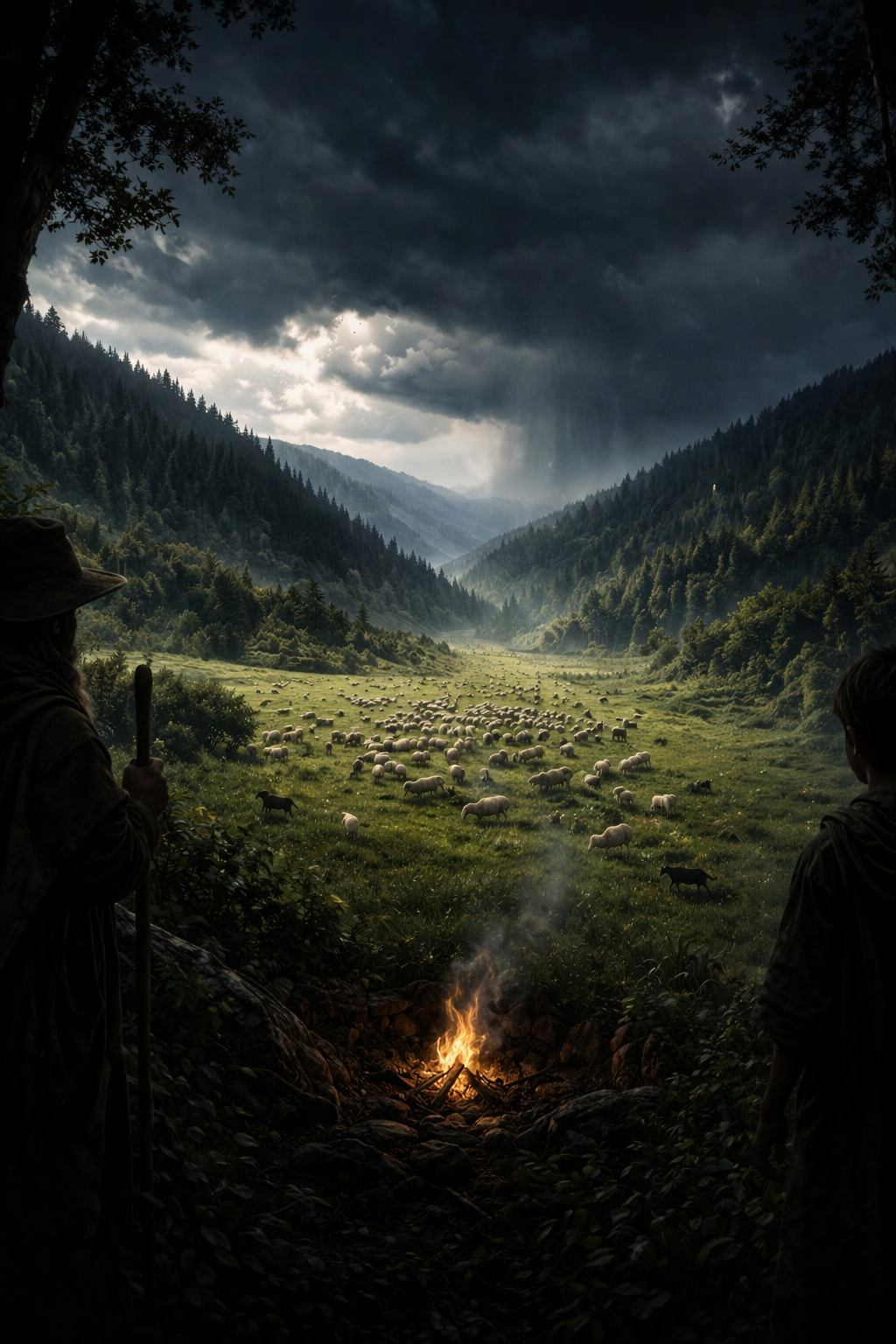
There is a field I carry in my mind when I try to explain what life felt like before I had the language to explain any of it. The same field I wrote of elsewhere. Wide, green, alive. Hills rising on either side like old ribs. Dense forest gripping the ridgelines. Sheep gathered in clusters, a few always too far out. Dogs lapping the edges. Wolves where the trees give way to shadows. Heavy rain dragging itself across the sky. A storm coming, not malicious, just real.
When I picture the boy from that old story, I do not picture a liar with a smirk. I picture him overlooking that field.
And the older I get, the harder it is to ignore that the field he sees is the same one I have always seen.
Same slope. Same weather. Same flock. Same wolves. Same ridgelines. Same uneasy border between beauty and danger. The only difference is that now I understand why the image stayed with me. It stayed because it was never just a story. It was a map handed to me by people who wanted to control which parts of the map I was allowed to speak about.
That did something to me.
It makes truth feel socially dangerous before it becomes linguistically possible. It teaches a child to negotiate with instinct before instinct has even matured. It turns inwardness into a courtroom. Every alarm has to present a case. Every discomfort has to survive cross-examination. Every warning must first ask permission from the very structures that benefit from it being wrong. By the time a person reaches adulthood, the damage is sophisticated. You do not merely feel fear. You doubt the part of yourself that knew to feel it. You do not merely struggle to speak. You distrust the machinery that would have formed speech in the first place.
Some wounds do not teach silence. They teach a person to doubt the part of themselves that need to speak.
That is a different kind of injury. As permanent as losing a digit, no outward proof.
I think that is why certain people learn the perimeter too early. Not because they are wiser. Not because they are chosen. Not because suffering secretly makes people noble. That is sentimental nonsense. Plenty of suffering only wounds. Plenty only distorts. Plenty leaves a person staring at life through a lens they did not ask to wear. But there are some people who are introduced to danger before they are introduced to safety. They learn movement at the tree line before they learn rest in the middle of the field. They learn the cost of being wrong, the cost of being right, and the cost of speaking at all before they have any healthy sense of what trust was supposed to feel like.
That kind of life does not produce saints. It produces architecture.
Walls. Mazes. Passages. Hidden rooms. Reinforced doors. False fronts. Escape routes. Whole internal blueprints built by someone too young to be an architect and too exposed not to become one. I learned early that if the world insisted on being dangerous in ways I could not stop, then I would have to become very good at fortifying the places in me that could still be harmed. I learned to strengthen weak points, conceal softer rooms, reroute traffic through safer corridors, and keep certain chambers hidden behind enough turns that almost nobody could reach them without getting lost.
I do not say that proudly. I say it accurately. Painfully.
Some people learn openness first and boundaries later. I learned fortification first and had to excavate my way back toward openness like a prisoner tunneling toward his own front door.
That is where fragility comes in.
Because fragility is not the flaw in life. Fragility is the point of life.
Love is fragile. Family is fragile. Trust is fragile. The self is fragile. Children are fragile. Peace is fragile. Animals are fragile. The body is fragile. The earth is fragile. Meaning is fragile. Every living system worth preserving is, in some essential way, breakable. That is not a defect in creation. That is what makes protection matter. That is what makes gentleness matter. That is what makes strength moral in the first place.
Strength exists to protect what should not be forced to become hard.
That is one of the hardest lessons I know.
Because once you have lived close enough to danger, there is always the temptation to misuse whatever strength you carved out of it. To mistake protection for expansion. To confuse vigilance with control. To turn a gift into a weapon because a weapon at least feels less vulnerable than an open hand. But strength has a rightful purpose, and it is narrower than people like to admit. We only get so many blocks. So much force. So much energy. So much capacity to fortify. If I spend those blocks taking more territory than I need, proving how hard I became, weaponizing whatever hurt taught me, or using my strength to crowd someone else’s fragility, then I weaken the more sacred parts of my own fortress. I rob the interior to enlarge the perimeter. I steal from the rooms that were supposed to shelter love.
— Every act of force is an allocation decision.
Perceived or not.
True for people. True for families. True for governments. True for institutions. True for systems. The moment strength stops protecting fragility and starts feeding on it, it becomes corruption. It does not matter how noble the uniform looks or how polished the language around it becomes. Strength that ceases to protect the tender and begins consuming it has betrayed its design.
Which is why the break runs so deep when pain breaches our inner fortifications.
It is not merely that something hurts. It is that certain pain gets past the outer walls and reaches the rooms that were built to keep the most irreplaceable things alive. That is why some injuries do not feel like damage. They feel like desecration. The wall did not merely crack. The chamber was entered. The softest cargo was touched by something that had no right to touch it. We break so deeply because those rooms were never built to store iron. They were built to shelter love.
People talk a great deal about becoming stronger. Much less gets said about what strength is for.
I do not believe we are here to become invulnerable. I think we are here to become trustworthy stewards of what is vulnerable.
That includes our own inner life. Other people’s tenderness. The innocent. The frightened. The not-yet-formed. The parts of a person that still believe in goodness without fully knowing why. The parts of the world that cannot protect themselves from appetite, greed, cruelty, indifference, or misuse. Strength is supposed to kneel before those things, not stand on them.
That is why I cannot fully separate the boy, the field, the wolves, and the dog.
They belong to one another now.
— Because a sheepdog is what happens when innocence survives the wolf, but never again mistakes the field for harmless.
That is not a glamorous transformation. It is not a heroic reveal. It is not a cloak, or a title, or a self-flattering mythology for wounded men who want to sound profound. It is sadder than that. More practical. More expensive. It means some part of you remained tender enough to care about the flock, but was changed permanently by contact with danger. It means your innocence did not entirely die, but it could never go back to ignorance. It means you came to understand that the field was beautiful and sacred and still not safe by default. It means you learned that weather would come, wolves would move, and some adults would insist that naming either one was the real offense. Shielding their shame with your wellbeing.
A sheepdog, in that sense, is not special. It is what certain kinds of pain make possible when they do not finish the job of turning a person to ash.
— Some forms of duty are born where innocence was interrupted.
That interruption can leave a person wrong in many directions. Hypervigilant. Overbuilt. Hard to reach. Too quick to scan the tree line. Too slow to trust calm. Too practiced at carrying what should have been shared. Too ready to read weather in rooms that have no clouds in them. I know that terrain well. I know how easy it is to mistake vigilance for personality when you learned it before you learned yourself. I know how exhausting it is to spend years arguing with your own alarms, wondering which ones are wisdom, which are trauma, which are memory, and which are all three braided together so tightly they no longer come apart cleanly in the hand.
That is part of why this hurts to write.
Not because the facts are difficult to state. I could state them plainly enough. The harder part is admitting how far down the roots go. Admitting that the story did not just bruise me. It helped shape the architecture of my mind. Admitting that there were years when my relationship with truth itself felt compromised, because truth had once been paired so aggressively with danger, betrayal, and consequence. Admitting that the child in the field did not merely become quiet. He became strategic. He learned angles, timing, concealment, self-erasure, and all the little internal negotiations a person makes when honesty is expensive and adults have made it clear who will pay the price.
I do not write that for pity. Pity is a poor builder.
— I write it because unnamed mechanisms still do named damage.
If a child learns early that warning is betrayal, then adulthood often arrives as a long, slow reintroduction to the self. You have to relearn what fear is for. You have to distinguish caution from conditioning. You have to recover the difference between discernment and dread. You have to examine every inner wall and ask whether it is still shelter, or merely an old prison that became familiar enough to confuse for home. You have to stop romanticizing your adaptations without discarding the real intelligence that grew inside them. You have to decide which parts of the fortress stay, which come down, which become windows, and which are rearranged into boundaries that protect life instead of only hiding it.
That work is ugly. And slow. And holy in a way I do not mean theatrically.
Because somewhere in that labor is the chance to stop becoming what the wound designed.
That is the line I care about now. Not whether I was wrong to be afraid. Not whether the adults were fair. Not whether the old story can be redeemed by arguing with it cleverly enough. The question now is whether I can become strong without becoming predatory. Whether I can remain alert without making fear my god. Whether I can protect fragility without despising it for being fragile. Whether I can carry what the field taught me without letting the wolves determine the final shape of my internal terrain.
That, to me, is the real task.
Not to become the shepherd. Not to become another throne. Not to gather a flock around my own damage and call it authority. Just to become honest enough, disciplined enough, and merciful enough that the things worth protecting remain protected when they come near me.
That includes other people.
That includes the self.
That includes whatever innocence survived.
And innocence does survive, sometimes. Changed, yes. Wiser, yes. Less easily fooled, certainly. But still alive. Still worth defending. Still worth keeping from hardening into a permanent theology of suspicion. I do not want my life to become a monument to what frightened me. I want it to become evidence that fear can be translated into function, that pain can become precision without becoming cruelty, that what was once used to keep a child quiet does not have to own the voice that child grew into.
Maybe that is what I have been trying to say every time I return to the field in my mind.
That the field is still beautiful.
That the flock is still worth protecting.
That the storm is not evil simply because it arrives.
That the woods are not wicked merely because they hide things.
That wolves are real.
That some people meet them too early.
That some stories get used like muzzles.
— That fragility is not an embarrassment to outgrow, but the whole living reason strength should exist at all.
And that when life teaches you the perimeter before it teaches you peace, the work of adulthood may simply be this: to recover your bond with truth so fully that your warning system no longer belongs to the people who once trained you not to trust it.
I think that is what I have been trying to reclaim all along.
— Not noise. Not revenge. Not vindication arranged like a public execution.
Just the right to know what I know when I know it.
The right to feel the edge of danger without apologizing for it.
The right to protect what is tender without treating tenderness like shame.
The right to speak without first betraying myself for someone else’s comfort.
The right to let the boy on the hill grow into something other than a frightened witness to his own silencing.
If that sounds heavy, good. Some truths are.
They were heavy when they happened.
They are heavy when carried.
They are heavy when cut open.
They are heavy when finally understood.
But heaviness is not the same thing as falsehood. In fact, some of the truest things in a life feel dense because they were never built to be handled casually.
So I will say it plainly.
I do not think the deepest human calling is to become harder.
— I think it is to become strong enough, clear enough, and honest enough to guard what must remain soft.
That has cost me. It will probably keep costing me. It has made parts of life lonelier than I would have preferred. It has made some rooms harder to sit in. It has forced me to question old scripts, old fears, old authorities, and old reflexes that once felt inseparable from survival. But I would rather pay that price than keep handing my perception to the ghosts of people who needed me confused.
The field is still there.
The weather is still real.
The flock is still fragile.
The wolves still move.
And somewhere inside all of that, so does the part of me that finally knows this:
I was never wrong for noticing the tree line. And I do not cry wolf.
-----/////-----
End.
tc.forseti
Free to read here. Free access does not by itself release this work or its artwork for republication.